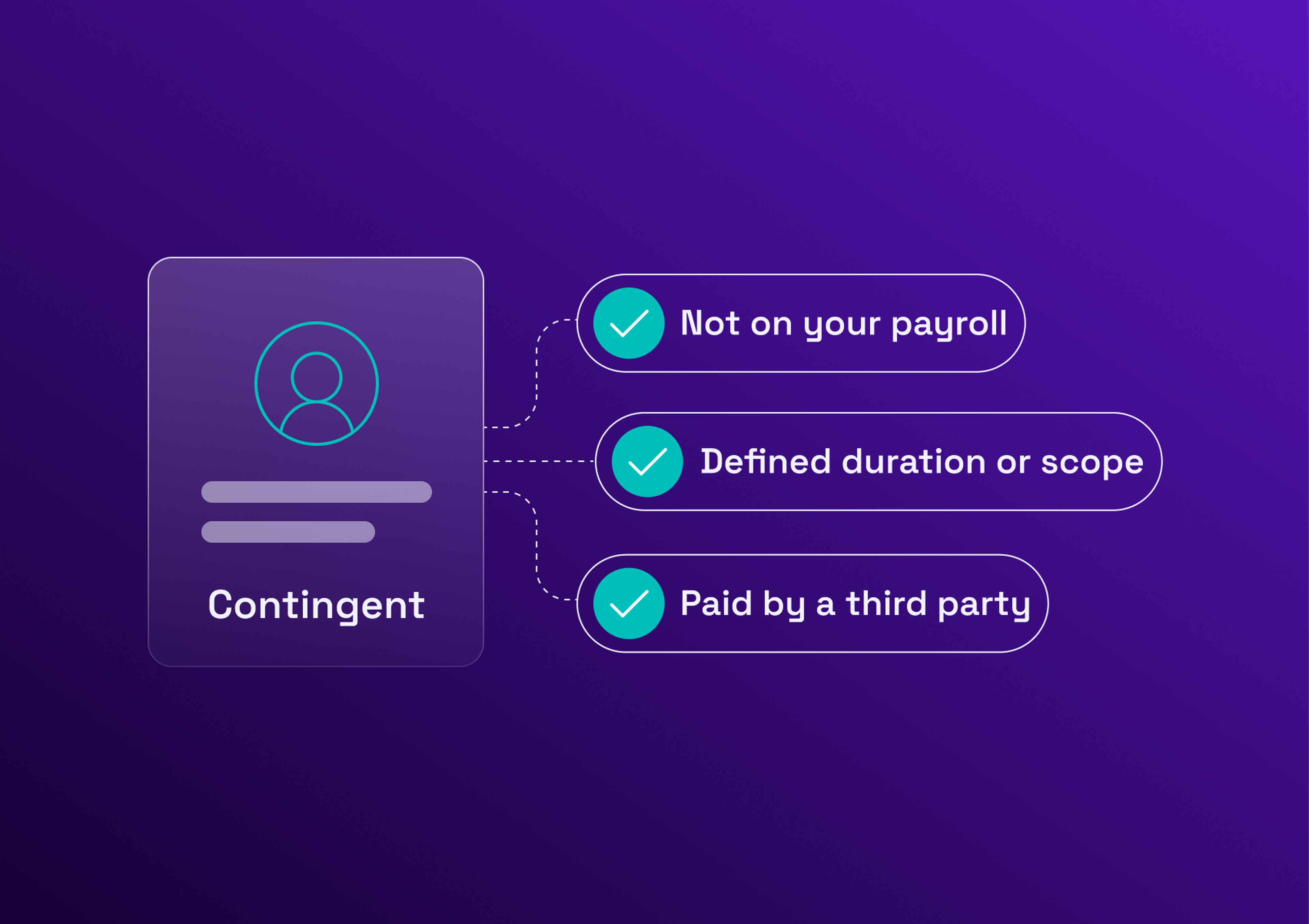
Contingent workforce is the pool of non-permanent workers an organization engages without adding them to payroll: independent contractors, consultants, agency staff, and statement-of-work providers, among others. In Staffing Industry Analysts' 2025 buyer survey, organizations reported that contingent workers already make up an average of 21% of their workforce, with the same buyers expecting that share to reach 26% within ten years. Flexible talent is easy to hire and hard to see, price consistently, and keep compliant once a program grows past a handful of engagements. This guide covers what counts as a contingent workforce, the main worker types, how it compares to permanent headcount, the risks of leaving it unmanaged, and a practical approach to running a program.
What is a contingent workforce?
A contingent workforce is any group of workers an organisation engages for a defined period or outcome without a permanent employment contract. It includes:
independent contractors and freelancers
consultants (IT, engineering, advisory)
agency temporary staff
statement-of-work (SoW) based service providers
interim managers
gig or platform workers
Contingent workers sit outside permanent payroll headcount: they are not carried on the organization’s employment books, and their engagement, pay and management typically run through a different process, procurement or a dedicated program, rather than HR's standard hiring path.
The line between these categories matters in practice, not just on paper. An independent contractor negotiates their own rate and reports to a project lead. An agency temp is employed and paid by the staffing agency, with the client paying the agency rather than the worker directly. A consultant engaged through a firm may combine both: billed at a day rate, but managed through the firm's own delivery process rather than directly by the client. Each arrangement carries different tax, compliance and management implications, which is exactly why treating "contingent workforce" as a single undifferentiated bucket creates blind spots later.
The main types of contingent workers
Each type is engaged, priced and managed differently, which is exactly what gets lost when a program treats "contingent workforce" as one undifferentiated pool.
| Worker type | How they're engaged | Typical use case | Who owns the relationship |
|---|---|---|---|
Independent contractor / freelancer | Direct contract, usually day rate | Short-term capacity gap, specialist skill | Procurement or hiring manager |
Consultant (IT, engineering, advisory) | Day rate or SoW, often through a firm | Expertise the organisation doesn't have in-house | Procurement, business line |
Agency temp / staffing supplier | Sourced and employed by a staffing agency | Volume or seasonal capacity | HR or procurement |
SoW / project-based service provider | Fixed-price contract for a defined deliverable | A scoped project with a clear outcome | Procurement |
Interim manager | Time-limited leadership assignment | Covering a leadership gap or leading a transition | Business line, HR |
Gig / platform worker | On-demand, task-based, via a platform | Ad hoc, short tasks | Business line |
Consultants and SoW-based providers are where most procurement-managed spend sits, since they're priced and tracked as intellectual services rather than headcount. Gig and platform work matters less for large-enterprise programs and is included here for completeness.
Ownership of the relationship shifts by type, and that has direct operational consequences. When Procurement owns a relationship, it typically comes with a rate card, a contract template and a defined onboarding step. When a business line owns it directly, without procurement involved, engagement terms, pricing and even basic records can vary from one contractor to the next, which is exactly the fragmentation a formal program exists to fix. A SoW-based provider, for instance, is contracted against a defined deliverable and a fixed price agreed before work starts, which places it closer to a procurement-of-services relationship than to a staffing one, even though both fall under the same contingent workforce umbrella.
Contingent workforce vs. permanent employees
The table below sets out where the two categories diverge in practice, beyond the obvious difference in contract length.
| Contingent worker | Permanent employee | |
|---|---|---|
Contract length | Fixed term or project-based | Open-ended |
Pay structure | Day rate or fixed price | Salary |
Benefits | Typically none from the client organisation | Full benefits package |
Tax / employer of record | Contractor's own entity, agency, or umbrella company | The organisation |
Onboarding | Lightweight, access-focused | Full HR onboarding |
Management owner | Procurement or the hiring manager | HR and line management |
Cost profile | Variable, tied to engagement length | Fixed, ongoing |
Contingent workers give an organisation capacity without the fixed cost and long-term commitment of a permanent hire, and without the multi-week hiring process a permanent role typically requires. The trade-off is that visibility and consistency take more deliberate work to maintain, since none of the built-in HR processes that govern permanent headcount apply automatically to a contractor or consultant.
Why companies rely on a contingent workforce
A contingent workforce gives an organisation workforce flexibility and scalability: capacity can scale up for a project or peak period and scale down again without severance or restructuring, and without carrying idle capacity during quieter periods.
It also provides access to specialised skills. Niche expertise, a specific technology, a regulatory specialism, a transformation skill set, is often not worth hiring permanently, but is available through a contractor or consultant, avoiding the cost of a permanent hire for a skill the organisation may only need once.
Engaging a contractor or SoW provider typically means a faster time-to-start than a permanent recruitment cycle, which commonly runs to several months once sourcing, interviews and onboarding are counted, and that matters when a deadline is at risk.
Done well, a contingent workforce also gives cost and spend control: finance and procurement gain visibility into external-services spend as it happens, rather than reconstructing it after the fact from scattered invoices, by which point the spending decision has already been made.
None of these benefits are automatic. They depend on engagements being tracked and priced consistently, which is exactly where organisations struggle once the number of contractors grows past a handful.
The risks and challenges of managing a contingent workforce
Worker misclassification and co-employment exposure
Treating a contractor like an employee (fixed hours, direct supervision, integration into internal structures) creates legal exposure in many jurisdictions. Worker misclassification covers the tests, penalties and procurement controls for this risk in depth.
Fragmented data and no single view of who is engaged
Without a central system, contractor and consultant engagements live in emails, spreadsheets and individual managers' inboxes.
→ Good practice: one system of record for every active engagement.
Uncontrolled tail spend and inconsistent day rates
The same role can be booked at different rates by different managers, with no visibility until the invoices land.
→ Good practice: standard rate cards benchmarked across the organisation.
Weak supplier performance oversight
Suppliers are chosen and re-chosen without structured feedback on delivery quality.
→ Good practice: track performance, not just cost, and feed it into the next sourcing round.
Manual admin that doesn't scale
Timesheets, contract renewals and invoicing handled by email work for five contractors and break down at fifty.
→ Good practice: automate the repetitive steps.
Offboarding and access-revocation gaps
A contract ending doesn't always mean system access ends with it.
→ Good practice: tie offboarding to the contract end date, not to someone remembering.
A contingent workforce that isn't actively managed doesn't stay neutral: it drifts toward exactly these failure modes as the number of engagements grows.
What is contingent workforce management?
Contingent workforce management (CWM) is the coordinated sourcing, contracting, tracking and payment of non-permanent workers under one governed process, rather than each manager handling it independently. It typically involves Procurement, HR, Legal, Finance and hiring managers, each with a defined role: Procurement negotiates and sources, HR manages classification and policy, Legal reviews contract terms, Finance tracks spend, and hiring managers define the need and manage day-to-day delivery.
CWM is the practice: the discipline of running this well. A vendor management system (VMS) is the software that supports it. The two are often blurred together, but a program can exist without the software (run manually, badly) and software alone doesn't create the governance a program needs.
A company can technically run contingent workforce management without any dedicated software, using shared spreadsheets and email approvals, but the process tends to break down once the number of active engagements and suppliers grows past what one or two people can track manually. Conversely, installing a VMS without first agreeing the underlying process, who approves what, which rate cards apply, how offboarding is triggered, produces a system nobody follows consistently. The software supports the practice; it doesn't replace the governance decisions the practice requires.
Two ways to engage contingent talent: day rate vs. statement of work
Not all contingent work is bought the same way, and the two main models carry different pricing, tracking and risk.
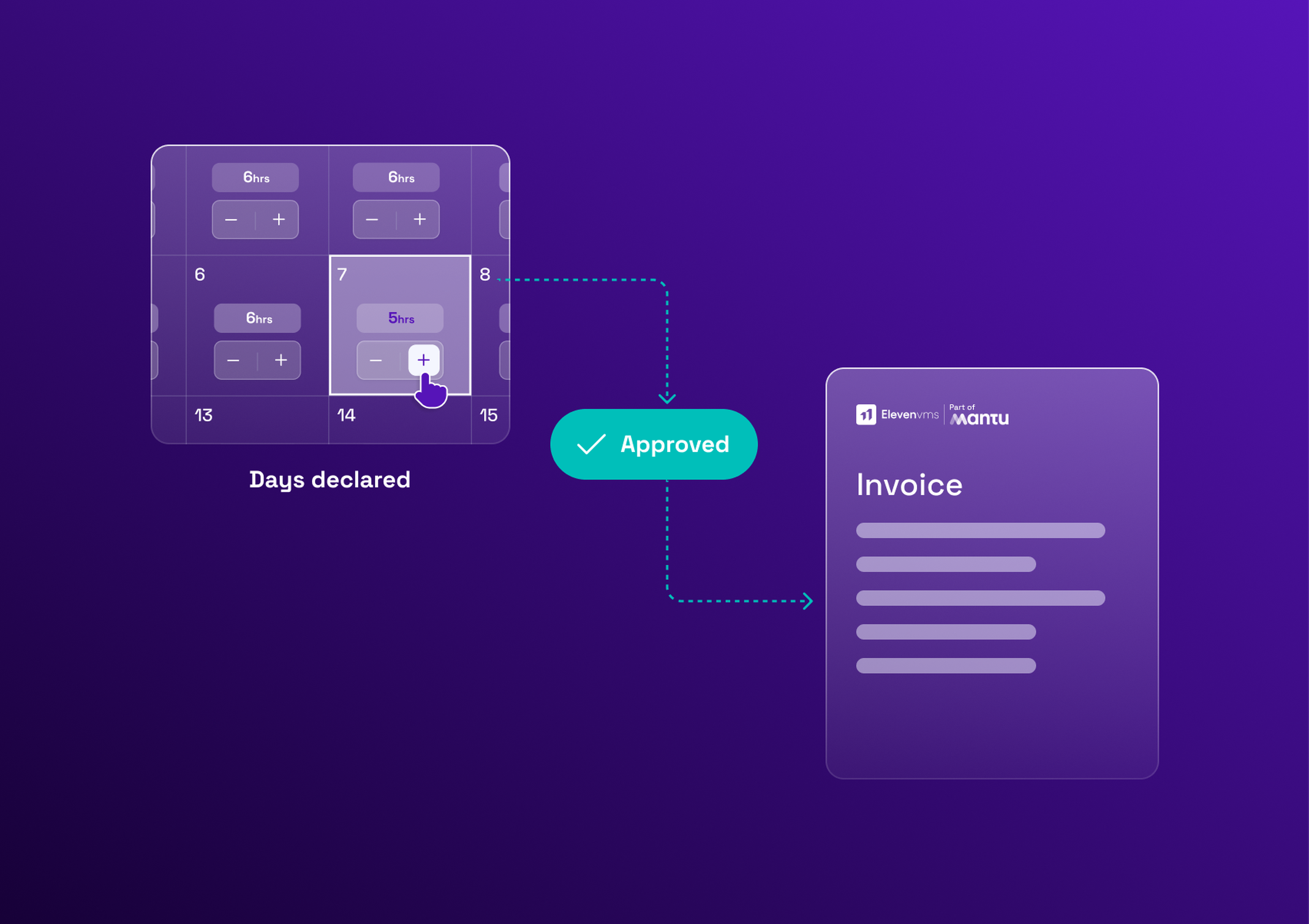
Day rate (time and materials): the organisation buys capacity (a person's time, at an agreed daily rate) and tracks it through timesheets. Delivery risk sits with the buyer: if the work takes longer than planned, the cost rises accordingly.
Statement of work (SoW / fixed price): the organisation buys a defined outcome for an agreed price, tracked through milestones rather than hours. Delivery risk shifts toward the provider: if delivery slips, the price is already fixed.
| Day rate | Statement of Work | |
|---|---|---|
Scope clarity | Evolves as the work progresses | Defined before work starts |
Deliverable defined? | No, capacity rather than a fixed output | Yes, a specific outcome |
Who carries delivery risk | The buyer | The provider |
How you track it | Hours, via timesheets | Milestones and deliverable acceptance |
Best fit when | The need is fluid or ongoing | The scope is fixed and self-contained |
Choosing the wrong model doesn't just create a pricing mismatch: it means tracking the wrong thing, hours instead of outcomes or vice versa, for the entire length of the engagement. The mechanics of structuring SoW-based procurement properly and of choosing between day rate and fixed price both go deeper than this summary allows.
How to manage a contingent workforce: a step-by-step approach
Centralise every engagement in one system.
A single source of truth for who is engaged, on what terms, and until when, not a mix of spreadsheets and inboxes. This single system becomes the reference point every other step in this list depends on: without it, standardising sourcing or tracking performance has no consistent data to work from.
Build a pre-qualified, dynamically ranked vendor list.
Sourcing from a known, ranked list of vendors is faster and more consistent than ad-hoc outreach for every new need.
Standardise sourcing.
Competitive RFQs, published rate cards, and a defined approval workflow replace one-off negotiations that produce inconsistent rates.
Choose the engagement model deliberately.
Decide day rate or SoW based on scope clarity and who should carry delivery risk, not by default or habit. Defaulting to day rate because it's familiar, or to SoW because it looks lower-risk on paper, produces the exact mismatch described above: tracking hours for a fixed outcome, or tracking milestones for open-ended capacity.
Standardise onboarding and, critically, offboarding.
Access provisioning, asset return and final invoicing should follow a defined process every time; offboarding is where most gaps appear.
Track deliverables and supplier performance, not just hours.
For SoW work, that means milestone acceptance; for all suppliers, it means feeding delivery quality back into the next sourcing decision. This is the shift from measuring activity, hours logged, to measuring delivery, which is what actually determines whether an engagement was worth its cost.
Automate administrative work.
Timesheets, contract renewals, invoicing and budget burn-down are repetitive by nature and scale poorly when handled manually.
Integrate with ERP and HRIS.
Connected systems mean spend reconciles automatically instead of being rebuilt by hand at month-end, which is what the source-to-pay process is built to do end to end.
Fold contingent labour into overall workforce planning.
Treating external and internal capacity as two separate conversations makes both harder to plan.
Govern jointly across Procurement, Legal, Finance and the business.
No single function owns every part of contingent workforce risk; governance has to be shared to be effective.
The role of a vendor management system (VMS)
A vendor management system is a software that centralizes the sourcing, contracting, tracking and payment of contingent workers and suppliers. It automates most of what the steps above describe: supplier pool management, RFQs and rate cards, timesheet and milestone tracking, contract renewal and offboarding alerts, and spend reporting, replacing the spreadsheets and email threads a manual process depends on.
A VMS sits alongside, not instead of, the ERP and HRIS: the ERP holds financial commitments and payments, the HRIS holds people and organizational data, and the VMS holds the operational detail of who is engaged, on what terms, and what they've delivered, feeding clean data back to both. In practice, that means a finance controller can see committed spend without waiting for an invoice, and an HR team can see who has system access without cross-referencing a separate contractor list, because the VMS is the layer that keeps both of those views current.
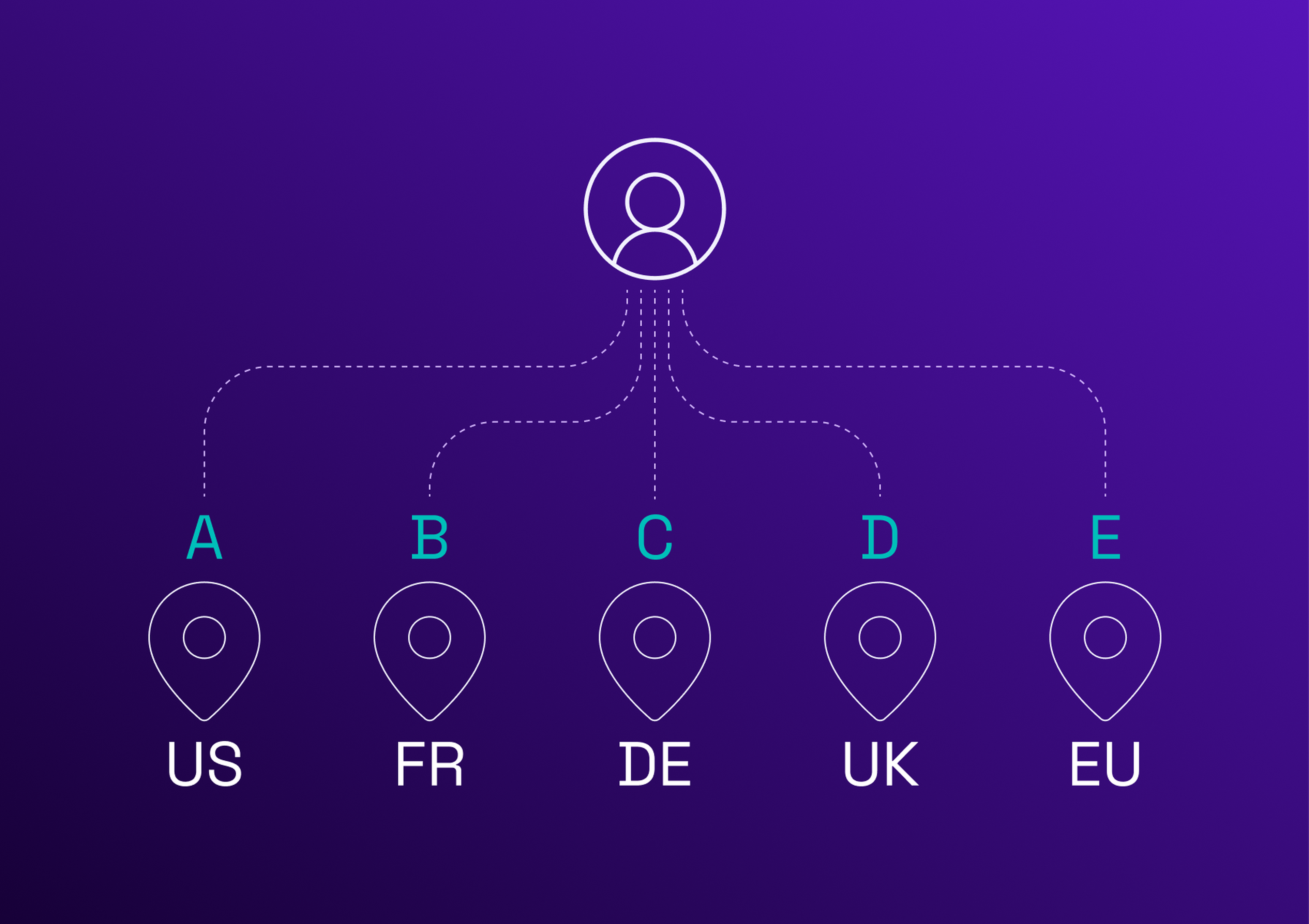
Eleven VMS operates in more than 50 countries and brings more than 10 years of experience in vendor management. This is what Eleven VMS's platform is built to centralise for external services specifically, giving procurement teams real-time visibility into who is engaged, what they cost, and when contracts end.
Do you need a formal contingent workforce program yet?
A few signals suggest it's time to formalise:
you can't say how many contractors are active right now, without asking around
rates for the same role vary widely depending on which manager sourced it
contract renewals happen by default rather than by review
Finance can't forecast external-services spend with any confidence
an audit request for contractor data takes days to answer, not minutes
If several of these are true, the gap isn't effort: it's the absence of a governed process. Starting with an assessment of your procurement maturity scopes what a formal program would need to cover, and calculating a VMS's ROI puts a number on what centralising it could be worth.
Governing contingent workforce spend
Governing a contingent workforce well doesn't require a different discipline for every worker type, day rate or SoW, contractor or consultant, it requires the same visibility and consistency applied across all of them. Eleven VMS centralises contingent workforce spend across sourcing, contracting, tracking and payment in one governed system, rather than leaving each engagement type to its own process. See the platform to discuss what a governed program would look like for your organisation.
Book a meeting with one of our experts for a personalized demo.