Procurement performance measures how well an organisation's purchasing activities contribute to its strategic objectives, across cost, quality, lead times, innovation and CSR, not cost reduction alone. As procurement takes on a more strategic role, knowing how to measure procurement performance has become essential to prove the function's value and decide where to invest next. This guide covers the definition, the KPIs and benchmarks to track, a dedicated look at services and external-workforce spend, and five levers to improve it.
What is procurement performance?
Before trying to improve it, it is essential to understand what procurement performance really covers. Often reduced to simple cost reduction, it actually encompasses a much broader scope, which also includes the quality of purchased products or services, lead times, supplier management, innovation, and the contribution to the company's CSR objectives. In other words, procurement performance is not limited to financial results: it is a true indicator of the maturity and value creation of the procurement function.
Definition and scope
Procurement performance corresponds to an organisation's ability to achieve its strategic objectives through its purchasing activities. It is therefore measured by how the procurement function contributes to the company's overall competitiveness.
The scope of procurement performance covers the entire procurement process, from the expression of the need to the monitoring of supplier relationships, including contracting, negotiation, procurement management, and continuous evaluation of the results obtained.
A useful distinction here is output versus outcome. Output is what procurement delivers: a signed contract, a completed sourcing event, a processed purchase order. Outcome is the business value that activity actually creates: money saved, risk avoided, a supplier relationship that holds up under pressure. A procurement function can generate plenty of output, contracts signed, POs processed, and still perform poorly on outcome if none of that activity translates into value the business can point to. Measuring performance means tracking both, not mistaking busyness for impact.
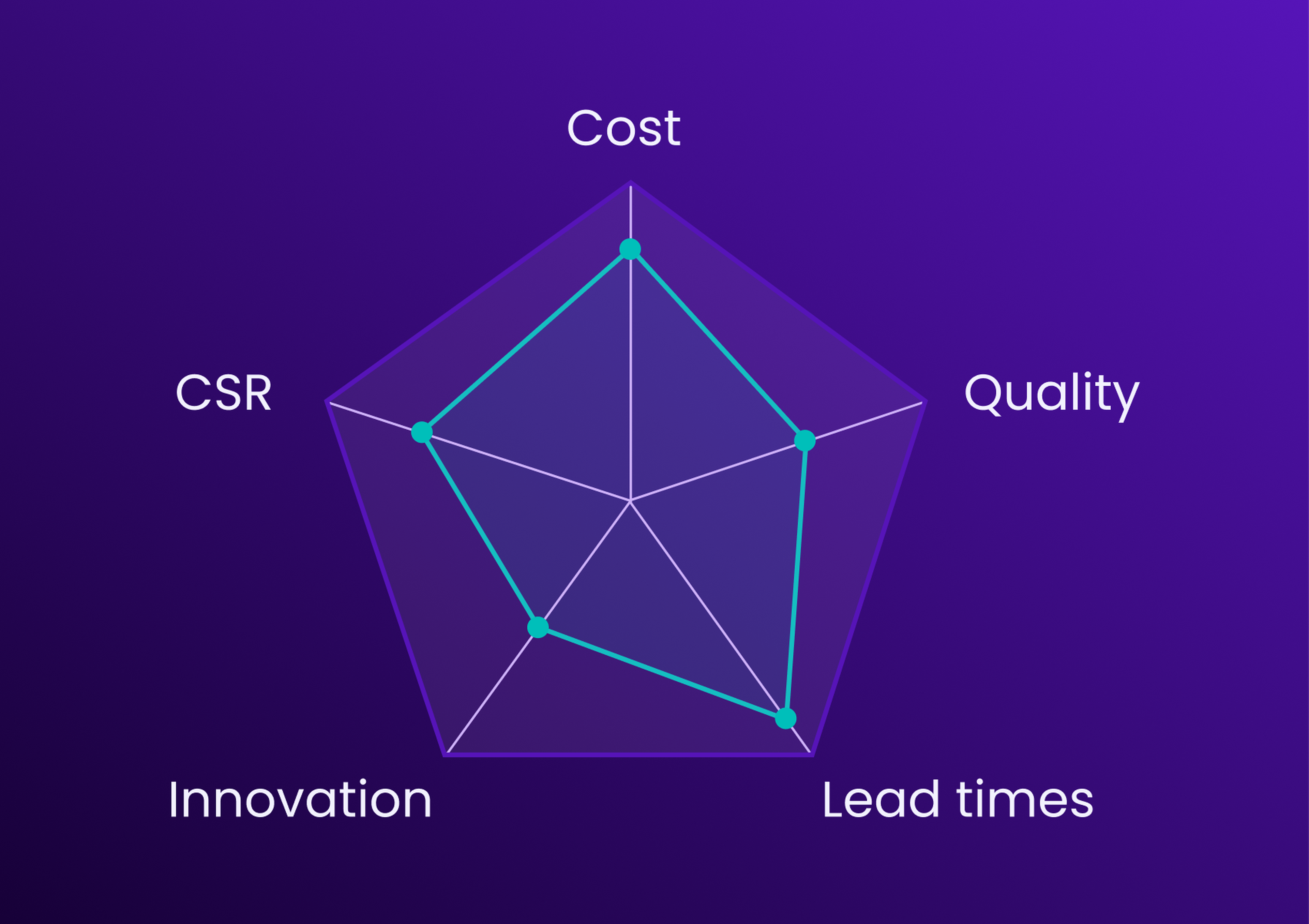
The 5 pillars of procurement performance (cost, quality, lead times, innovation, CSR)
To fully evaluate procurement performance, it is necessary to take into account several complementary dimensions:
Cost: this is the most obvious dimension. It includes the savings made, the total cost of ownership (TCO), and the control of expenses over time.
Quality: ensuring that the goods and services acquired meet the expected level of quality and operational requirements, since poor quality creates indirect risks further down the line.
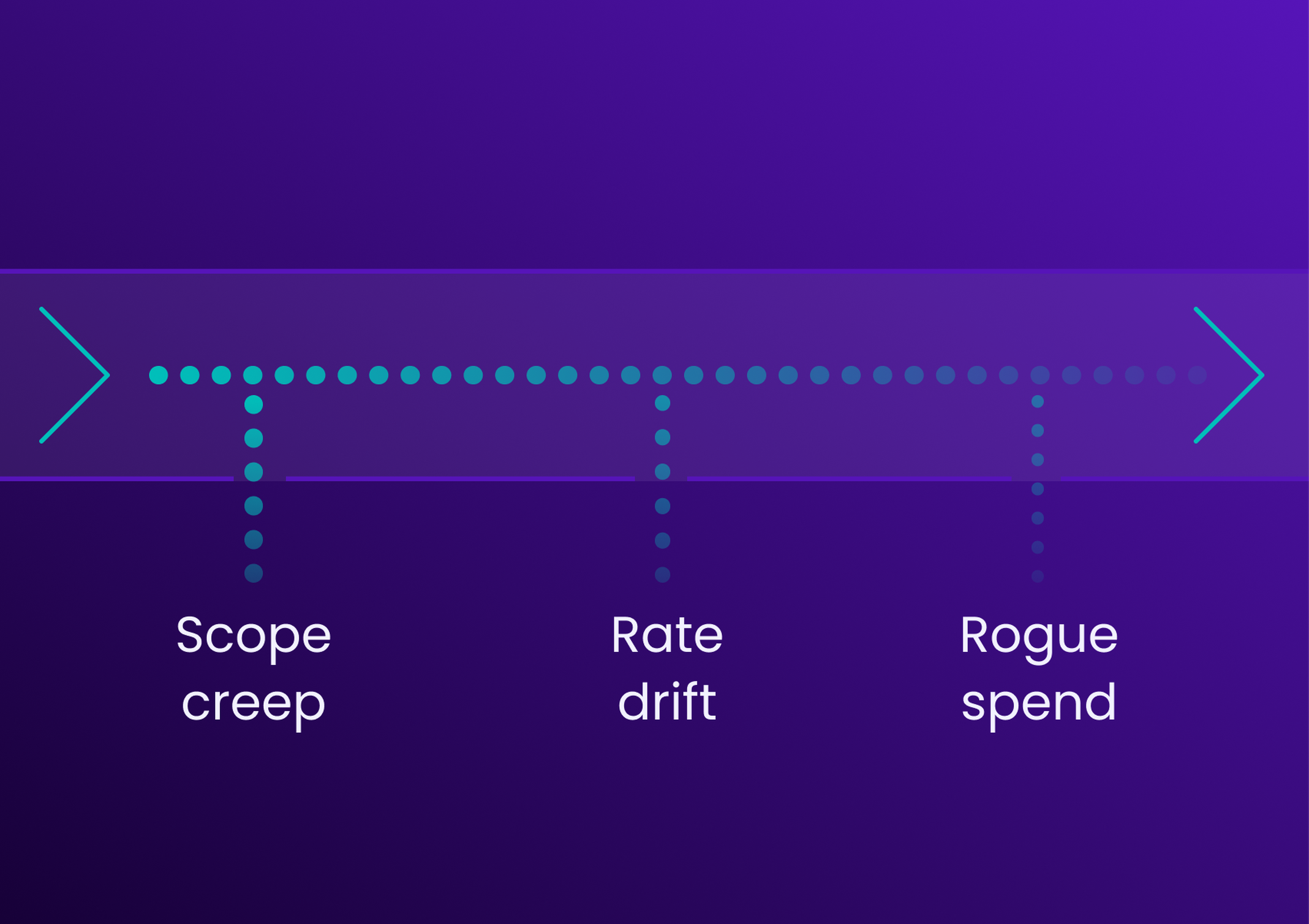
Lead times: securing delivery deadlines and avoiding supply disruptions or delays that impact operations. On fixed-price contracts, this relies on defining precise milestones from the request for proposals onward, to track progress and reduce the risk of drift.
Innovation: identifying new solutions, innovative suppliers, and collaborative innovation approaches, particularly important in professional services where skills become obsolete quickly and new suppliers enter the market constantly.
CSR and compliance: the company's ability to respect ethical, environmental, and social criteria in its purchases, including responsible purchasing, traceability, and regulatory compliance.
| Pillar | What it covers | Example metric |
|---|---|---|
Cost | Savings, TCO, expense control | Cost savings %, spend under management |
Quality | Meeting expected quality and operational requirements | Supplier non-compliance rate, quality score |
Lead times | Securing delivery deadlines, avoiding disruption | Requisition-to-PO cycle time |
Innovation | Identifying new solutions and innovative suppliers | Number of co-development initiatives |
CSR and compliance | Ethical, environmental and social criteria in purchases | % responsible supplier spend, contract compliance rate |
By combining these dimensions, a company builds a global procurement approach focused on sustainable value creation rather than simple cost reduction.
Why is procurement performance a strategic lever for the company?
Once perceived as an essentially administrative function focused on negotiation, procurement has gradually evolved into a much more strategic role. Procurement performance now directly contributes to competitiveness, innovation, and the company's ability to meet economic, societal, and environmental challenges.
From cost reduction to value creation
While cost control remains a central element, the most successful procurement departments today adopt a global approach oriented toward value creation. This means optimising every link in the chain, need, sourcing, contracting, supplier relationship, innovation, to generate sustainable gains and improve the company's overall operational performance. Procurement becomes a lever of competitiveness, just like R&D or production. Cost reduction becomes one component of a broader role rather than the whole of it, though it remains a crucial lever, especially in professional services. A team that only reports savings is answering yesterday's question; a team that can also show risk avoided, supplier quality trends, and time-to-value is speaking finance and the board's language today.
A growing role of procurement in overall strategy
This evolution comes with a strengthening of the buyer's role in defining and implementing corporate strategy. By managing supplier relationships, anticipating risks (disruptions, compliance, geopolitics), and integrating CSR criteria into decisions, procurement acts as a strategic partner of other departments: finance, innovation, production, sustainability.
The scale of that shift shows up in the numbers. According to Ardent Partners' 2025 benchmarking research, procurement now manages an average of 70.8% of total enterprise spend, the highest share recorded in the firm's 20 years of research, a sign of how far the function's remit has expanded beyond its traditional boundaries.
How to measure procurement performance
As procurement gains strategic weight, it becomes essential to rely on appropriate tools capable of providing a global view and precise tracking of activity. Digital solutions, especially those with built-in monitoring modules, make it possible to follow relevant KPIs, manage performance in real time, and make informed decisions.
Build a measurement framework before choosing KPIs
Picking KPIs before agreeing on how they'll be used is how most measurement efforts stall. A simple framework, worked through in order, avoids that:
Define the objective for each pillar: what does good cost, quality, lead-time, innovation and CSR performance actually mean for this organisation.
Pick 1 to 3 KPIs per pillar. More than that dilutes attention rather than sharpening it.
Agree the data source and the owner for each KPI before tracking starts, not after the first report is due.
Set a review cadence: monthly for operational KPIs, quarterly for strategic ones.
Benchmark externally once internal tracking is stable, so results mean something beyond "better than last quarter."
Skipping straight to a KPI dashboard without this sequence is why so many procurement scorecards get built once and never revisited: nobody agreed what the numbers were for.
Key procurement performance KPIs to track
Grouped by pillar, these are the indicators worth tracking first, before adding category-specific metrics on top.
| KPI | What it measures | How to calculate | Typical target |
|---|---|---|---|
Cost savings | Realised reduction vs. baseline | (Budgeted cost − actual cost) / budgeted cost | 6 to 8% annually |
Cost avoidance | Spend prevented, not reduced | Proposed cost − negotiated/held cost | Tracked separately from savings |
Spend under management | Share of spend actively managed by procurement | Managed spend / total addressable spend | Over 70% |
Procurement ROI | Value delivered per unit spent on procurement operations | (Savings + avoidance) / procurement operating cost | Varies widely by maturity |
Requisition-to-PO cycle time | Speed of the procure-to-pay front end | Time from request raised to PO issued | Around 1 day for services, faster for top performers |
Supplier lead time | Fulfilment speed against commitment | Contracted vs. actual delivery time | Category-dependent |
Contract compliance rate | Share of spend following negotiated contracts or rate cards | Contracted spend / total category spend | Around 80% |
Maverick spend | Share of spend bypassing procurement | Off-contract spend / total spend | As close to zero as the category allows |
Supplier performance score / OTIF | Delivery and quality reliability | Weighted score across on-time, on-budget, quality criteria | Set per category |
% responsible or diverse supplier spend | CSR reach of the supplier base | Spend with vetted suppliers / total spend | Set per CSR policy |
Not every KPI needs a live dashboard from day one. Cost savings and spend under management are usually the first two an organisation can report reliably; cycle time and contract compliance follow once transactional data is clean; supplier performance scores and CSR metrics tend to come last, since they depend on structured review cycles rather than transactional data alone.
Procurement performance benchmarks: what good looks like
Sourced, dated ranges give these targets weight instead of leaving them as round numbers:
| Benchmark | What good looks like | Source |
|---|---|---|
Spend under management | 70.8% on average, 91.7% among top-quartile teams (vs. 61.1% for the rest) | Ardent Partners, Procurement Metrics That Matter, 2025 |
Contract compliance | Around 80%, with top performers near that level and others closer to 56% | Hackett Group benchmark data, 2025 to 2026 |
Cost savings rate | 8.0% among top-quartile teams vs. 6.4% for the rest | Ardent Partners, Procurement Metrics That Matter, 2025 |
Requisition-to-PO cycle time | 1.0 day median for services procurement specifically | APQC, Cycle time to issue a purchase order for services, 1,145 companies |
These figures vary by industry and category, and should be read as directional targets, not universal thresholds. A team below these ranges isn't necessarily underperforming: category mix, contract maturity and how recently a category was brought under management all shift where the bar realistically sits. Services and contingent spend in particular benchmark differently from goods, which is where standard KPIs need adapting rather than applying as-is.
Measuring and improving performance on services and external-workforce spend
This is the blind spot in most procurement performance programmes. Services spend, consulting, IT, engineering, contingent labour, SoW-based work, tends to have fragmented ownership across business lines, weak rate visibility across suppliers, onboarding and compliance risk that goods procurement doesn't carry in the same way, and deliverable quality that's genuinely harder to track than a physical receipt.
The standard KPIs above still apply, but each needs redefining for services:
Cycle time becomes time-to-onboard a contractor or consultant, not just requisition-to-PO.
Quality becomes SoW milestone acceptance rather than a goods inspection.
Compliance extends to worker classification and contractor tenure limits, not only contract terms.
Cost requires rate-card visibility across a fragmented supplier base, where the same role can be booked at different prices by different managers.
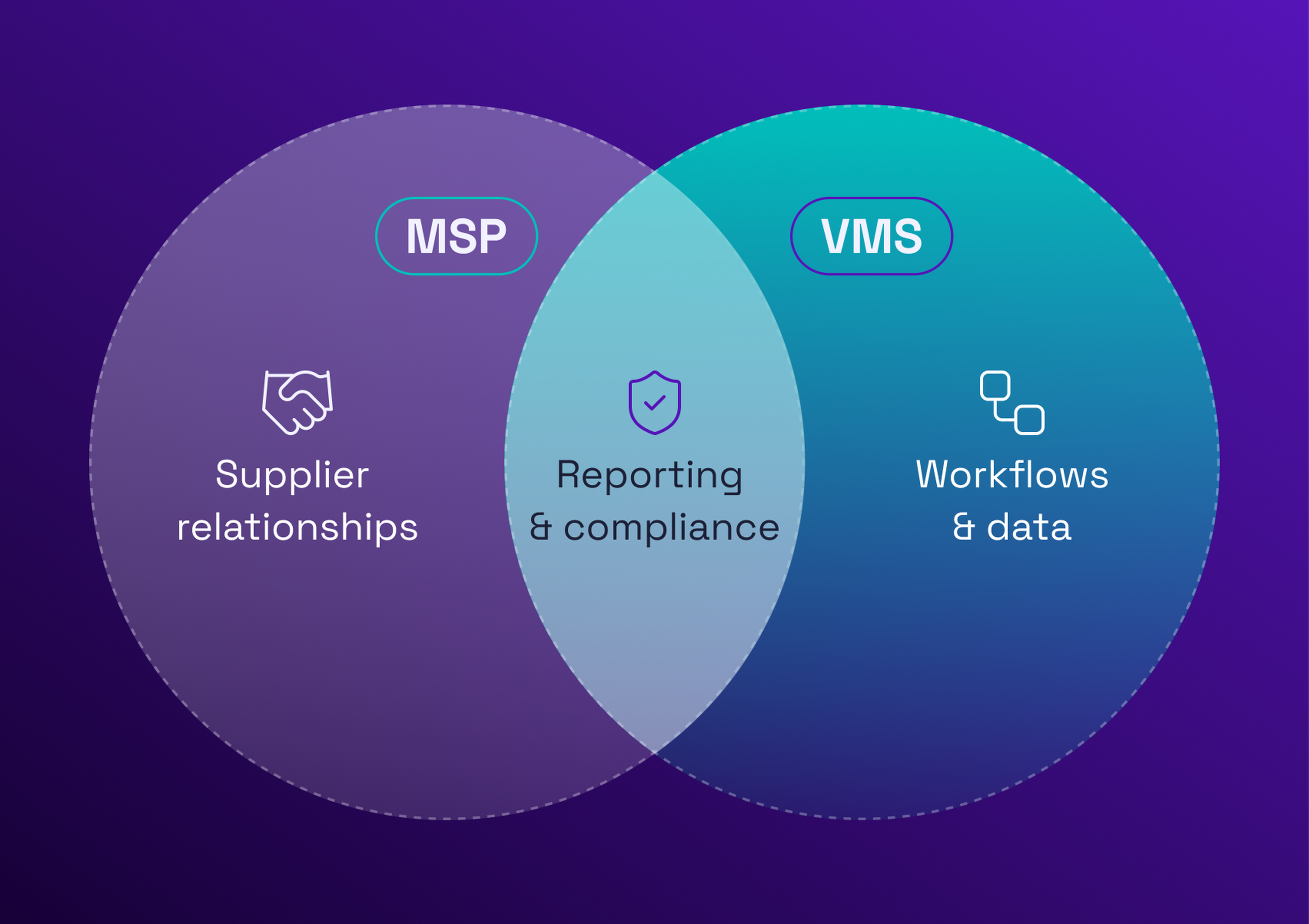
An ERP or e-procurement suite, built around purchase orders and physical goods, generally leaves this spend unmeasured: it can record that an invoice was paid, but not whether the mission delivered on time, on budget, and to spec. A vendor management system closes that gap by tracking spend at the mission level: rate cards, timesheets, milestones and renewals in one place, rather than reconstructed after the fact from scattered contracts.
Eleven VMS clients report, on average, an 11% reduction in professional services spend and 70% less time spent by buyers and operational teams on administrative tasks, alongside full visibility across processes and service providers. At Groupama Supports & Services, Augustin de Gérard, Head of Purchasing for Intellectual Services, describes how his team transformed the way it steers intellectual-services purchasing once VMS data became usable for that purpose, rather than just recorded.
The 5 levers to sustainably improve procurement performance
Improving procurement performance means implementing structuring levers across the entire procurement cycle, not chasing immediate savings alone. None of the five works in isolation: segmentation without digitisation just produces a well-organised spreadsheet, and digitisation without supplier management automates a relationship that was never well managed to begin with. Here are the 5 priority levers to activate.
Needs analysis and spend segmentation
Impact: high | Effort: low
Before any action, it is essential to have a clear vision of expenditure. This involves a detailed analysis of the needs expressed by business units and a segmentation of procurement by category, which helps identify segments with high optimisation potential, rationalise suppliers, and adapt strategies (RFPs, renegotiation, partnerships) according to priorities. Segmentation typically separates strategic categories, high spend, high risk, from routine ones, high volume, low risk, since the two need fundamentally different sourcing strategies rather than the same playbook applied everywhere.
Process optimisation and digitisation
Impact: high | Effort: medium
Fluid, well-formalised procurement processes are a major performance lever. Digitisation, VMS, e-procurement, e-sourcing, SRM, automation, improves traceability, accelerates cycles, ensures data reliability, and reduces administrative tasks. It also improves collaboration between procurement, finance, and business units.
The two tool categories solve different problems. An e-procurement or S2P suite is built for structured, catalogue-based goods and standard services: requisitions, POs, approvals. A VMS is built for the parts that break in that model: time-based and outcome-based external services, contractor rate cards, milestone tracking, and mission-level performance. Most mature procurement functions run both, each covering the ground the other wasn't designed for. Spreadsheets sit at the other end of that spectrum: functional for a handful of suppliers, but they don't scale, validate time, or flag a renewal before it lapses.
Supplier management (SRM)
Impact: medium | Effort: medium
Procurement performance largely relies on the quality of the supplier relationship. Supplier Relationship Management (SRM) helps track performance, identify risks, develop strategic partnerships, and support innovation or co-development initiatives. A structured SRM approach usually tiers suppliers by strategic importance, applying scorecards and business reviews to the top tier and lighter-touch monitoring to the rest, rather than spreading equal attention across a supplier base where most of the spend sits with a handful of names.
Internal collaboration and cross-functional integration
Impact: medium | Effort: low
Value creation in procurement cannot happen without strong involvement from other departments. Working closely with R&D, operations, finance, or sustainability lets procurement anticipate needs, co-build solutions, and secure the implementation of initiatives. In practice, that means involving finance and the business unit at the sourcing stage, not just at sign-off, so the specification reflects what's actually needed rather than what was easiest to write down.
Innovation and responsible purchasing
Impact: medium | Effort: high
The most advanced organisations integrate an innovation and societal responsibility dimension into procurement strategy: actively seeking innovative suppliers, co-developing solutions, and building CSR criteria into procurement frameworks. This lever contributes to overall performance by strengthening the company's image and building sustainable competitive advantages. It tends to get deprioritised when budgets tighten, which is precisely when the cost of losing access to innovative suppliers or falling behind on CSR commitments is hardest to reverse later.
Common challenges in measuring procurement performance
No single source of truth. Data scattered across ERPs, spreadsheets and individual inboxes makes any KPI unreliable before it's even calculated.
Measuring activity, not outcomes. Tracking POs processed or contracts signed shows busyness, not whether the business is better off.
Cost-only scorecards. Ignoring quality, risk and CSR produces a performance picture that looks good on one axis and hides problems on the others.
No external benchmark. Without a reference point, "better than last quarter" can still mean well below where peers stand.
Contingent and tail spend invisible. Services and off-panel spend rarely show up in the same systems as goods, so a large share of the picture goes untracked by default.
KPIs no stakeholder owns. A metric nobody is accountable for tends to stop being reported the first time it looks bad.
Most of these compound each other: fragmented data hides contingent spend, which makes cost-only scorecards look better than they are, which removes the pressure to fix the fragmentation in the first place.
Towards a value-oriented procurement performance
Procurement no longer simply chases immediate savings. Today it takes a global approach, focused on value creation, innovation and resilience, and that performance can be measured and optimised with the right tools and the right measurement discipline behind them. The organisations that get the most from it treat measurement as infrastructure, built once and reviewed on a cadence, rather than a report assembled from scratch every time finance asks for numbers.
Turning measurement into action
Procurement performance is only useful once it's measured consistently and tied to a plan, not reconstructed once a year for a board slide. The five levers matter less as a checklist to complete than as a system: segmentation shows you where to look, digitisation and SRM give you the data, and cross-functional collaboration turns that data into decisions the business actually trusts. Services and external-workforce spend is usually where this breaks down first, since it's the category least visible in traditional procurement systems, and the one most often left off the scorecard entirely.
Assess your procurement maturity to see exactly where the gaps sit, or run the numbers through the VMS ROI calculator to size what closing them is worth for external services specifically.
Book a meeting with one of our experts for a personalized demo.