Services procurement is the sourcing, contracting and management of external providers who deliver people-based work, consulting, IT, engineering, marketing, facilities, against a defined scope or outcome, rather than physical goods. It now accounts for a large and growing share of external spend at most enterprises, but it's routinely managed with far less rigour than goods procurement: fewer standard processes, weaker spend visibility, and almost no measurement. This guide covers the process, the pricing models, where the spend actually leaks, the KPIs to track, and a maturity model to see where your organisation stands.
What is services procurement?
Services procurement is the sourcing, contracting and management of external providers delivering people-based services against a defined scope or outcome, rather than a physical product.
That definition sits between two categories it's often confused with. It's not contingent labour management in the narrow sense: a staffing-agency temp managed by the hour is contingent labour, while a consulting engagement scoped against a deliverable is services procurement, even though the two overlap heavily in practice. It's also not traditional or direct procurement: you can't inspect a completed audit or a piece of custom engineering the way you inspect a pallet on arrival.
What typically falls in scope:
IT and technology services
management or strategy consulting
engineering and technical services
marketing and creative services
professional services (legal, finance, HR)
facilities and other managed services
One thing sets services procurement apart from goods regardless of category: the person requesting the work is often not a buyer at all, but an operational hiring manager who knows the need best but not necessarily the procurement rules. That adds a real constraint to the process: it has to give that requester enough autonomy to move on a genuine need without delay, while still keeping the engagement inside the rules procurement has set, rather than forcing a choice between speed and compliance.
Services procurement vs. goods procurement
| Services procurement | Goods procurement | |
|---|---|---|
What's bought | Services procurement vs. goods procurement | A physical item |
Main risk | Scope creep, rate drift, unreviewed deliverables | Defects, late delivery |
Quality verification | Deliverable review, milestone acceptance | Inspection on receipt |
Cycle time | Highly variable, harder to standardise | More predictable, often templated |
Who owns it | Procurement, business line, or both | Procurement, largely |
How spec if defined | Scope of work, deliverables, competencies | Technical specification, quantity |
Pricing basis | Day rate, fixed price or milestone | Unit price |
These differences matter because the controls that work for goods don't transfer. A goods buyer can inspect what arrived against a spec sheet; a services buyer has to judge whether a deliverable met an outcome that was, more often than not, only loosely defined at the start. That ambiguity is where most of the cost leakage in services spend actually originates, not in the rates themselves.
What counts as a service? The main categories
IT and technology services
Usually staff augmentation or SOW-based development work. Typical pitfall: treating a fixed-scope build like ongoing capacity, or vice versa.
Management or strategy consulting
Nearly always deliverable-based, often milestone-billed. Typical pitfall: vague deliverables that make milestone acceptance subjective.
Engineering and technical services
A mix of day-rate specialists and fixed-price technical studies. Typical pitfall: scope defined by the engineer rather than the buyer, which drifts as the work progresses.
Marketing and creative services
Project-based work with subjective quality criteria. Typical pitfall: no acceptance criteria agreed before the brief goes out.
Professional services (legal, finance, HR)
Often retainer or hourly, sometimes fixed-fee for defined matters. Typical pitfall: retainers that renew by default without a usage review.
Facilities and managed services
Typically an ongoing service against SLAs rather than a single deliverable. Typical pitfall: SLA metrics that don't reflect what the business actually cares about.
The services procurement process, step by step
Define scope and target outcomes
This is the single biggest determinant of whether the engagement succeeds. Scope ambiguity, not rate, is where cost leaks start: a vague brief gives everyone downstream room to interpret it differently, and by the time that's visible, work has already been paid for.
Choose a contracting model
Before pricing, this is a decision about the channel: sourced directly through a referenced supplier panel, through a marketplace, under umbrella contracting, through an MSP, or via an interim or temp arrangement. Each channel carries different speed, control and compliance trade-offs, and it shapes what pricing options are even available in the next step.
Choose a pricing model
Day rate, fixed price, or milestone-based, chosen deliberately based on how well-defined the scope is and who should carry delivery risk. Comparing day rate against fixed-price engagements on that basis, not on which sounds cheaper, is what the next section covers in more depth.
Source and shortlist providers
Either from an existing, pre-qualified panel or an open-market search. A panel is faster and more consistent; an open search widens the field for a category that doesn't have one yet.
Contract and onboard
A statement of work or master service agreement with explicit acceptance criteria, plus whatever system access the engagement requires. Skipping explicit acceptance criteria here is what turns a delivery dispute into a negotiation later.
Manage delivery, time and budget
Timesheet or deliverable validation, budget-burn tracking, and a change-control process for when scope shifts, because it usually does. Without this step, scope creep isn't caught until the invoice is already due.
Close out and review
Deliverable sign-off, a supplier scorecard, and a short lessons-learned note. This is the step competitors' process lists skip entirely, and it's the one that makes the next sourcing round faster instead of starting from zero.
SOW vs. staff augmentation: which model fits
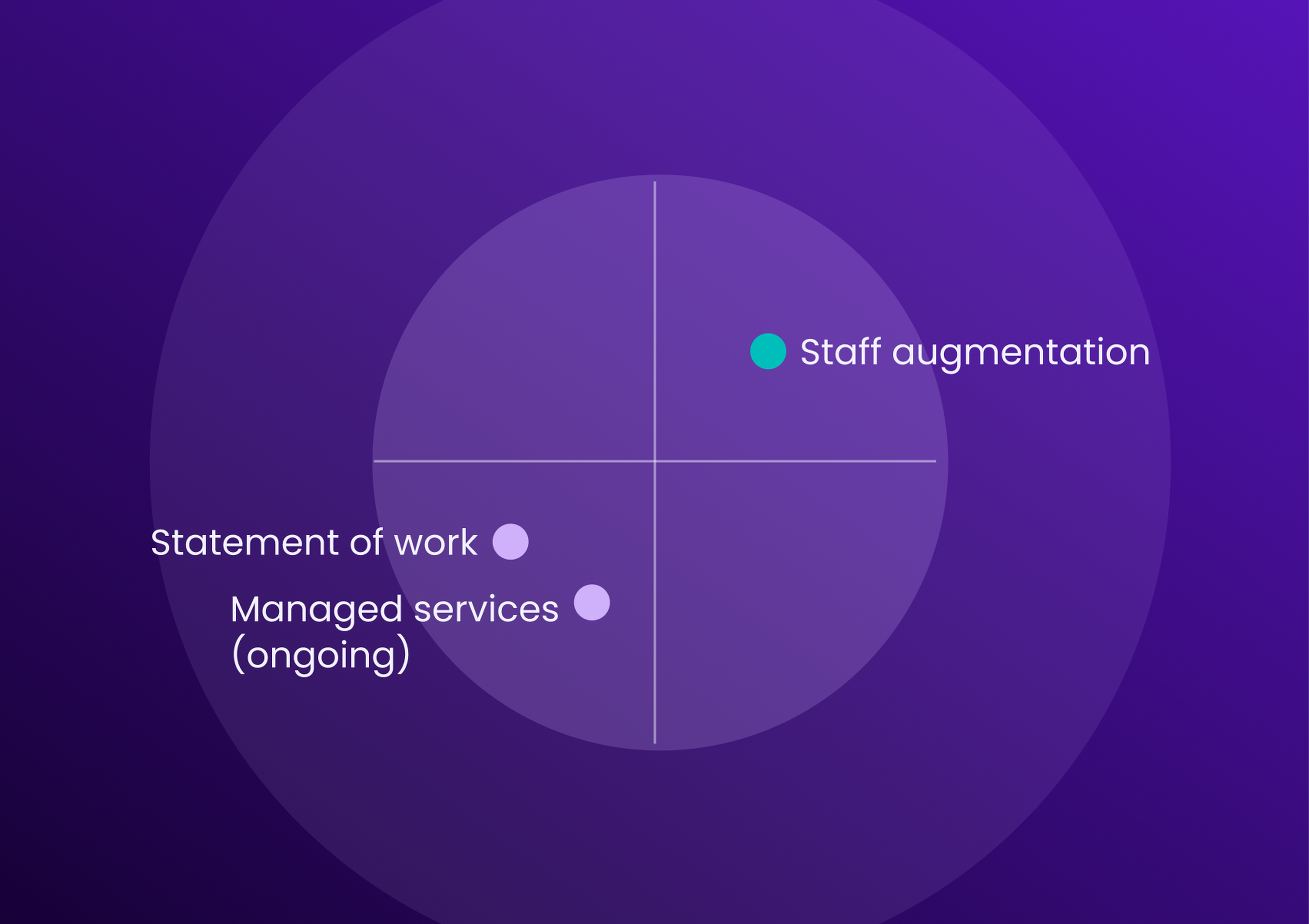
Three questions settle most of this decision: Is the scope well-defined before work starts? Is the deliverable objectively measurable? Is the need a project with an end date, or ongoing capacity?
Where scope is clear and the deliverable is measurable, a statement of work or milestone-based structure fits: you're buying an outcome, and the provider carries delivery risk. Where the scope is fluid or the need is ongoing capacity rather than a fixed deliverable, staff augmentation or time-and-materials fits better: you're buying capacity and directing the work yourself.
Getting this wrong in either direction creates the exact problems the rest of this guide covers: a fluid need forced into a fixed SOW produces constant change orders, while an ongoing capacity need billed as if it were a project produces scope that nobody is actually managing to an outcome.
Why services procurement leaks money: 6 common challenges
Low spend visibility
Services spend is frequently scattered across business-line budgets and individual purchase orders rather than consolidated under procurement, so nobody has a full picture until finance closes the books. Intake is usually decentralised, initiated by whichever business prescriber has the need, so each one runs it their own way, by email, by spreadsheet, whatever's fastest, none of it necessarily compliant with procurement strategy.
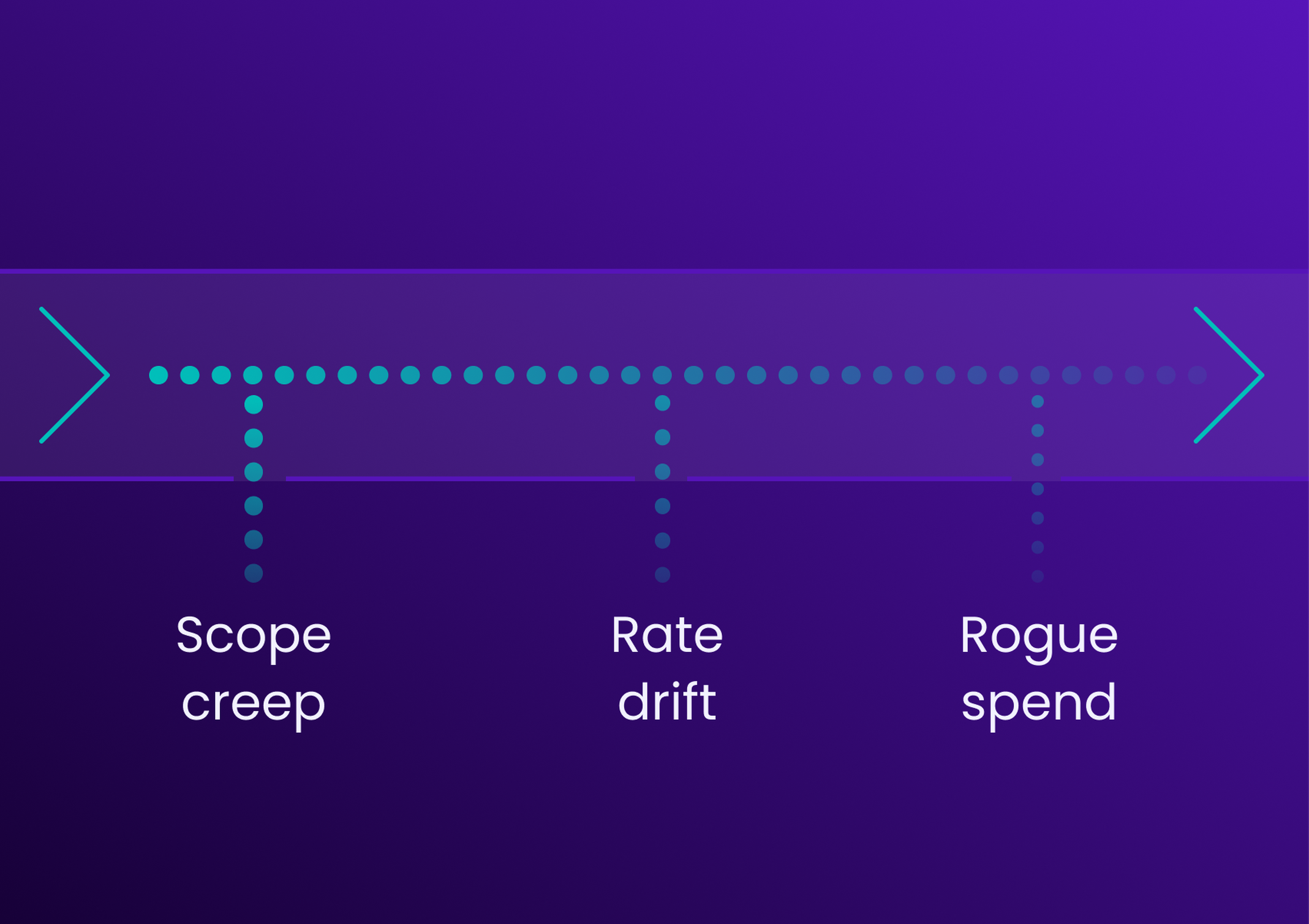
Scope creep on T&M engagements
Time-and-materials pricing has no built-in brake: without active scope management, "a bit more work" accumulates invisibly until the total bears no relation to the original estimate.
Rate drift across a supplier base
The same role gets booked at different rates by different managers, and without a rate card, nobody notices until someone compares invoices. This is the second-order problem of decentralised intake across many different prescribers: with no visibility into what's being booked where, there's nothing to standardise or optimise against.
Rogue or tail engagement outside procurement
A manager engages a provider directly because it's faster than going through the process, and that spend never shows up in category reporting. The Hackett Group's 2025 Digital World Class Procurement research found that top-performing procurement teams achieve 60% less savings lost to maverick buying and contract noncompliance than their peers, which is largely a function of how much of this kind of spend they catch.
Deliverables accepted without review
An invoice gets approved because the engagement is nearly over and nobody wants to hold it up, not because the deliverable was actually checked against what was scoped.
Compliance and worker-classification exposure
A long-tenured, closely-directed contractor can start to look like an employee to a regulator, which is a cost risk as real as any of the above, just one that shows up later.
The scale of the underlying workforce this touches keeps growing: Staffing Industry Analysts' 2025 buyer survey found that contingent and external workers already make up an average of 21% of organisations' workforce, with buyers expecting that to reach 26% within ten years, which means the categories most exposed to these six leaks are getting larger, not smaller.
How technology supports services procurement: VMS, e-procurement, ERP, spreadsheets
Each tool was built for a different kind of spend, and each breaks in a predictable place once services spend runs through it.
ERP and e-procurement systems are built around purchase orders and physical goods: they're strong on the transaction itself but weak on time-based work, since a PO doesn't validate a timesheet or flag a renewal date. Spreadsheets handle a handful of engagements adequately and then stop scaling entirely: no automated validation, no renewal alerts, no consolidated view once more than a few people are maintaining them. A vendor management system is built specifically for time-based and outcome-based external work: rate cards, milestone and timesheet validation, renewal tracking, and spend visibility across a supplier base, the exact gaps ERP and spreadsheets leave open for this category.
None of these tools replace the process decisions in the sections above; they operationalise them once you've made them.
KPIs to measure services procurement performance
| KPI | What it tells you | How to calculate | Healthy range |
|---|---|---|---|
Request-to-contract cycle time | How fast a need becomes a signed engagement | Time from request raised to contract signed | 1.0 day median for services procurement, per benchmarked organisations |
Rate-card compliance % | Whether spend follows negotiated rates | Spend at rate-card price / total category spend | Higher is better; large gaps signal rate drift |
Maverick / off-contract spend % | Spend bypassing procurement entirely | Off-contract spend / total spend | As close to zero as the category allows |
On-time & on-budget delivery rate | Whether engagements deliver as scoped | Engagements meeting both criteria / total engagements | Category-dependent |
Realised savings vs. baseline | Value procurement is actually capturing | (Baseline cost minus actual cost) / baseline cost | Tracked against your own baseline, not a universal target |
Supplier performance score | Delivery quality and reliability | Weighted score across delivery, quality, responsiveness | Set per category |
Renewal-on-time rate | Whether renewals happen by decision, not default | Renewals reviewed and confirmed on time / total renewals due | Higher is better |
The cycle-time figure above comes from APQC's benchmark specifically for services procurement, based on 1,145 companies, worth noting because it's one of the only benchmarks in this space that isolates services from goods rather than blending them.
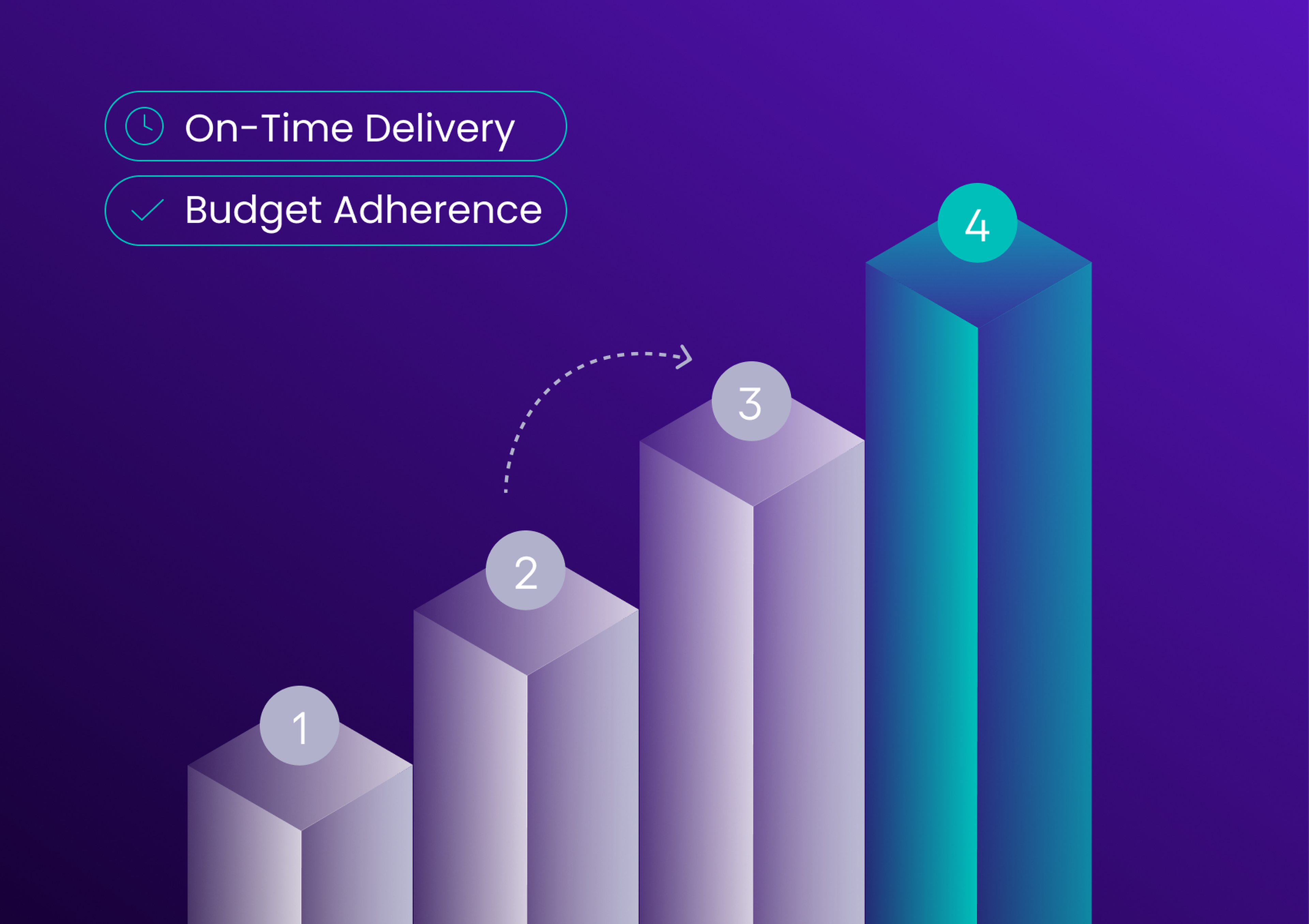
Services procurement maturity: where does your organisation stand?
Explore: professional services management relies mainly on informal exchanges and manual tools. Overall visibility remains limited: it's difficult to know who is engaged, at what rate, under which contract, and with what level of risk.
Structure: a procurement framework exists, and compliance and supplier control have been identified as priorities, but management remains fragmented across entities, categories or local practices, producing heterogeneous processes and a high operational workload.
Steer: the category is structured and data-driven: processes are clearly defined, supplier panels are better controlled, spend is consolidated, and KPIs are monitored regularly. Procurement is recognised as a business partner rather than an administrative function.
Transform: professional services are managed as a strategic category, with global, near real-time visibility, close supplier performance monitoring, and cross-functional governance across business, finance and IT.
Most organisations sit somewhere between Explore and Structure for services specifically, even when their goods procurement is considerably more mature. If that description matches, Eleven VMS’s procurement maturity assessement is a 10 questions, 3 minute self-assessment that places your organisation on this exact framework and outlines the priorities to reach the next level.
Services procurement best-practice checklist
Centralise intake for services requests, don't let each business line run its own process.
Standardise SOW templates and acceptance criteria so quality isn't judged after the fact.
Maintain a pre-qualified supplier panel instead of sourcing cold for every new need.
Default to outcome-based pricing where scope genuinely allows it.
Validate time and deliverables before payment, not after.
Track renewals actively so they're a decision, not a default.
Review supplier performance on a quarterly cadence.
Report services spend to finance monthly, not at year-end.
Bringing services spend under the same rigour as goods
If your organisation recognised itself at "ad hoc" or "coordinated" above, the gap usually isn't effort, it's the absence of a system built for this category specifically. Eleven VMS's platform is built for time-based and outcome-based services spend, or size the opportunity with the VMS ROI calculator.
Book a meeting with one of our experts for a personalized demo.