An MSP is a managed service provider, in the contingent workforce sense, which is a third party that manages all or part of an organization’s external workforce program end to end. This guide is for procurement, HR and contingent workforce owners deciding whether they need one, and covers the operating models, what it actually costs, and a decision framework for MSP, VMS, or both. If your program already runs on a contingent workforce of any size, the question this guide answers is who runs the program itself, not just who fills the roles.
What is a managed service provider (MSP)?
A managed service provider is a third party that manages all or part of an organisation's contingent workforce and external-services program end to end: supplier management, requisition handling, onboarding and offboarding, compliance, and reporting, typically operating a vendor management system as its system of record.
That's a broader scope than it might sound. An MSP doesn't just supply workers, that's what a staffing agency does. An MSP manages the whole program and the agencies inside it: which suppliers get which requisitions, how compliance is enforced across all of them, and what gets reported up to the business. The scope now regularly spans both temp labour and statement-of-work or consulting engagements, not just hourly staff augmentation the way most MSP content still assumes.
The category itself is sizeable and growing again after a slower patch: Staffing Industry Analysts' MSP Global Landscape Summary put the global MSP market at $226 billion in spend under management in 2024, a 2% return to growth after a weaker 2023.
MSP vs VMS: what's the difference?
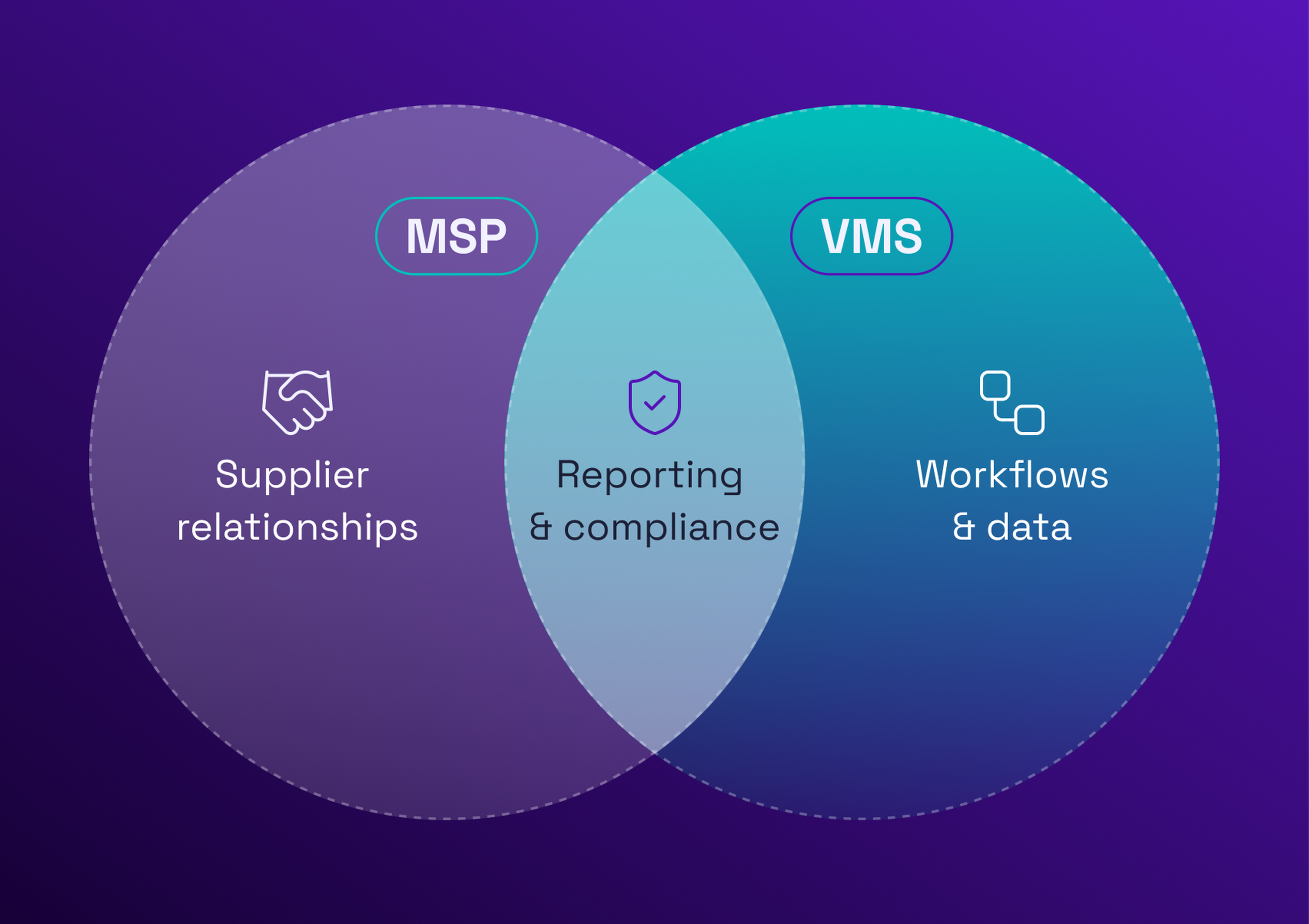
A Vendor Management System (VMS) is a software and an MSP is a service. That distinction resolves most of the confusion, but the practical split matters more than the label.
| Dimension | VMS (Vendor Management System) | MSP (Managed Service Provider) |
|---|---|---|
What it is | Technology platform | Outsourced service team |
Owns | Workflows, data, reporting, audit trail | Day-to-day program operations, supplier relationships, hiring-manager support |
Best when | You have internal program ownership | You lack internal capacity or want a single accountable partner |
Cost model | Licence or subscription or engagement-based | A percentage of contingent spend, see funding models below |
Can you have one without the other? | Yes | Rare, an MSP almost always runs a VMS |
In a VMS-only setup, your internal team (Operations or Procurement) owns requisition intake, sourcing decisions, compliance checks and analytics, with the VMS providing the system of record. Bring in an MSP, and the day-to-day operational work shifts, though the VMS stays the underlying data layer either way.
| Function | VMS-only | MSP + VMS |
|---|---|---|
Requisition intake | Hiring manager submits directly through the VMS | MSP program team receives and triages it |
Sourcing decisions | Sourcing across the approved vendor list or preferred vendor program | MSP sources against the panel it manages |
Compliance checks | Internal team runs them, VMS enforces the rules | MSP runs them day to day, VMS still enforces the rules |
Analytics and reporting | Internal team pulls reports from the VMS directly | MSP compiles and presents findings to the client |
The pattern holds across all four rows: the VMS enforces the rules and holds the data regardless of who's operating it, and what actually changes is whose desk each decision lands on first. That's also where escalation differs: a rate dispute or a compliance exception goes to whoever internally owns the category in a VMS-only setup, or to the MSP's program team first in an MSP setup, with the client pulled in only if it can't be resolved at that level.
What an MSP actually does: core functions
Supplier sourcing and rationalization
Building and maintaining the supplier panel, so requisitions go to a pre-qualified, ranked pool rather than wherever a hiring manager happens to know someone.
Rate-card and SoW governance
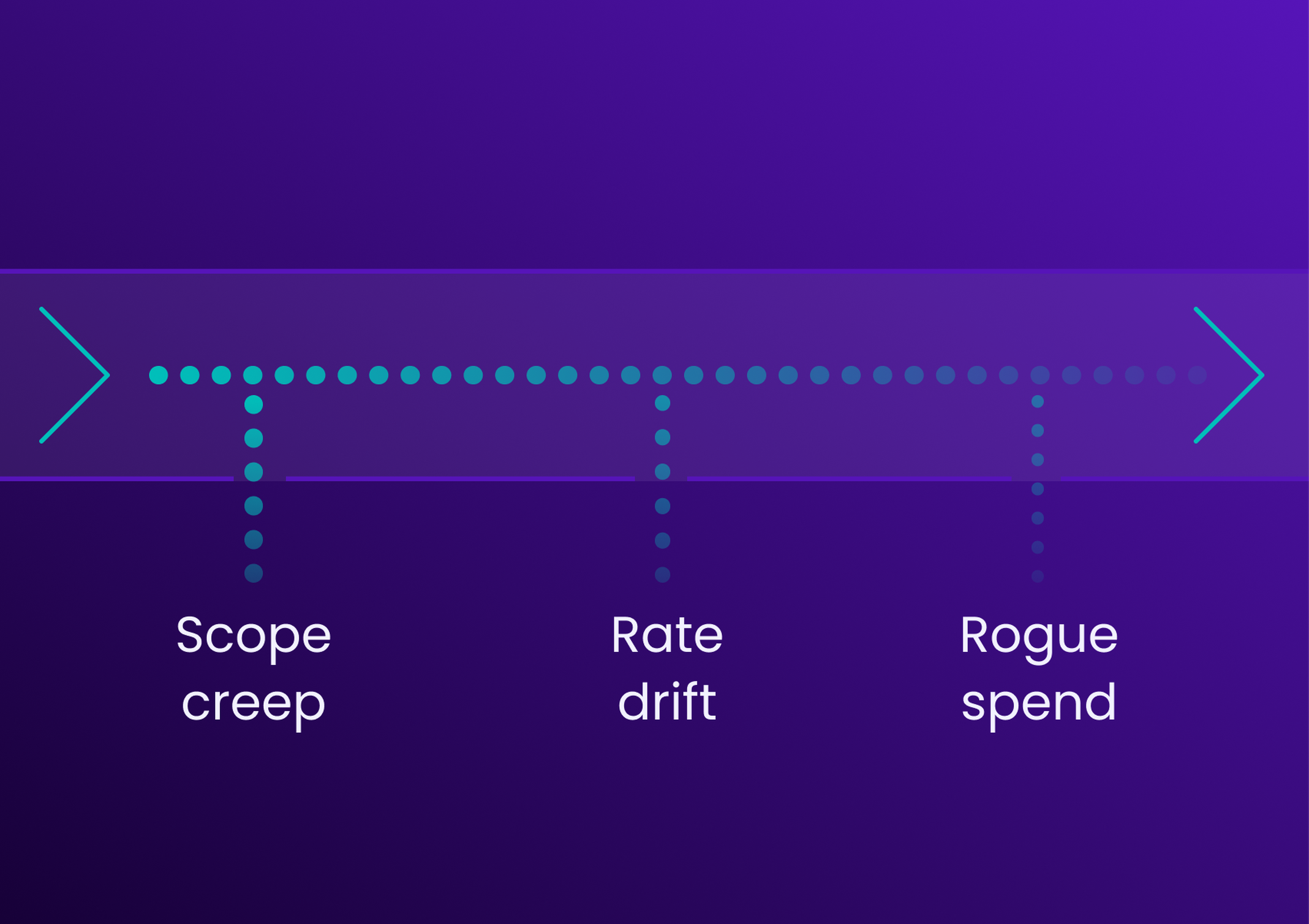
Enforcing negotiated rates across the panel, which controls maverick spend and margin creep before it happens rather than catching it at invoice time.
Requisition distribution and selection support
Routing new requests to the right suppliers and helping hiring managers evaluate candidates or proposals consistently.
Onboarding, compliance and worker-classification checks
Verifying documentation and classification status before someone starts, not after a regulator asks.
Timesheet and invoice consolidation
One reconciled view of spend instead of a separate invoice trail per supplier.
Program reporting and QBRs
Regular, structured visibility into spend, performance and compliance, rather than a report assembled from scratch when finance asks.
Continuous savings and process improvement
An MSP with skin in the program's outcomes has a reason to keep tightening the process, not just run it as-is.
Not every MSP runs all seven functions at full depth from day one. Most programs start with whichever two or three address the most acute pain, usually supplier rationalisation and rate governance, and build out reporting and continuous improvement once the basics are stable.
How an MSP program works, step by step
Program design and baseline: spend analysis, worker population, and goals get mapped before anything else changes, so the program is built against actual current state rather than assumptions. This step also sets which categories launch first: most programs phase in rather than converting everything at once, since redesigning every category simultaneously is exactly what produces the adoption problems the later steps then have to fix.
Technology setup: VMS configuration and integrations with ATS, ERP or procurement systems, the data plumbing that everything else depends on.
Supplier onboarding and tiering: the panel gets built and ranked, not just populated, so routing decisions have a basis from day one.
Go-live and hiring-manager enablement: the point where the program either sticks or doesn't: hiring managers need to actually use the new process, not route around it out of habit.
Steady-state operations: the day-to-day requisition-to-onboard cycle, running on the process and technology set up in the earlier steps.
Governance and optimization: SLAs, KPIs and quarterly business reviews that keep the program improving rather than just running in place.
A typical implementation runs 8 to 16 weeks depending on scope and supplier count. Hiring-manager adoption is consistently the biggest failure point: a technically well-built program that managers route around by habit delivers none of the visibility it was built for.
MSP operating models: vendor-neutral, master vendor, hybrid, self-managed
| Model | How it works | Best for |
|---|---|---|
Vendor-neutral | The MSP has no financial stake in which supplier wins the work | Large, multi-supplier programs where channel bias would distort sourcing |
Master vendor | A single lead supplier manages the panel, often subcontracting the rest | Simpler to run, but concentrates risk in one relationship |
Hybrid | Vendor-neutral for hard-to-fill or specialist roles, master vendor for volume | Programs with a mix of commodity and scarce-skill categories |
Self-managed / internal MSP | The organization runs MSP functions internally, usually on a VMS | Mature programs that want to keep control without giving up the discipline |
The right model tracks program size and skill scarcity more than anything else: a large, multi-country program with genuinely scarce skills usually needs vendor-neutral or hybrid to avoid a single supplier's bench becoming the ceiling on quality.
None of these models is inherently better: the trade-off is between bias risk and simplicity. Vendor-neutral removes any incentive for the MSP to favour its own placements, but it takes more coordination to run well. Master vendor is faster to stand up and easier to govern, at the cost of concentrating delivery risk in one relationship, if that supplier's bench thins out, the whole category feels it. Hybrid applies the stricter model only where scarcity makes bias genuinely costly, and the simpler model where volume matters more than specialism. Self-managed only works once an organisation already has the internal discipline an external MSP would otherwise provide; without it, it's staff augmentation with extra steps.
What does an MSP cost? Funding models explained
Two funding models dominate, and they shift the cost in different directions.
Supplier-funded. The MSP fee, usually 1.5 to 4% of contingent spend, comes out of the supplier's margin rather than being billed directly to the client. No direct client cost on paper, but it can compress supplier rates or shrink the pool of suppliers willing to participate at that margin.
Client-funded. A flat or variable management fee paid directly by the buyer. More transparent about what the MSP actually costs, and generally the better fit for scarce or high-skill talent categories, where compressing supplier margin would just shrink the available pool further.
Beyond the headline fee, a few costs are easy to underestimate: implementation, VMS licence costs passed through from the MSP, and the internal change-management effort of getting hiring managers to actually adopt the new process. The choice between funding models comes down to how much margin transparency you need and how scarce the talent is: the harder the category is to source, the more a compressed supplier margin costs you in quality rather than in visible fees.
MSP for staff augmentation vs statement-of-work (SoW) services
Most MSP content assumes staff augmentation: hire a contractor, bill by the hour, manage headcount. Governance changes considerably once SoW or consulting spend enters the program.
Staff augmentation governance tracks time and presence: hours logged, tenure, rate compliance. SoW governance has to track a deliverable instead: scope definition, milestone and acceptance criteria, and rate benchmarking against fixed-price bids rather than an hourly card. An MSP built only for staff-aug governance applies the wrong controls to SoW work, timesheet validation instead of milestone acceptance, which misses exactly the risks that matter for deliverable-based spend.
That mismatch has a name worth knowing: "SoW-washing", where a staff-augmentation engagement gets relabelled as a statement of work to sidestep classification or tenure rules to sidestep classification or tenure rules, without the deliverable-based structure that would make it a genuine SoW. It's both a compliance risk and a cost risk, since the engagement gets managed, and priced, as something it isn't. Structuring this properly starts with choosing the right model deliberately: day rate vs. fixed price covers that decision in more depth, and it connects to the same source-to-pay process an MSP program ultimately feeds into.
Benefits and limitations of an MSP
Benefits: consolidated spend visibility across the whole contingent program, faster time-to-fill from a pre-qualified panel, stronger compliance rigour applied consistently, supplier consolidation instead of a sprawling ad hoc list, and one accountable partner rather than a dozen separate relationships to manage.
Limitations: hiring managers can genuinely feel a loss of control compared to sourcing directly, rate compression can push suppliers out of the panel over time, an MSP can be less agile for a niche or critical role that needs a fast, direct relationship, there's an added layer between the manager and the talent, and switching MSPs later carries real transition cost.
Both lists are true at the same time, so the decision rarely comes down to counting which side has more items. What actually tips it is whether the visibility problem the benefits solve is costing you more right now than the control you'd give up to fix it.
Compliance and risk: co-employment, misclassification, and data
An MSP structure mitigates co-employment and joint-employer exposure by centralising direction and documentation, but it doesn't remove the client's legal exposure entirely, it operationalises control over it. Worker misclassification, treating a contractor as an employee in practice through fixed hours, close supervision or long unbroken tenure, remains a live risk regardless of who's running the program: an MSP standardises the contract terms and the tenure tracking, but the underlying test a regulator applies doesn't change just because a third party is managing the process.
France adds a specific layer on top of that general risk. Article L8241-1 of the Code du travail prohibits for-profit arrangements whose sole purpose is lending out staff, prêt de main-d'œuvre illicite, separate from the related offence of délit de marchandage, which covers supplying labour in a way that harms the worker or circumvents an employer's legal obligations. An MSP operating in France needs contracting structures that sit outside these prohibitions, genuine service delivery rather than pure headcount supply, which is exactly the distinction a properly structured statement of work is meant to preserve.
The UK applies a different mechanism to the same underlying problem. Under HMRC's off-payroll working rules, IR35, it's the client, not the contractor, who determines whether an engagement should be taxed as employment for most medium and large private-sector organisations, and getting that determination wrong can leave the client liable for the resulting tax and National Insurance. An MSP operating in the UK needs a process for making and documenting that determination on every engagement, not just a contract template that assumes the answer.
Data adds a third strand. Contingent-worker personal data, contracts, timesheets, background-check results, performance records, moves through both the MSP's systems and the client's, and GDPR obligations apply to that flow the same way they'd apply to any other processor handling personal data on an organisation's behalf: a lawful basis for processing, data minimisation, and clear terms on what happens to that data once an engagement ends. The European Data Protection Board's baseline guidance sets out these principles in more detail.
This is general information, not legal advice, and classification, prêt de main-d'œuvre, and data-handling decisions should each involve qualified counsel familiar with the relevant jurisdiction.
Do you need an MSP? A decision framework
| Your situation | Likely fit |
|---|---|
Under $5M contingent spend, single site, low complexity | Internal management, maybe a light VMS |
$5 to 25M spend, growing, some maverick spend | VMS plus an internal PMO, or a lean MSP |
Over $25M spend, multi-country, many suppliers, audit pressure | MSP plus VMS |
Mostly SoW or consulting, needs deliverable governance | VMS with SoW capability, with or without a specialist MSP |
Strong internal team, wants control plus tooling | VMS-only |
A short readiness check before committing either way: Can you currently say how many contractors are active right now? Are rates consistent for the same role across managers? Is compliance checked the same way every time, or does it vary by who's running the requisition? Can you produce an audit trail for external spend without days of manual reconciliation? Does your current setup handle SoW and staff augmentation with the same rigour, or does one get more attention than the other? Would centralising this free up meaningful time from whoever's doing it manually today?
A useful way to read these six questions: ask them of someone in procurement and someone on the business side separately, and compare the answers. A wide gap between the two is usually a clearer signal than either answer on its own.
If several of those expose a gap, an assessment of your procurement maturity is a reasonable next step before deciding between VMS-only, a lean MSP, or a full MSP-plus-VMS setup.
MSP, VMS, or both: where Eleven VMS fits
Eleven VMS is the technology layer in this picture, and it works the same way whether the program is run internally or through an MSP: as the system of record for suppliers, rates, compliance and reporting. Its particular strength sits in SoW and intellectual-services procurement specifically, the category most MSP tooling still treats as an afterthought to staff augmentation.
Book a meeting with one of our experts for a personalized demo.