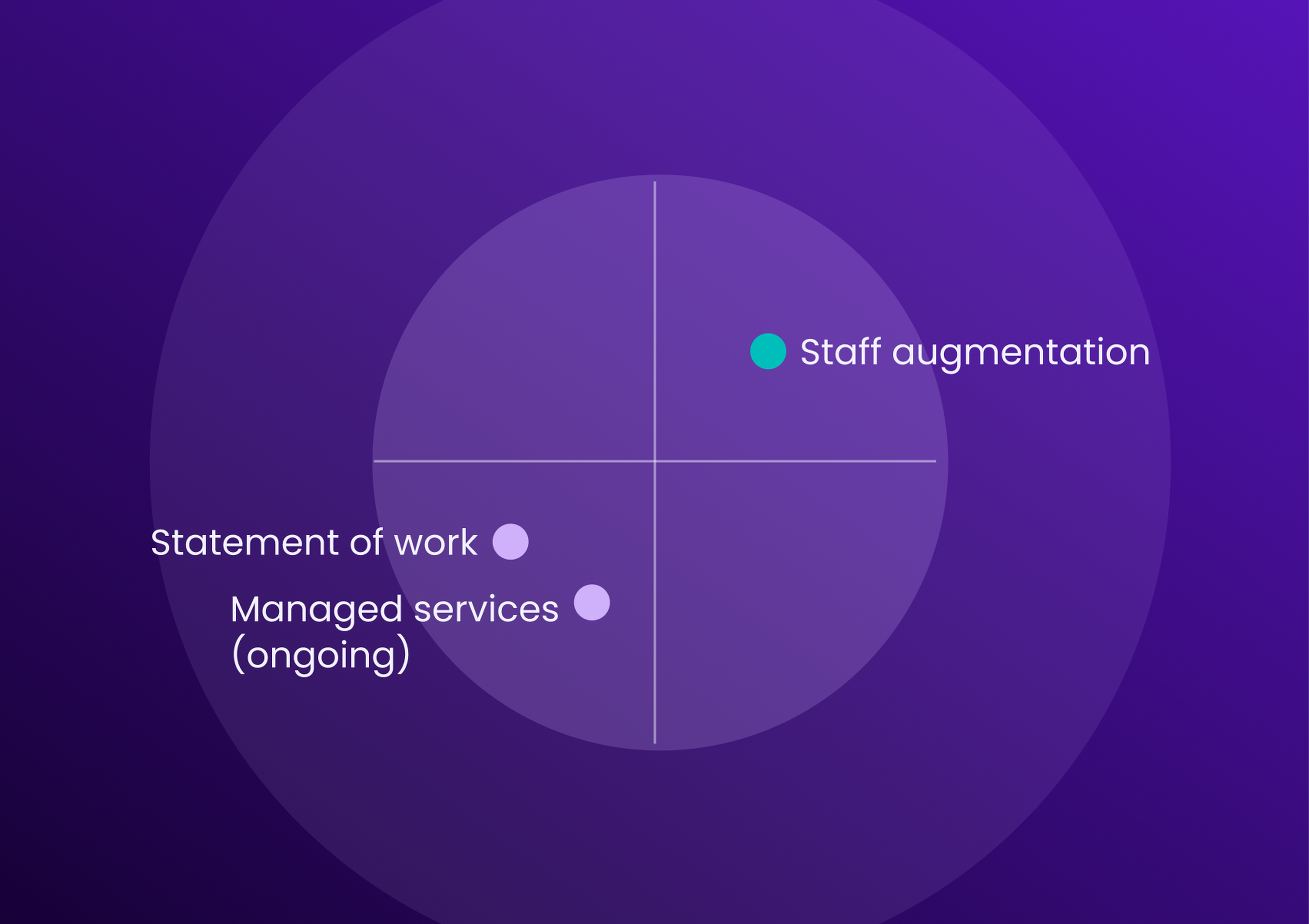
Staff augmentation is a model for adding vetted external specialists to your existing team, under your management, for a defined period, without hiring them directly. The provider sources, employs and pays the specialist; you direct the day-to-day work. Companies use it to close a skills gap or meet a deadline faster than a permanent hiring process allows, while keeping control over how the work gets done.
How staff augmentation works
The model follows a consistent sequence, whatever the provider or role.
Define the need and the role profile: the skill, seniority level and expected duration.
The provider sources and pre-vets candidates against that profile.
You interview and select the specialist, as you would for an internal hire.
Contracting and rate agreement follow, setting the day rate, engagement dates and terms.
Onboarding brings the specialist into your tools, systems and workflows.
From that point, the specialist reports to your managers and works as part of your team.
The engagement ends on the agreed date, or converts into a renewal or a permanent offer if both sides want that.
The defining trait of the staff augmentation model is the split in responsibility: you direct the work, and the provider handles employment, payroll and compliance. That split is also what separates it from outsourcing and managed services, covered below.
Types of staff augmentation
Staff augmentation splits along several axes, and providers often mix them within the same engagement.
By skill level: commodity roles (interchangeable, high-volume skills), skill-based roles (a defined technical competency), and highly-skilled or expert roles (scarce, specialist expertise commanding a premium rate).
By duration: short-term augmentation covers a capacity gap or a surge in workload, while long-term or strategic augmentation supports an ongoing programme over many months.
By location: onshore (same country), nearshore (nearby time zone, often lower cost), and offshore (further afield, largest cost gap, more coordination overhead).
By function: IT and software development is the largest category, followed by engineering, data and analytics, and a smaller but growing share in finance, legal and creative roles.
| Model | Best for | Typical engagement length | Trade-off |
|---|---|---|---|
Short-term augmentation | A surge, a deadline, a temporary gap | Weeks to a few months | Fast to start, limited depth of context by the time it ends |
Long-term augmentation | An ongoing programme or sustained capacity need | Several months to years | Requires the same governance discipline as permanent capacity |
IT staff augmentation specifically tends to combine skill-based and highly-skilled tiers, since generalist commodity IT roles are increasingly handled through other channels such as managed services.
These axes combine in practice more than they operate independently. A short-term surge need is often filled onshore for speed, while a long-term strategic augmentation is more likely to run nearshore or offshore once the relationship is established and the coordination overhead has been absorbed. Skill level and function interact the same way: a highly-skilled IT role commands both a premium rate and closer vetting than a commodity data-entry or support role, even when both technically sit under the same staff augmentation umbrella.
Staff augmentation vs outsourcing, managed services, and consulting
This comparison is where most of the confusion sits, and where the wrong choice has the most consequence.
| Staff augmentation | Project outsourcing | Managed services | Consulting | |
|---|---|---|---|---|
Who manages the work | You | The provider | The provider | The consultant, with your input |
What you buy | People (capacity) | An outcome | An ongoing service | Expertise and recommendations |
Pricing basis | Day rate | Fixed price | Recurring fee | Day rate or fixed price |
Who owns deliverables | You | The provider | The provider | Shared, often advisory only |
Flexibility to scale | High, add or remove people | Low, scope is fixed | Moderate, within the service agreement | Low, tied to the engagement scope |
Misclassification / co-employment risk | Present if direction is treated like employment | Low, provider owns delivery | Low, provider owns delivery | Low |
Staff augmentation vs outsourcing comes down to who directs the work day to day: with augmentation, you do; with outsourcing, the provider does against a defined outcome.
Staff augmentation vs managed services follows the same logic at a larger scale: managed services hands over an entire function or service on an ongoing basis, while augmentation adds individual capacity you still direct.
Consulting sits apart from the other three. A consultant is typically engaged for expertise and recommendations rather than hands-on delivery, and ownership of the resulting work stays mixed: the consultant advises, but your team usually still builds or decides. That makes consulting a poor substitute when what's actually needed is extra delivery capacity rather than an outside opinion.
As a decision cue: choose staff augmentation when scope shifts and you want to keep control of how the work happens. Choose SOW or managed services when scope is fixed and you would rather transfer delivery risk to the provider.
How much does staff augmentation cost?
Staff augmentation is priced on a day rate or time-and-materials basis, occasionally billed monthly for longer engagements. That headline rate is not the full picture.
A day rate typically covers four components: the specialist's base pay, the provider's employer payroll burden (social charges, benefits, insurance), the provider's margin, and overhead such as recruitment, vetting and account management. The split between these varies by provider and market, but base pay rarely accounts for the full rate.
Metrics' 2025 day-rate benchmark, based on an analysis of actual signed IT sourcing contracts in Western Europe, gives a concrete picture for application development roles:
| Level | Definition | Day rate (2025, 8-hour day, excl. VAT) |
|---|---|---|
Developer | Design, implementation and maintenance of applications; 3+ years of experience | €793 |
Senior developer | Design, implementation and maintenance of applications; 7+ years of experience | €1,162 |
Special skills | Design and implementation of complete IT solutions; 5+ years of experience | €1,571 |
Rates vary by market, skill and region, and move with demand cycles. On top of that, and beyond the day rate itself, a few costs are easy to underestimate: onboarding ramp time before a specialist is fully productive, tooling and licence costs, the management overhead of directing external specialists well, and replacement churn if a specialist leaves mid-engagement. Comparing day rate against fixed-price engagements on total cost, not headline rate alone, usually changes which model looks cheaper, and running the numbers through a VMS ROI calculator does the same for a full program rather than a single engagement.
When to use staff augmentation, and when not to
Staff augmentation fits well when the situation has a specific shape.
Use it when: there is a defined skill gap on an existing team, a delivery deadline is at risk, the long-term need is uncertain, a niche skill isn't worth a permanent hire, a team needs to ramp faster than recruitment allows, or you want to test a working relationship before a contract-to-hire decision.
Choose something else when: the work is a self-contained project with fixed scope (a statement of work fits better), you need an outcome owned end-to-end rather than capacity you direct (managed services fits better), the need is permanent and core to the business (hiring fits better), or the team doesn't have the management capacity to direct additional people effectively.
These aren't always clean either/or decisions. A project that starts with a fixed scope can still need augmentation later if the scope expands mid-delivery, and a team that starts with augmented capacity sometimes converts a specialist to a permanent hire once the long-term need becomes clear. The distinction matters most at the point of sourcing: naming the model deliberately, rather than defaulting to whichever one was used last time, is what keeps pricing, tracking and risk ownership aligned with what the work actually needs.
Benefits and risks of staff augmentation
The benefits are well established: speed to skill, the ability to scale up or down without severance costs, access to niche expertise, retained control over how the work is done and over intellectual property, a lower fixed-cost commitment than permanent headcount, and knowledge that stays closer to your own team than it would with fully outsourced delivery.
The risks are less often addressed with any precision:
Co-employment and worker misclassification.
Direction that looks too much like employment, fixed hours, close supervision, integration into internal reporting lines, creates legal exposure. Rules differ significantly by country: the European Labour Authority's research on misclassification sets out how enforcement has intensified across EU member states.
Contractor tenure limits.
Several countries cap how long a contractor can work on the same assignment before requalifying as an employee. Tracking these limits matters more as engagements extend.
Knowledge loss at offboarding.
A specialist who leaves without a structured handover takes undocumented context with them.
Security and access sprawl.
Augmented staff often need system access similar to an employee's, and that access needs the same discipline at offboarding that it gets at onboarding.
Over-reliance and rate creep across many vendors.
Without a consolidated view, the same role gets booked at different rates by different managers, and dependency on a handful of individuals builds up unnoticed.
Cultural and integration friction with offshore models.
Time zone gaps and working-style differences add coordination cost that a day-rate comparison alone doesn't capture.
What's in a staff augmentation contract
Verbal agreements and a one-page purchase order might get an engagement started, but they leave the terms that matter most to informal understanding, which tends to break down exactly when something goes wrong. A well-structured contract covers each of these points explicitly, rather than leaving them to assumption:
role profile and rate schedule
engagement dates and renewal terms
tenure cap, where applicable
IP assignment
confidentiality and data-security terms
background-check requirements
replacement SLA and notice period
termination for convenience
timesheet and approval process
invoicing terms
Missing terms tend to surface as disputes later, typically around IP ownership or what happens when a specialist needs replacing mid-engagement. IP assignment matters more than it might seem: without an explicit clause, ownership of work produced during the engagement can default to the specialist or their employer rather than to you, depending on jurisdiction. A replacement SLA matters just as much on the other side, since losing a specialist mid-project without an agreed timeline for a substitute turns a staffing gap into a delivery risk.
How to manage augmented staff at scale
One or two contractors is easy to manage informally. The problem starts at ten or more specialists spread across several providers, which is where most organisations running staff augmentation actually sit.
None of the six disciplines below work well in isolation. Rate cards without workforce visibility just standardise ignorance; performance tracking without a feedback loop into sourcing just accumulates data nobody acts on. The value comes from running them together, in one place.
Consolidate rates into standard rate cards.
Every vendor gets benchmarked against the same grid, instead of each manager negotiating independently.
Keep a single view of the workforce.
Who is on-site, from which vendor, on what project, with what end date, in one place rather than reconstructed from memory or scattered contracts.
Control timesheets and spend.
Approval workflows and budget-vs-actual tracking per mission remove invoice surprises at month-end.
Build in compliance guardrails.
Automated alerts on approaching tenure limits and contract renewals catch what a manual calendar review usually misses.
Track vendor performance.
Delivery quality and satisfaction, not just cost, should inform which providers get the next sourcing round.
Apply the same onboarding and offboarding discipline at scale that works for one person.
Provisioning, and critically deprovisioning, access needs to hold whether it's one specialist or fifty.
A vendor management system (VMS) is the tool built for exactly this: it centralizes rate cards, workforce visibility, timesheets, compliance alerts and vendor performance data in one place instead of spreading them across each provider's own systems. The alternative, running this manually once the vendor count grows, is where rate creep, compliance gaps and untracked spend tend to originate. One VMS's role in supporting a purchasing department covers this in more operational detail.
Clients running Eleven VMS report, on average, an 11% reduction in professional services spend and 70% less time spent by buyers and operational teams on administrative tasks, alongside full visibility across processes and service providers once external specialists are consolidated into one system.
How to choose a staff augmentation provider
A structured evaluation covers more than rate:
relevant domain and skill coverage for the roles you need
vetting rigour and typical time-to-shortlist
rate transparency, ideally against a published rate card
contractual flexibility on replacement and ramp-down
references from comparable companies, not just case studies
geographic coverage matching where you need people
reporting and integration capability, specifically whether their data can feed your VMS or ERP
Rate transparency deserves particular weight in this list. A provider unwilling to share a clear rate card upfront is unlikely to become more transparent once the engagement is underway, and inconsistent pricing across roles or over time is one of the clearest early signals of a vendor relationship that will need active management later.
Before signing, a short list of questions clarifies most of what a proposal alone won't: What happens if the specialist isn't a fit after two weeks? How is the replacement SLA defined? What access do they have to your systems, and how is it removed at offboarding? Can their timesheet and invoicing data integrate with your existing systems, or will it sit in a separate portal?
Managing external talent without losing control
Staff augmentation works best when you keep control over how the work happens while governing rates, compliance and spend consistently across vendors. That discipline matters more as the specialist count grows: a couple of contractors is easy to track from memory, but ten or twenty spread across several providers need the same rate cards, workforce visibility and compliance guardrails applied consistently, not reconstructed every time someone asks who's on-site and for how much longer. Eleven VMS's platform centralises exactly that.
Book a meeting with one of our experts for a personalized demo.