Contractor compliance means making sure every external contractor, and their supplier, meets the legal, regulatory, contractual and internal-policy requirements that apply to their engagement, before work starts and continuously until offboarding.
Why contractor compliance matters: the risks and the cost
As contingent workforce spend grows, so does the compliance surface it creates. Non-compliant contractor spend isn't an administrative nuisance, it's a board-level risk. The consequences rarely show up in one place: back-taxes and penalties follow a misclassification finding, a contract or tender gets lost if due diligence wasn't documented at the time it mattered, operations can be interrupted where a required certification or right-to-work check was missed, reputational damage follows when a compliance failure becomes public rather than staying internal, and IP or data exposure follows an offboarded contractor whose access was never properly revoked.
The penalties attached to getting this wrong are not symbolic. Under the UK's off-payroll rules, for example, HMRC penalises a misclassification finding on a sliding scale set by Schedule 24 of the Finance Act 2007: 30% of the unpaid tax for a careless error, rising to 70% for a deliberate one, and up to 100% where the error was both deliberate and concealed, on top of the back-tax itself and interest accruing from the date it was originally due. Other jurisdictions structure the penalty differently, but the shape is consistent: the cost scales with how avoidable the error looks in hindsight, which is precisely why a documented, systematic process matters more than a clean-looking contract.
The scale of the underlying risk is also larger than most procurement teams assume, and it isn't confined to the industries usually associated with contractor risk. The Economic Policy Institute's most recent analysis puts the figure at 10 to 30% of employers misclassifying at least some workers, citing a National Employment Law Project analysis of state-level reports, a range that has held across multiple independent studies for over a decade.
The four compliance domains
Contractor compliance splits into four domains, and most gaps trace back to one of them being handled informally rather than systematically, usually because it was nobody's clearly assigned job.
| Domain | What it covers | Typical evidence |
|---|---|---|
Worker classification | Employee vs. independent contractor status | Classification assessment, contract terms, working-practice review |
Contractual and financial | Scope, rates, insurance, tax registration | Signed SoW or contract, rate card, insurance certificate, tax or VAT ID |
Regulatory and legal | Right to work, sector rules, sanctions or AML, health and safety | Right-to-work check, licences, screening results |
Data security and access | System access, GDPR, confidentiality, IP | NDA, data processing agreement, access log, offboarding record |
An insurance certificate or a right-to-work check isn't the point in itself, it's evidence that the engagement was checked against all four domains systematically, rather than assumed to be fine because nothing had gone wrong yet.
Worker misclassification: the risk that costs the most
Worker misclassification is when a contractor is treated, in practice, more like an employee than an independent supplier, through the degree of control, integration and dependency involved, regardless of what the contract says on paper.
Regulators test for this differently by jurisdiction, but the underlying question is consistent: does the actual working relationship look like employment, whatever label the contract uses?
| Jurisdiction | Rule | How it works |
|---|---|---|
UK | Off-payroll working rules, IR35 (HMRC) | The client determines status for most medium and large organisations; getting it wrong can leave the client liable for the resulting tax |
California | ABC test, AB5 (California DIR) | A worker is presumed an employee unless the business proves all three: freedom from its control, work outside its usual course of business, and an independently established trade |
France | Article L8221-1, Code du travail (Légifrance) | Prohibits travail dissimulé, including disguised salaried employment, where a worker declared independent is in practice subject to the same direction and dependency as an employee |
EU, platform work | Directive (EU) 2024/2831 (EUR-Lex), in force since December 2024 | Introduces a legal presumption of employment where facts indicate direction and control; targets digital labour platforms specifically, narrower in scope than the other three |
Sources: UK, HMRC · California, DIR · France, Légifrance · EU, EUR-Lex
Warning signs regulators and courts look for are consistent across jurisdictions:
fixed hours set by the client rather than the contractor
close day-to-day supervision
no other clients during the engagement
a long, unbroken tenure with no natural end point
the contractor using company equipment and systems as if they were staff
What triggers a closer look isn't usually random. A tax filing that doesn't match expected patterns, a worker complaint, or a benefits claim from someone the business considered a contractor are the three most common starting points for an audit, which is why the check needs to hold up well before any of those happen.
This is general information, not legal advice, and classification decisions should involve qualified counsel familiar with the relevant jurisdiction. None of these tests requires bad intent to trigger: a contract can be entirely well-meaning and still fail the underlying test if the working relationship, in practice, looks like employment.
Contractor compliance checklist by engagement phase
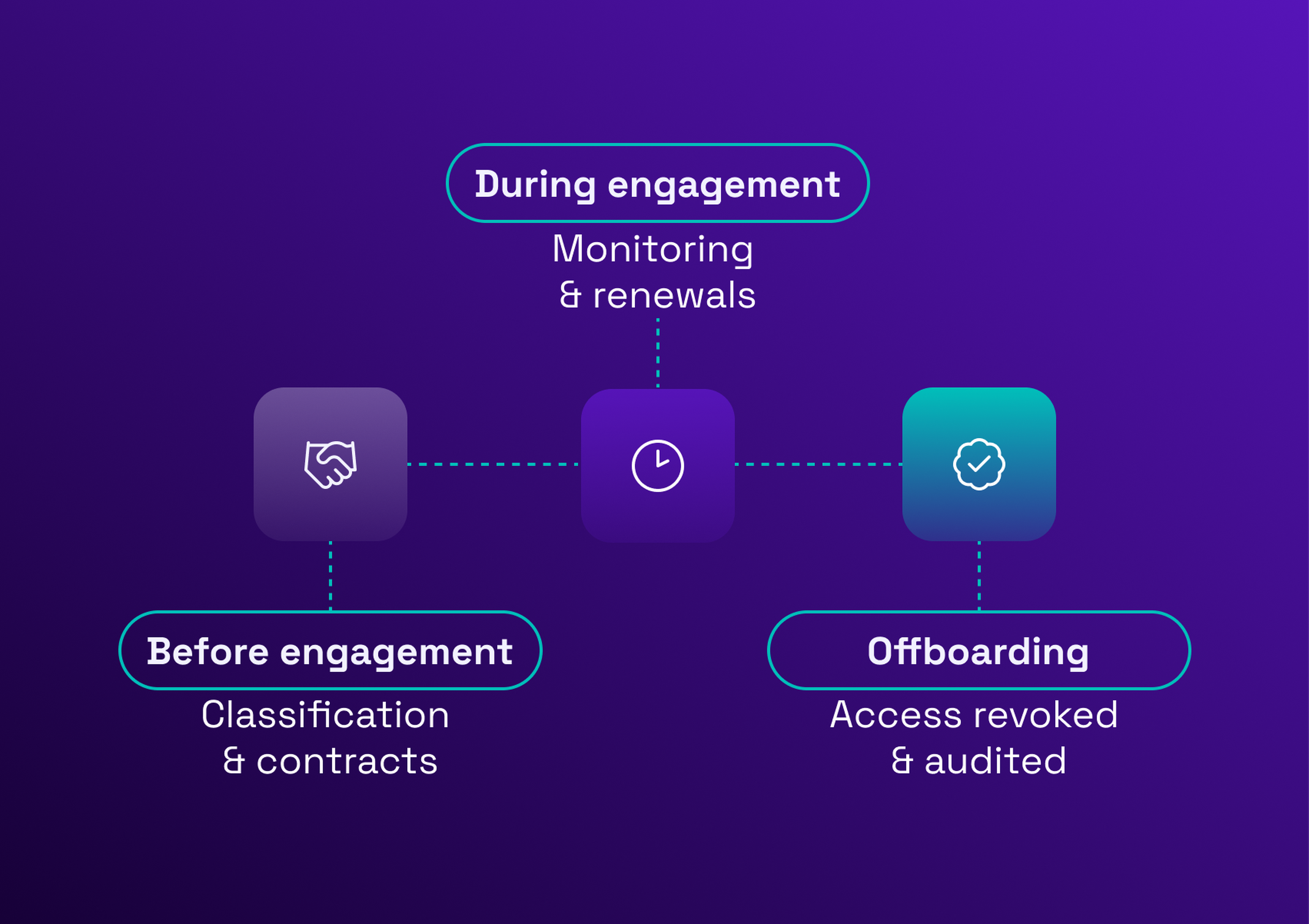
Compliance holds up when it's checked at each phase of the engagement, not verified once at the start and assumed to still be true months later. Organising the checklist by lifecycle phase, rather than as one long undifferentiated list, also makes ownership clearer: pre-engagement items typically sit with procurement, in-flight items with the hiring manager or category owner, and offboarding items with IT and the hiring manager together.
Before engagement
classification assessment completed
signed contract or SoW with scope and independence terms
rate agreed against the rate card
proof of insurance on file
tax or company registration verified
right-to-work or entity verification completed
sanctions and adverse-media screening run
NDA and data processing agreement signed
During engagement
deliverable or milestone sign-off tracked
timesheet or SoW progress validated against the contract
invoice matched to the contract before payment
certification and insurance expiry monitored
tenure and any extension reviewed against policy
scope changes go through a control process, not informal agreement
At offboarding
final deliverable formally accepted
system access revoked
equipment returned
IP assignment confirmed
documentation archived for audit
lessons-learned or supplier performance note logged
Each item benefits from a named owner and a set cadence rather than sitting as a general responsibility: a check nobody specifically owns tends to be the one that lapses first.
SoW vs day-rate engagements: how compliance obligations differ
The two engagement models carry meaningfully different compliance exposure.
| Day-rate / staff augmentation | Statement of work (SoW) | |
|---|---|---|
Who directs the work | The client, day to day | The supplier, against agreed deliverables |
Classification and co-employment exposure | Higher, exactly the pattern regulators test for | Lower, but only if genuinely managed as an outcome |
What compliance looks like | Timesheet validation, tenure tracking | Milestone acceptance, deliverable review |
Key risk | The contractor resembling an employee in practice | Mislabelling a staff-aug engagement as an SoW to sidestep scrutiny |
That last point matters more than it might seem: mislabelling a staff-augmentation engagement as an SoW to sidestep classification scrutiny is itself a compliance risk, not a workaround, since the working practices, not the contract's title, are what a regulator actually examines. Managing SoW-based procurement properly from the outset is what makes the distinction hold up if it's ever tested.
Common contractor compliance mistakes
Most of these aren't failures of policy, the policy usually exists on paper. They're failures of consistent application, which is exactly what makes them hard to spot until an audit or a dispute forces the question.
Treating compliance as a one-time onboarding check. Certifications expire, tenure accumulates, and scope drifts, none of which a single check at the start catches.
No single owner. Split between procurement, HR, legal and the hiring manager, with nobody accountable for the whole picture, gaps fall in the space between roles rather than in any one of them.
Relying on the supplier to self-certify. A supplier's word that they're compliant isn't evidence, and it's the client's exposure if it turns out not to be true, not the supplier's.
Ignoring tenure and auto-renewing extensions. A contractor extended five times without a fresh look at classification risk is precisely the pattern regulators watch for, even when each individual extension looked routine.
Off-system engagements with no paper trail. Rogue spend that never enters the compliance process is, by definition, unchecked, whatever its actual risk level turns out to be.
Applying one country's rules globally. Classification tests differ meaningfully by jurisdiction, and a single global policy tends to under-protect in the stricter ones while over-engineering the more lenient ones.
No audit trail. Evidence scattered across inboxes and personal drives isn't retrievable when an audit actually happens, which functions, in practice, the same as never having done the check at all.
How a vendor management system supports contractor compliance
A vendor management system doesn't replace the judgement calls in classification or the checklist above, but it closes the gap between having a policy and actually following it consistently across every engagement. Concretely:
a centralised contractor and document repository instead of files scattered across inboxes
automated collection and expiry alerts for insurance and certifications so nothing lapses silently
a standardised classification workflow applied the same way across every supplier rather than varying by who happens to be running the engagement
rate-card enforcement at both the engagement and invoice stage
timesheet validation built into the approval flow rather than checked after the fact
automated renewal alerts so tenure and contract extensions are a decision, not a default
a single view of contracts and active missions instead of one per supplier
a complete audit trail per engagement rather than one reconstructed after the fact when it's already needed
a consistent process across countries and business units instead of each one improvising its own version
Where the VMS connects to e-procurement or ERP systems via API, that integration also smooths three-way matching, checking the purchase order, the goods or service receipt, and the invoice against each other automatically, rather than reconciling them by hand at payment time.
Staying audit-ready as the program scales
Most of what's covered above holds up fine for a handful of contractors tracked by memory and a shared folder. It stops holding up once the number of active engagements, jurisdictions and suppliers grows past what any one person can hold in their head, which is exactly the point where a documented policy and what's actually happening on the ground start to drift apart. Assess your procurement maturity to see where that gap sits in your own program today.
Book a meeting with one of our experts for a personalized demo.