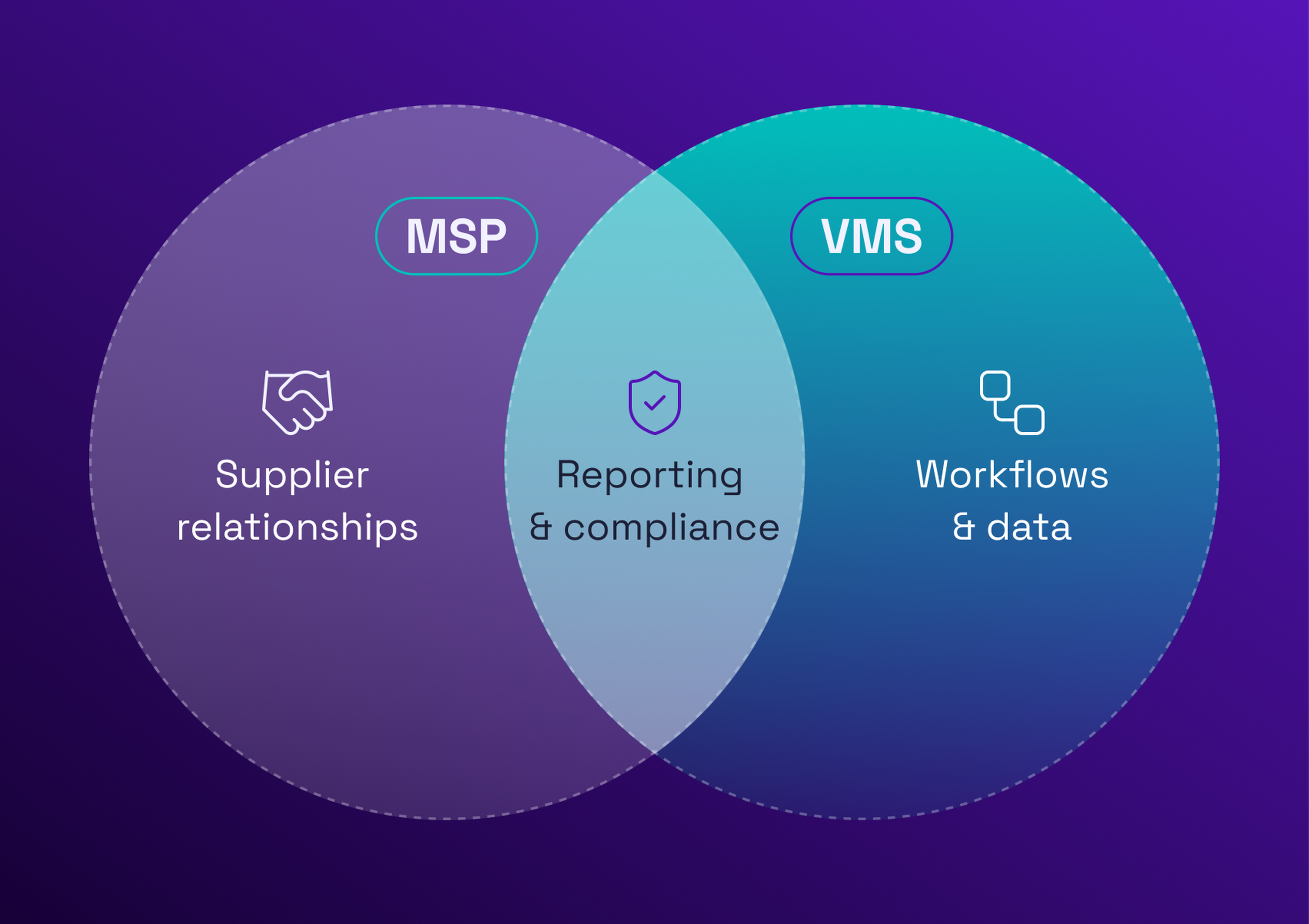
Staff augmentation vs managed services is usually framed as an IT decision, but it's really a procurement one: what you buy, who directs the work, and who's accountable when something goes wrong. This guide is for procurement leads, category managers and department heads comparing the two before an RFP or a contract renewal, and most enterprises end up running both, not choosing one permanently. The right call for a given piece of work depends on how clear the scope is, how much in-house capacity you have to direct it, how much risk you're willing to hold, and how you plan to measure whether it worked.
Staff augmentation vs managed services: the short answer
Staff augmentation adds external specialists to your team, under your direction, for a defined period. Managed services hands responsibility for a function or outcome to a provider who delivers it using their own people, tools and methods against agreed service levels. The core trade-off: with staff augmentation you keep control and the management responsibility that comes with it; with managed services you transfer both, and buy an outcome instead.
| Staff augmentation | Managed services | |
|---|---|---|
Who manages the work | You | The provider |
What you buy | Capacity (people, time) | An outcome |
Pricing basis | Day rate, time and materials | Fixed fee, per-ticket, or outcome-based |
Where accountability sits | With you | With the provider |
Best-fit duration | Weeks to around 12 months | 12 months or longer |
What is staff augmentation?
Staff augmentation embeds external professionals into your existing team, under your direction, to close a capacity or skills gap. It's typically bought on a time-and-materials or day-rate basis, priced per resource, and the defining trait is that you assign the work and manage the day-to-day: the provider sources and employs the specialist, but you direct what they actually do.
It fits well when the need is a specific missing skill, a temporary surge in workload, or niche engineering expertise that doesn't justify a permanent hire. A manufacturer bringing in two contract systems engineers for a nine-month product program is a typical case: a defined technical gap, a bounded timeframe, and work that needs to stay under the manufacturer's own direction because it touches proprietary systems.
Typical triggers for staff augmentation:
a skills gap on an existing team that a permanent hire wouldn't justify
a delivery deadline at risk without extra capacity
a niche or short-lived technical need
wanting to keep IP and methodology in-house rather than handing it to a provider
What are managed services?
Managed services means outsourcing responsibility for a function or an outcome to a provider who runs it with their own people, tooling and delivery model, against agreed service levels. Pricing is usually a fixed monthly fee, per-ticket, or tied to outcomes rather than hours, and accountability sits with the provider: if the service level isn't met, that's their problem to fix, not yours to manage.
It fits a stable, well-defined function more than a fluid one: application support, a helpdesk, managed testing, facilities engineering. Continuing the earlier example, the same manufacturer might hand its entire CAD support desk to a managed provider: a well-understood, ongoing function with clear service levels, where day-to-day direction from the manufacturer's own team adds little value.
Typical triggers for managed services:
a stable function that doesn't need to evolve week to week
wanting a predictable, outcome-based cost rather than variable headcount
lacking the in-house expertise to run the function well
being comfortable trading day-to-day control for a single accountable partner
Key differences between staff augmentation and managed services
| Staff augmentation | Managed services | |
|---|---|---|
Who directs the work | You | The provider |
What you're buying | Effort and capacity | An outcome |
Pricing model | Day rate, time and materials | Fixed fee or outcome-based |
Accountability for results | Yours | The provider's |
Scalability speed | Fast, add or remove people | Slower, tied to the service agreement |
Integration with your team | High, works inside your processes | Low, provider runs its own |
Knowledge retention at exit | Stays with your team | Leaves with the provider unless captured |
Management overhead on your side | Higher | Lower |
Contract vehicle | Time-and-materials or staffing agreement | SOW or SLA-based contract |
Typical engagement length | Weeks to ~12 months | 12 months or longer |
Three of these rows are the ones buyers consistently underestimate:
Management burden is the first: staff augmentation looks cheaper on the rate card, but someone on your side has to direct, review and integrate the work, and that time rarely gets costed into the comparison.
Outcome accountability is the second: a managed service's fixed fee only looks predictable until you check what's actually covered by the SLA versus what counts as a billable change, since providers price the guarantee, not unlimited scope.
Knowledge transfer at exit is the third and the most commonly missed: augmented staff leave knowledge with your team by default, while a managed service takes its operational knowledge with it unless you've built in a structured handover, which needs to be negotiated up front, not discovered at contract end.
Cost comparison, and the hidden costs of each model
The visible cost is straightforward to compare: a day rate against a fixed fee. The hidden costs are where the real total-cost-of-ownership gap usually sits.
Staff augmentation hidden costs:
| Cost | What drives it |
|---|---|
Management time | Directing, reviewing and integrating the work is your team's time, not a line item on the invoice |
Ramp-up lag | A new contractor takes time to become fully productive, during which you're paying full rate for partial output |
Subcontracting margin stack | Each layer of subcontracting between you and the person actually doing the work adds its own margin, inflating the effective day rate without adding value, and it's invisible on the invoice unless you can see past the prime contractor to who's underneath |
Replacement cost on attrition | Losing a contractor mid-engagement means re-sourcing and re-ramping, often at a worse rate |
Tooling, licences, workspace | Often absorbed into your own budget rather than the contractor's rate |
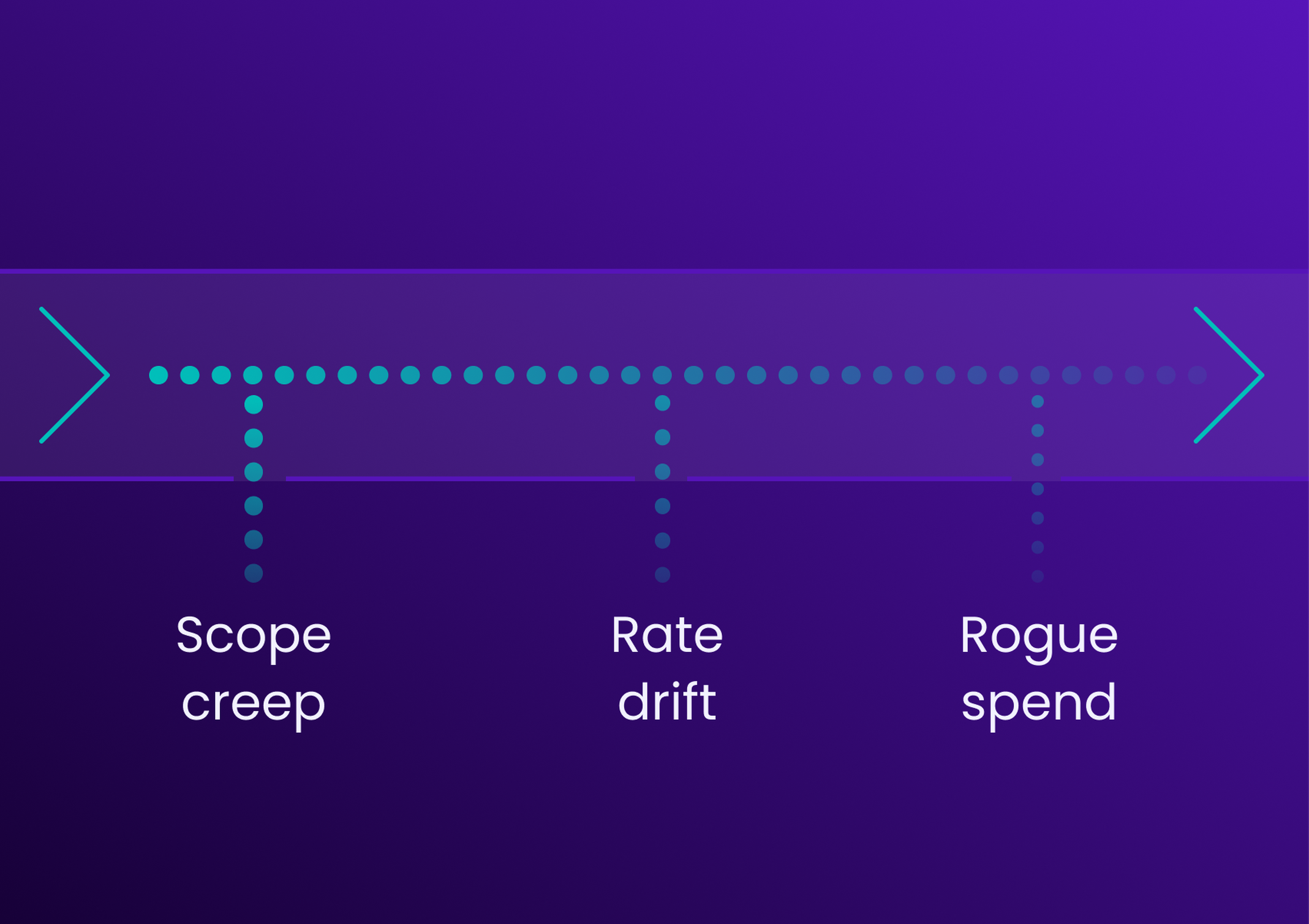
Rate creep on extensions | Renewals negotiated individually, without a rate card, tend to drift upward over time |
Managed services hidden costs:
| Cost | What drives it |
|---|---|
Transition and knowledge-transfer cost | Standing up a new managed provider, or exiting one, is rarely free |
Scope-change fees | Anything outside the original SOW gets billed separately, often at a premium |
Over-provisioning in the fixed fee | Providers price in a margin for demand spikes you may not actually hit |
SLA disputes | Time spent proving a service level was or wasn't met is a real, if indirect, cost |
Lock-in and exit cost | Switching providers on a mature managed function is harder and slower than swapping a contractor |
Reduced flexibility | A fixed SLA doesn't flex quickly when your actual need changes mid-contract |
The pattern across both tables is the same: the cheaper headline rate often isn't the cheaper program, and the only way to know is to track actual consumption and outcomes against the total cost, not the rate card alone. Calculating the ROI of centralising this spend is where that comparison actually gets made with real numbers instead of directional estimates.
Risk, compliance, and co-employment exposure
This is where most comparisons stop short, and it's a real gap: worker classification and provider dependency both carry consequences that a rate comparison never surfaces.
Co-employment and worker misclassification. A long-tenured, closely-directed staff-augmentation contractor can start to look like an employee to a regulator or a court, particularly where fixed hours, close supervision and integration into internal reporting lines make the working relationship indistinguishable from employment. This is why enterprises set tenure limits on contractor assignments and actually enforce them, rather than treating the cap as a formality. Rules vary meaningfully by jurisdiction: the European Labour Authority's research on misclassification documents how enforcement has intensified across EU member states, and this is general information, not legal advice, so classification decisions should involve qualified counsel familiar with the relevant jurisdiction.
Data, IP and security. The two models split this differently. With staff augmentation, augmented staff sit inside your own environment and systems, so your access controls and IP assignment clauses carry the weight. With managed services, the provider controls its own environment, which shifts some of that burden to their security posture and your due diligence on it, not yours to manage directly.
Business-continuity risk. Staff augmentation carries key-person dependency: if a critical contractor leaves mid-project, that knowledge leaves with them unless it was captured. Managed services carries provider dependency and lock-in instead: the risk shifts from one person to one relationship.
How procurement mitigates each. Tenure tracking and classification tests for staff augmentation; standardised clauses and provider audits for managed services; and centralised visibility across every engagement, regardless of model, so nobody's relying on memory to know who's active, under what terms, and for how much longer.
Governing the engagement: KPIs, SLAs, and tracking for each model
The two models need genuinely different measurement, not the same scorecard applied twice.
Staff augmentation is measured on input and progress: utilisation, timesheet accuracy, milestone burn-down, skills validation, and manager satisfaction with the day-to-day work. Review cadence is typically weekly or bi-weekly, since the whole point is active direction. The contract lever that keeps this governed is a rate card plus a tenure cap, enforced consistently rather than negotiated fresh each time.
Managed services is measured on outcomes and service levels: SLA attainment, resolution times, quality or defect rates, customer satisfaction, and cost-per-unit. Review cadence is typically monthly, with a proper quarterly business review, since the point is outcome accountability rather than daily oversight. The contract lever here is SLA credits paired with a continuous-improvement clause, so the provider has a reason to keep getting better rather than just meeting the floor.
Both models need the same underlying thing, though: a single source of truth for spend, headcount or tenure, deliverables and performance. Spreadsheets and email threads don't hold up once more than a handful of engagements run at once across both models simultaneously, which is exactly the gap a vendor management system is built to close.
The governance failure mode looks different for each model, which is worth naming explicitly. Staff-augmentation programs tend to fail quietly: tenure caps exist on paper but nobody tracks them against real dates, so a contractor drifts past the limit without a flag. Managed-services programs tend to fail loudly, at renewal, when the SLA data needed to negotiate from a position of evidence was never actually captured month to month, so the provider sets the terms of the conversation instead of procurement.
When staff augmentation is the right call
you can clearly define and direct the work yourself
your team has the management capacity to actually direct additional people
the need is a specific skill or temporary capacity, not a permanent function
retaining knowledge in-house matters for this piece of work
the likely duration is weeks to around 12 months
you want maximum flexibility to scale the team up or down quickly
A utility bringing in two contract protection engineers for a substation upgrade is a clean example: a defined technical scope, work that needs direct oversight because it touches critical infrastructure, and a natural end date once the upgrade is commissioned.
The common failure mode runs the other way: staff augmentation kept running past its natural end point, quietly becoming a permanent capacity gap filled by contractors instead of a deliberate hiring decision, because nobody revisited the original reason it started.
When managed services is the right call
the function is stable and well-defined, not something that changes week to week
you want to buy an outcome, not manage effort
you lack the in-house expertise to run the function well yourself
predictable cost matters more than day-to-day control
you're genuinely comfortable with less direct oversight
the engagement is realistically 12 months or longer
An aerospace firm outsourcing its facilities engineering helpdesk to a managed provider fits this well: a well-understood, ongoing function where a fixed SLA and a single accountable partner beat managing a rotating cast of contractors directly.
The risk runs the other way here too: a function moved to managed services too early, before it's actually stable enough to specify in an SLA, tends to produce disputes over what the fixed fee was ever supposed to cover.
Running both: a portfolio approach by spend category
The realistic enterprise answer is both, and the unit of decision is the category, not the company as a whole.
| Category | Recommended model | Why |
|---|---|---|
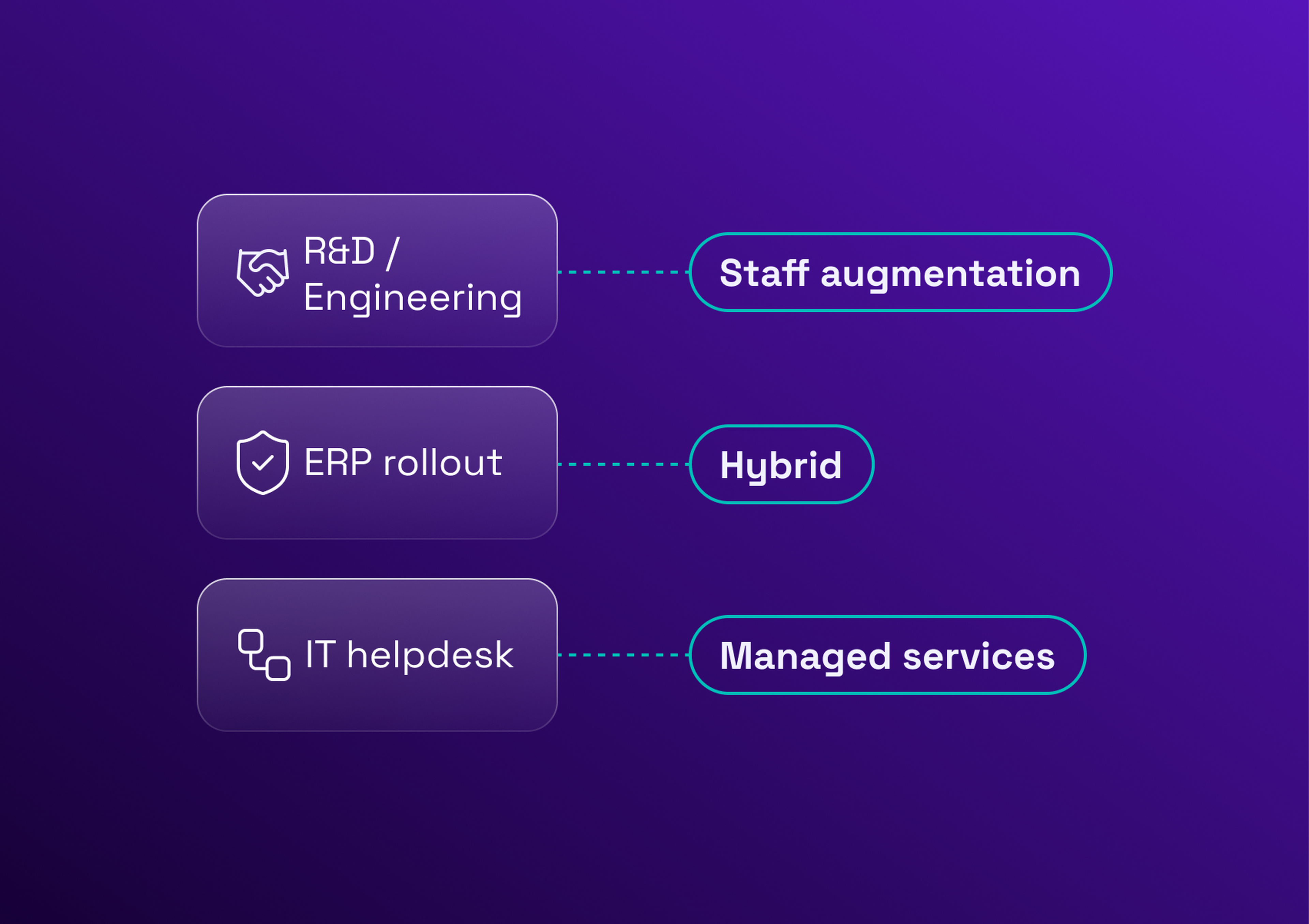
IT helpdesk | Managed services | Stable, measurable, commoditised: a fixed SLA fits |
Specialist R&D / systems engineering | Staff augmentation | Needs your direction, and the IP should stay in-house |
QA / testing | Managed or hybrid | Can be commoditised, but complex products may need direct oversight |
ERP rollout | Hybrid: managed core + augmented SMEs | A managed backbone with augmented subject-matter experts layered on top |
This mapping holds across sectors, not just IT: a telecom operator's field-services category often runs staff augmentation for specialist installation work while managing its call-centre support entirely through a managed provider. Running both is the right answer operationally, but it comes with a governance risk of its own: spend spread across dozens of suppliers, in two different pricing models, fragments visibility fast unless it's centralised somewhere. Without that, two things tend to happen at once: nobody can say what total external-workforce spend actually is across both models combined, and categories drift onto whichever model was used last time rather than the one that actually fits, simply because that's the path of least resistance for whoever's sourcing it.
How a vendor management system supports the decision, and both models
A VMS doesn't make the staff-augmentation-versus-managed-services decision for you, but it makes the decision measurable instead of a judgement call repeated from memory every time. Concretely, it gives you comparable rate and cost data across both models to decide on evidence, one place to run RFPs regardless of which model wins, standardised contracts with the clauses that actually matter (tenure caps, SLAs, IP assignment), automated tenure and compliance tracking, vendor scorecards for staff-aug and managed engagements sitting side by side, and real consumption tracked against budget so the true program cost is visible rather than reconstructed at renewal time.
That kind of centralisation matters more as external-workforce spend grows as a share of the business. Staffing Industry Analysts' 2025 buyer survey found that contingent and external workers already make up an average of 21% of organisations' workforce, with buyers expecting that to reach 26% within ten years, a mix that increasingly spans both staff-augmentation and outcome-based engagements rather than sitting entirely in one model.
Choosing and governing the right model
Staff augmentation and managed services solve different problems, and most enterprises need both, applied by category rather than chosen once for the whole business. The harder work is less in picking a model and more in governing whichever one you pick, with the same rigour, rate cards, tenure tracking, SLAs, applied consistently regardless of which model a given category uses. Assess your procurement maturity to see where the governance gaps sit today, or calculate the ROI of centralising both models in one system.
Book a meeting with one of our experts for a personalized demo.