An RFP for services is a formal document a company issues to invite suppliers to propose how they'd deliver a piece of external professional work, consulting, IT, engineering or staffing, along with their approach, team, timeline and price. Unlike an RFP for goods, where the specification is usually fixed and the comparison is mostly on price, an RFP for services has to define a scope that doesn't yet physically exist and compare proposals on judgment as much as on numbers: who's actually going to do the work, and how.
Written well, it forces the scoping decisions that prevent disputes later. Written poorly, or skipped entirely in favor of an informal ask to a known supplier, it's usually where scope creep and rate disputes trace back to.
RFP vs. RFI vs. RFQ: which do you need?
The three are often used interchangeably, and that's part of why services buyers default to whichever one they've used before rather than the one that actually fits.
| Document | Purpose | When to use it |
|---|---|---|
RFI (Request for Information) | Gather general information about potential suppliers and what's possible | Early stage, when you're still exploring the market or don't yet have a defined approach |
RFQ (Request for Quotation) | Get a price for a clearly specified, well-understood piece of work | When scope and requirements are already fixed and the main variable is price |
RFP (Request for Proposal) | Get a full proposal: approach, team, timeline and price for a scope that still has some open questions | When you know the outcome you need but the how, and who, is genuinely part of what you're evaluating |
For services procurement specifically, an RFP is usually the right instrument, because the "how" and "who" genuinely vary between suppliers in a way that a fixed RFQ specification can't capture. An RFI is worth running first only if you're not yet confident enough in the market to write a specific proposal request.
How to write an RFP for services: a 7-step framework
None of these steps is optional if you want proposals you can actually compare side by side. Skip one, and you'll find yourself either re-issuing the RFP or comparing proposals that answered different questions. The order matters too: the steps that feel most skippable under time pressure, the compliance section especially, tend to be exactly the ones missing from whatever generic template got reused to save time.
1. Introduce your company and the project
Every RFP opens with enough context for a supplier to write a relevant proposal, not a generic pitch. Cover four things:
company overview: a brief description of who you are and what you do
business context: the need behind the project
objectives: what success looks like at the end of the engagement, not just the task being outsourced
timing: why this work matters now
Suppliers who don't understand the "why" tend to propose the wrong "how", over-engineering a simple need or under-scoping a complex one. A thin, generic paragraph also signals a low-priority engagement, and the quality of responses tends to match that signal. Stating the objective rather than the task leaves room for a stronger supplier to propose a better approach than the one implied by a narrow task description.
2. Define the scope of work: day rate vs. fixed price
This is the single biggest source of ambiguity in a services RFP, and the decision has to be made before you write the scope section, not after proposals come in.
A day-rate scope buys capacity: you're asking for people, at a rate, directing the work yourself, and the deliverable is time well spent rather than a fixed output.
A fixed-price scope buys an outcome: the supplier commits to a defined deliverable for a set price, and carries the risk if it takes longer than expected. Each demands different information from suppliers. A day-rate RFP needs to specify seniority levels, expected volume of work and duration. A fixed-price RFP needs to specify deliverables, acceptance criteria and milestones in enough detail that "done" isn't a matter of opinion later.
Comparing day rate against fixed price properly, on who carries delivery risk and how well-defined the scope actually is, is worth doing before the RFP goes out, not worked out mid-negotiation with whichever supplier responds first. Where scope is genuinely fixed and measurable, a formal statement of work structure gives the comparison a much firmer footing than an open-ended day-rate ask. Mixing the two within a single RFP is a common failure mode worth naming directly: asking for a day-rate team while describing the work as a fixed deliverable produces proposals that quietly hedge on both fronts, padding the rate to cover risk they were never explicitly asked to price. If the honest answer is that the work has a fixed core and an uncertain extension, price them as two separate asks rather than blending them into one ambiguous scope.
3. Set your budget and selection criteria
A budget range, even an approximate one, changes what suppliers propose. Without it, bids span a wide range, from lean approaches to enterprise-scale ones, and none of them are comparable. Stating a range, or at minimum a ceiling:
filters out proposals that were never going to fit
sharpens the ones that come back
makes bids comparable, because every supplier scopes against the same assumption about what the engagement is worth
Some buyers hold the budget back, on the theory that stating it invites suppliers to price up to the ceiling. In services procurement, that risk is usually outweighed by the alternative: proposals built on wildly different assumptions can't be fairly compared, however the scorecard is weighted.
Selection criteria need the same clarity. State them in the RFP itself, rather than deciding them informally after proposals arrive. At minimum, include:
price or rate competitiveness
proposed team quality and relevant experience
methodology and approach
references from comparable engagements
proposed timeline
Weighting these upfront, even roughly, is what makes the eventual comparison defensible rather than a gut call dressed up as a process.
4. Specify submission requirements and timeline
Suppliers need to know exactly what to submit and by when. Specify:
the proposal format, including page or word limits and required sections
how questions are submitted and answered before the deadline
the submission deadline, with a specific time and timezone, not just a date
A realistic timeline matters as much as a realistic scope. Services suppliers, especially smaller specialist firms, often can't turn around a serious proposal, with real team commitments and honest pricing, in under a week or two. Compressing that window doesn't get you a faster process, it gets you shallower proposals from suppliers who had the least else going on.
Building in a short question-and-answer window before the deadline, rather than leaving ambiguities for suppliers to guess at, improves every response that comes back, including from suppliers who never asked a question.
5. Call out compliance and risk requirements specific to services
This is where services RFPs differ most from goods RFPs, and where most generic RFP guides say nothing at all, because the risks don't exist in the same way for a physical purchase.
Confidentiality and NDA terms. Suppliers evaluating the opportunity, and later working inside it, need a clear confidentiality obligation, ideally signed before detailed scope discussion begins.
IP ownership of deliverables. State explicitly who owns the work product. Without an explicit clause, ownership can default to the supplier or the individual contractor rather than to you, depending on jurisdiction.
Contractor security clearance or background checks. If the work touches sensitive systems or data, state the screening requirement in the RFP itself, not as a surprise during onboarding after the supplier's already been selected.
Data access and handling. Specify what systems or data the engagement will require access to, and what data-protection obligations apply to that access.
Insurance requirements. Professional indemnity or liability insurance, sized to the engagement's actual risk, should be a stated requirement, not an afterthought raised at contract signature.
Subcontracting disclosure. Require suppliers to disclose whether any part of the work will be subcontracted, and to whom, before you're relying on a team you never actually vetted.
6. Distribute the RFP and manage supplier responses
How the RFP goes out shapes how comparable the responses come back. Sent manually, by email, to a handful of suppliers, with responses arriving as separate documents in separate formats on different days, comparison happens by manually rebuilding a spreadsheet from each one, and it's easy for a strong proposal to lose to a better-formatted one simply because it was easier to read at 6pm on the deadline day.
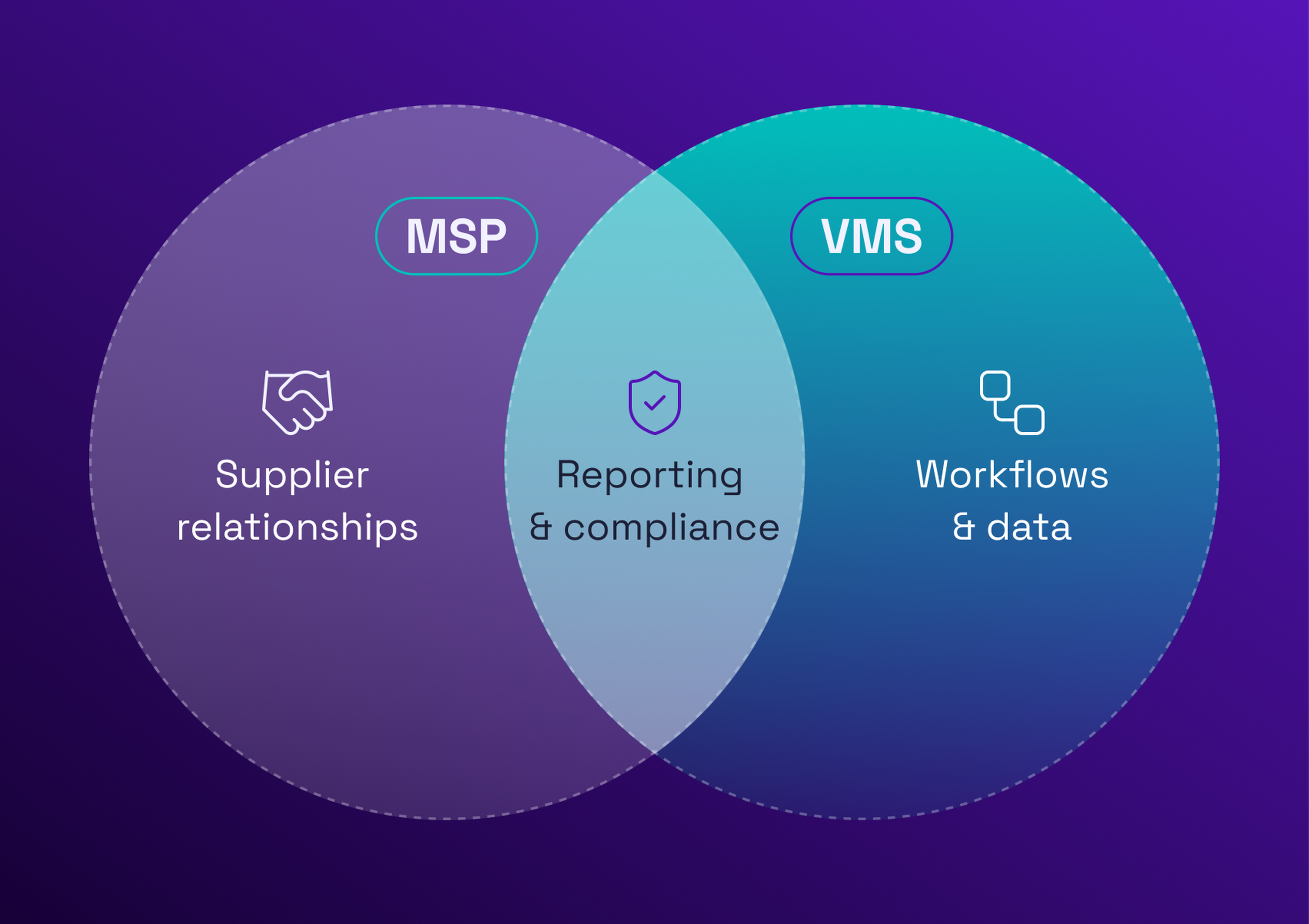
Distributing centrally, through a platform rather than individual emails, keeps every supplier working from the identical brief and deadline, and collects responses in a comparable format from the start. A vendor management system is one way to do this at scale: the RFP goes to a defined supplier panel simultaneously, responses come back structured against the same fields, and reviewers see them side by side rather than reconstructing that view from a stack of PDFs. That matters more the more suppliers you're inviting: comparing three proposals by hand is manageable, comparing twelve rarely stays fair without some structure behind it. The gap tends to widen with scale rather than shrink: a program running a handful of services RFPs a year can survive on email and a shared drive, but one running dozens across several category managers usually finds the informal approach has already split into several incompatible versions, each with its own template and its own idea of what a complete response looks like.
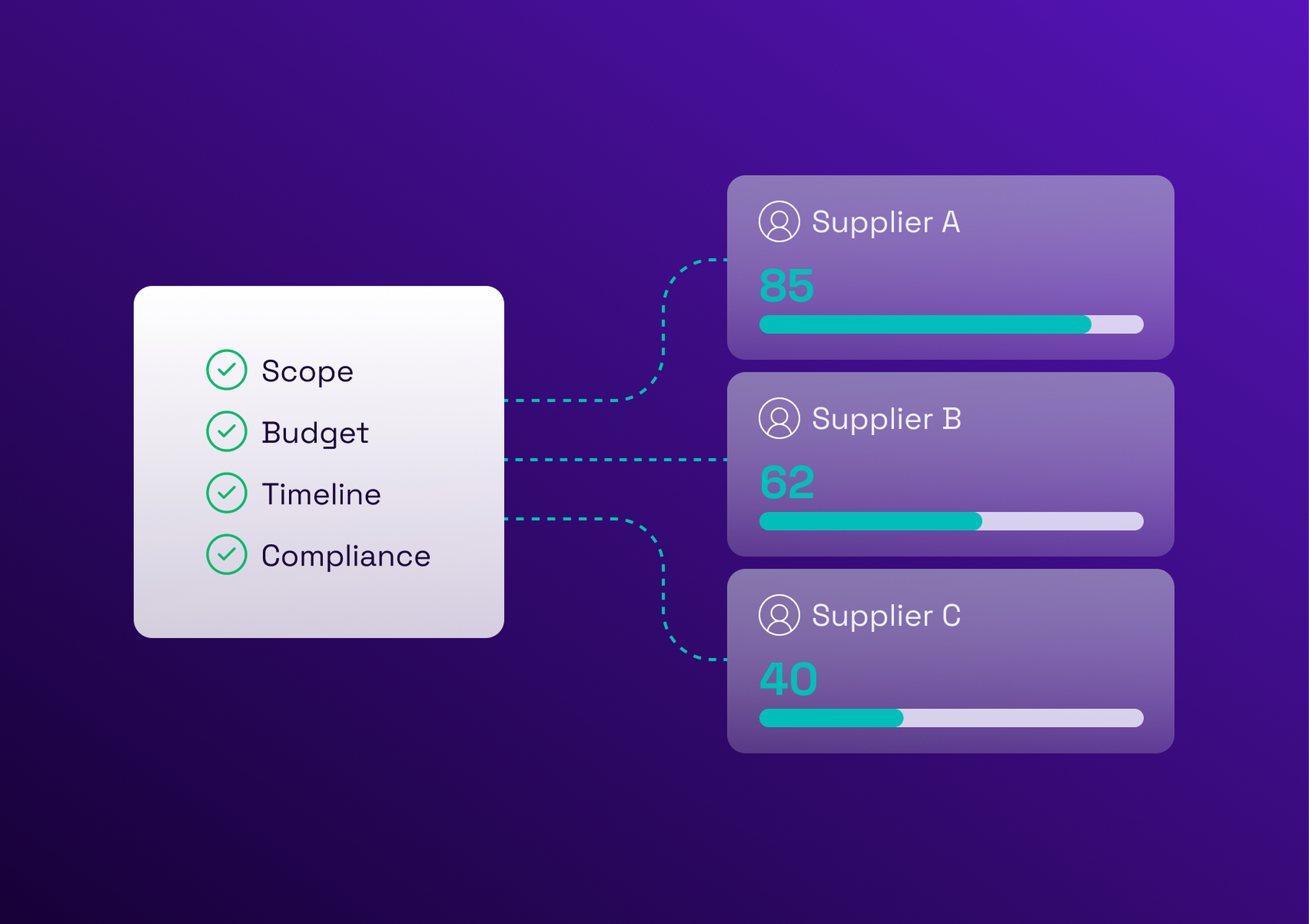
7. Evaluate proposals with a weighted scorecard
A scorecard turns "which proposal did I like best" into a decision you can actually defend, especially useful when more than one stakeholder is weighing in and their instincts don't agree.
| Criterion | What to look for | Suggested weight |
|---|---|---|
Price or day rate | Competitiveness against budget and market rate, not just the lowest number | 25% |
Proposed team quality | Seniority, relevant experience, and whether the named individuals, not just the firm's brand, fit the work | 25% |
Methodology and approach | Whether the proposed approach actually fits the problem, not a generic template response | 20% |
References | Verifiable outcomes from comparable engagements, checked, not just listed | 15% |
Timeline | Realistic against the stated deadline, without corners visibly cut to make a number work | 15% |
Weights should shift with what actually matters for the engagement: a highly specialized technical build might weight methodology and team quality higher, while a well-understood, repeatable engagement might weight price higher. What matters is deciding the weights before proposals arrive, not adjusting them afterward to fit a preferred outcome. Involving more than one reviewer, each scoring independently before comparing notes, surfaces disagreement early rather than letting one stakeholder's first impression quietly set the outcome for everyone else. A sharp gap between two reviewers' scores on the same proposal is usually more informative than either number alone, often pointing to a criterion the RFP itself left ambiguous.
Common mistakes when writing an RFP for services
Vague scope that invites scope creep later. A scope written loosely enough for every supplier to interpret it differently isn't flexible, it's a dispute waiting to happen once work starts and expectations diverge.
No day-rate vs. fixed-price clarity. Leaving the pricing model ambiguous produces proposals that can't be compared on the same basis, because they were never answering the same question.
Missing evaluation weighting. Deciding how proposals will be scored after they've already been read invites the weighting to bend toward whichever proposal already feels like the favorite.
Unrealistic timelines. A submission window too short for a serious response filters for whoever had the least else going on, not whoever's the best fit.
No compliance or risk section. Skipping IP, confidentiality and security requirements at the RFP stage means negotiating them from a weaker position later, after a supplier's already been selected and has less reason to concede.
Treating every supplier response as a one-off document. Without a consistent format or a shared point of comparison, evaluating five or ten proposals against each other turns into rebuilding a spreadsheet from scratch instead of actually comparing what was proposed.
How a VMS simplifies RFP management for services procurement
An RFP for services generates a lot of coordination work. Distributing to multiple suppliers, chasing responses, and reconciling formats that were never designed to sit side by side all take time that could go into evaluating the proposals themselves.
A vendor management system addresses that coordination layer specifically, without replacing the judgment calls in scoping or evaluation. In practice, it gives you:
A defined supplier pool. The RFP goes out to suppliers already on your approved vendor list or in your preferred vendor program, rather than whoever is on this month's contact list.
Automated distribution and deadline tracking, instead of chasing responses by email.
Side-by-side comparison against the scorecard criteria, instead of manually rebuilding a spreadsheet from separate documents.
A complete audit trail of who was invited, what was submitted and how the decision was reached, useful well beyond the RFP itself if the selection is ever questioned.
Getting from scope to a comparable set of proposals
Writing a strong services RFP comes down to the same handful of decisions covered above: define the scope and the pricing model deliberately, state your evaluation criteria before proposals arrive, don't skip the compliance section because the work is intellectual rather than physical, and distribute in a way that keeps responses comparable rather than scattered across formats and inboxes. Centralizing your RFP process on one platform handles the last part structurally, so the comparison stays fair regardless of how many suppliers you invite.
Book a meeting with one of our experts for a personalized demo.