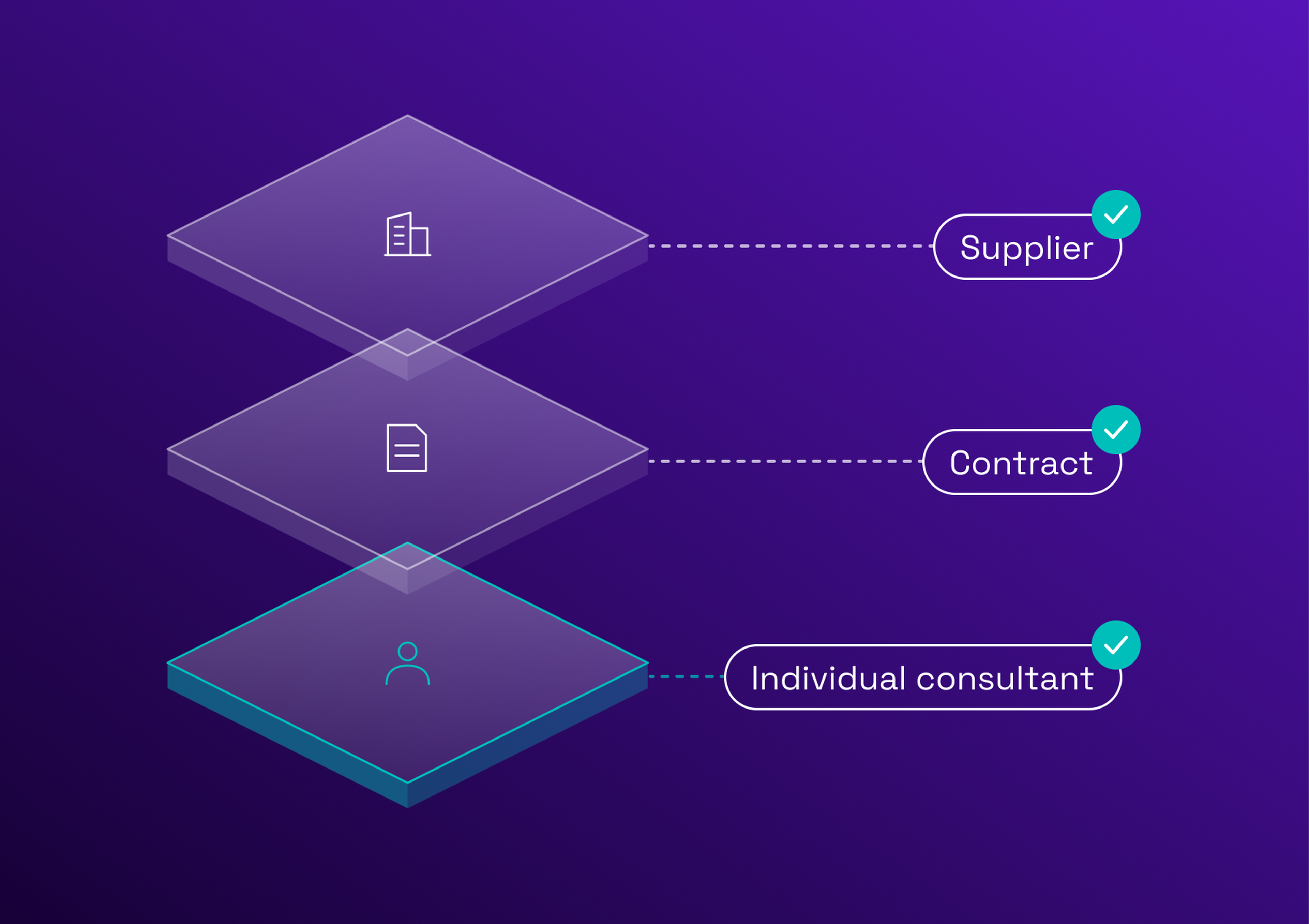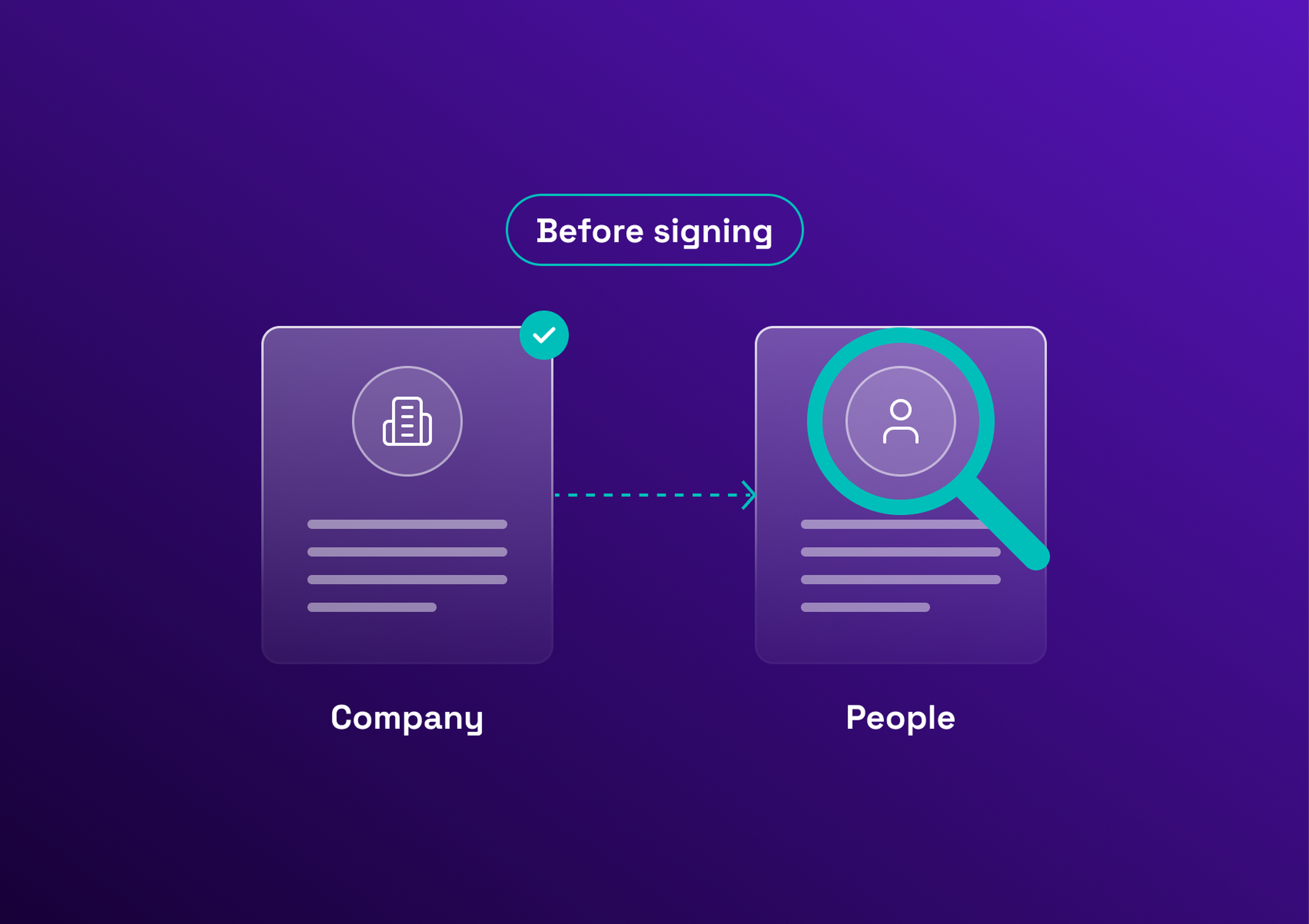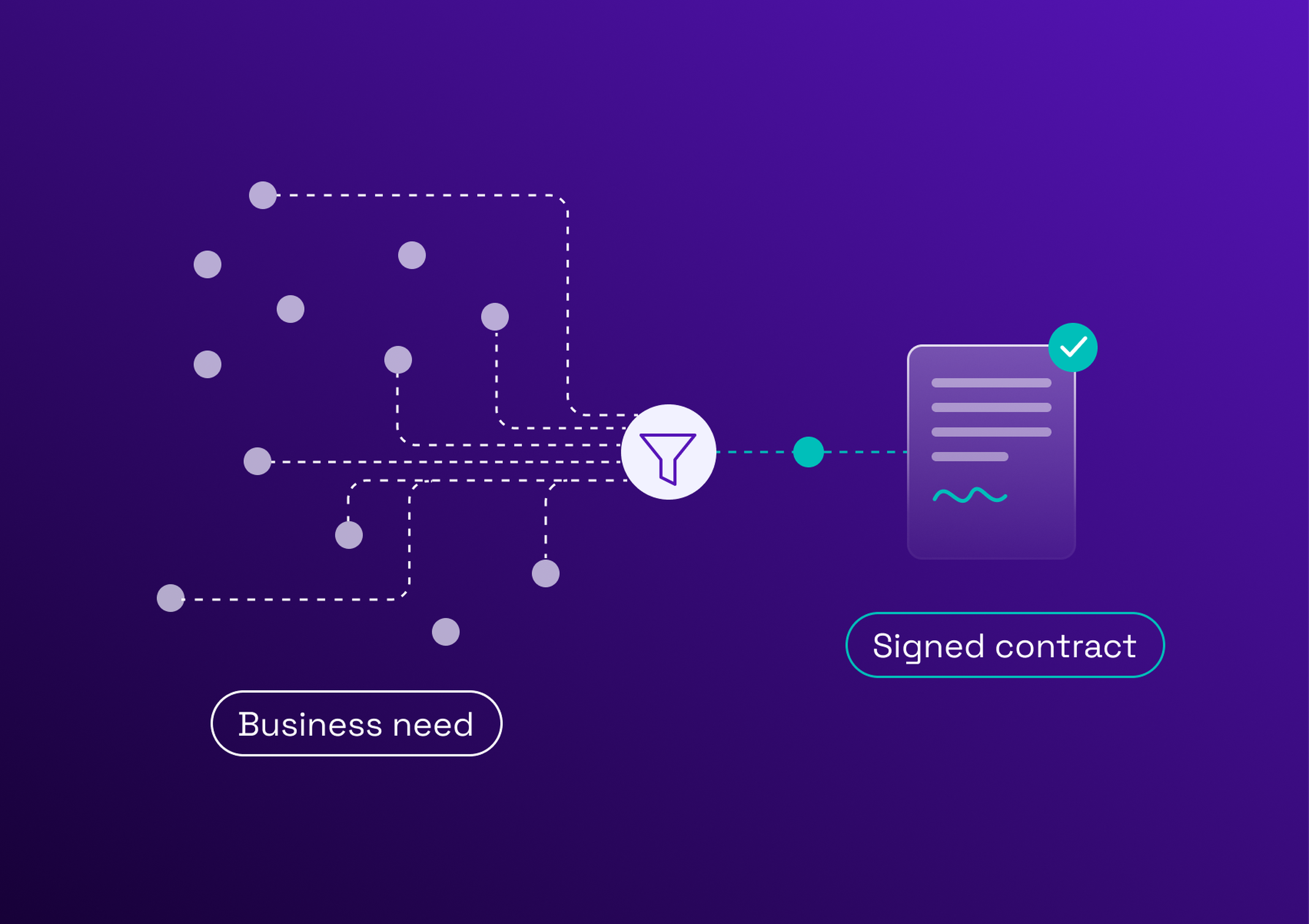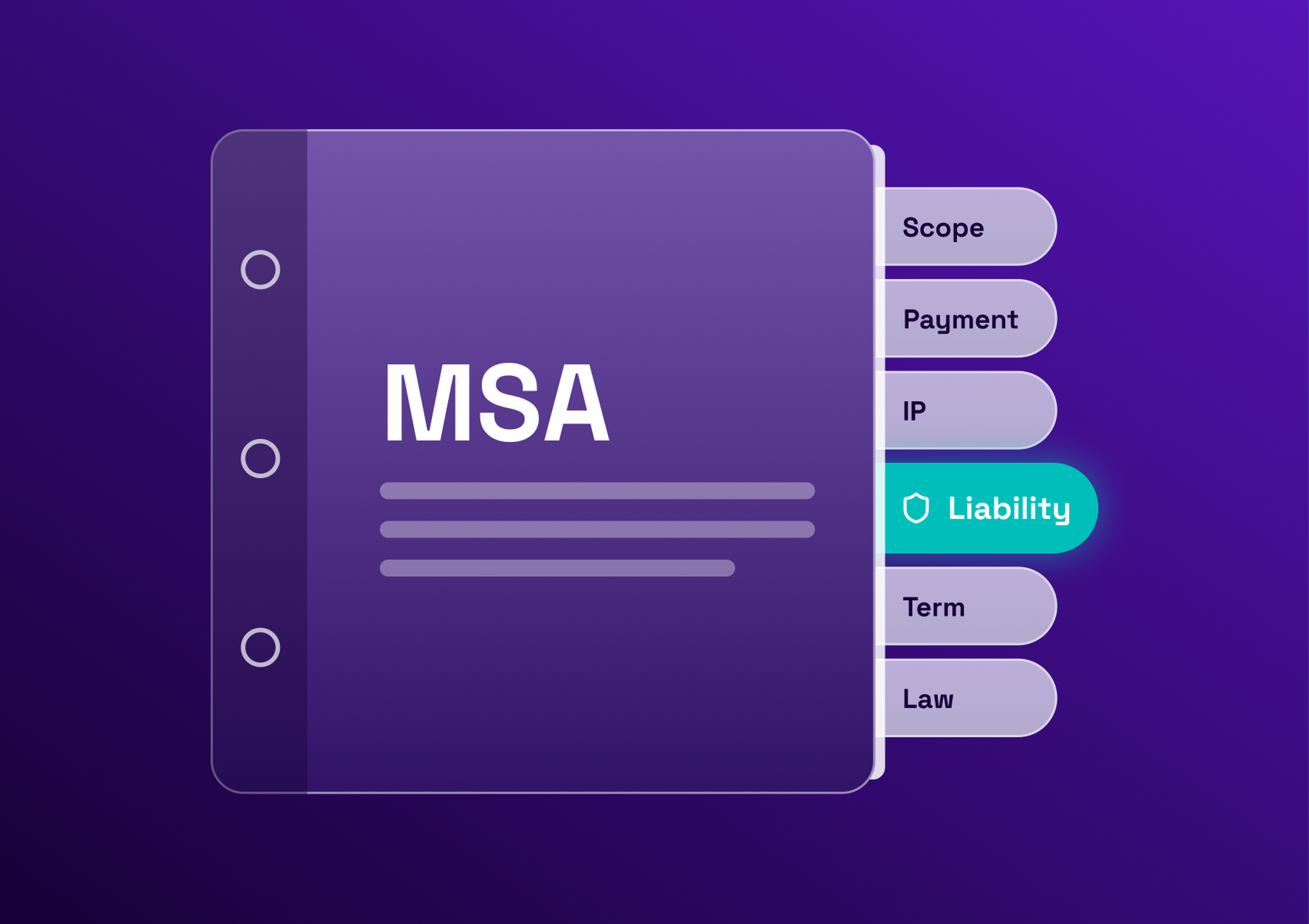
A master service agreement (MSA) is a framework contract that sets the standing terms for future work between a buyer and a supplier, such as liability, confidentiality, payment and data protection, while each project is defined in its own statement of work (SOW). It lets a company negotiate the legal terms once and order many times.
This guide is for procurement, legal-adjacent and operations teams that buy consulting, IT and engineering services. It covers how an MSA is structured, which clauses to negotiate, what changes across countries, and how to keep the contract enforced after signature.
How a master service agreement works
A master service agreement works in three layers, each with its own job:
The MSA holds the legal terms that apply to every engagement: liability, confidentiality, data protection, payment conditions and exit rights.
The SOW or work order describes one project: its scope, deliverables, timeline and price.
The purchase order releases the spend for that project and lets the supplier invoice.
The result is that legal teams review the core legal terms once, and business teams order work through short documents that inherit them. Some contracts are titled "master services agreement", with an s. It is the same document. In European practice, the same idea is called a framework agreement.
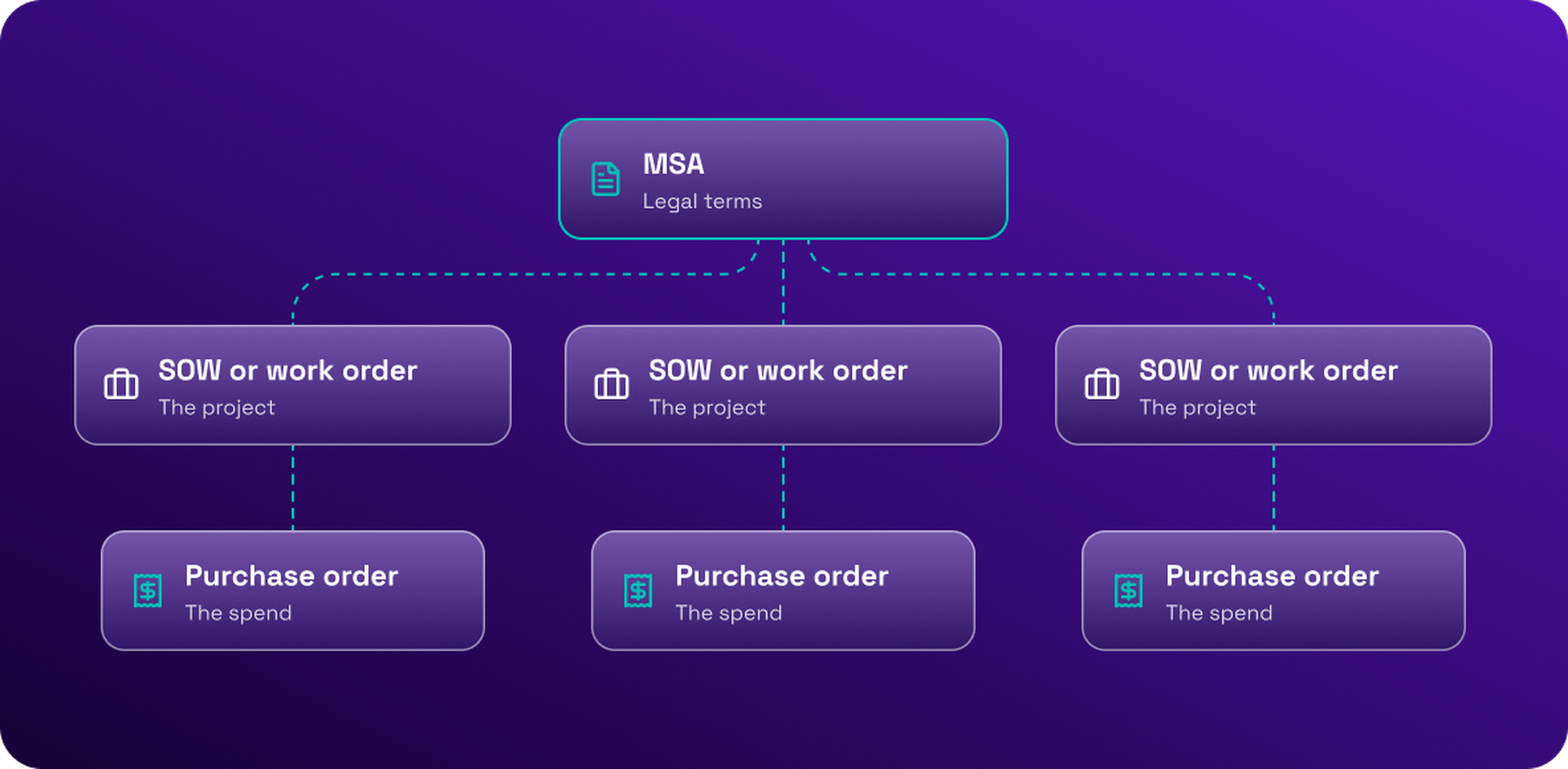
How an MSA and a SOW work together
The MSA says how the relationship works, and each SOW says what is bought this time. A SOW should never repeat the legal terms of the MSA, and an MSA should never describe a single project. The full comparison between the two documents is in the guide to MSA vs SOW.
Which document wins if they conflict?
Documents drift apart. A clause in a SOW can say something different from the MSA, and unless the contract says which one prevails, the dispute starts with a debate about hierarchy. The remedy is an order of precedence clause. It states which document wins on a conflict, and a common rule is that the MSA prevails, unless a SOW overrides a term by naming the exact clause it changes.
A worked example shows why this matters. The MSA caps each party's total liability at the fees paid in the previous twelve months, say 1,200,000 euros. A SOW for a 300,000 euro project states a cap of 100,000 euros for that project.
With a clause that says the MSA prevails, the SOW wording is ignored on that point, and the 1,200,000 euro cap applies.
With a clause that lets a SOW prevail only if it names the MSA clause it changes, the 100,000 euro cap applies to that project, provided the SOW names the MSA liability clause it changes.
With no clause at all, each side argues for the cap that suits it.
When do you need an MSA?
An MSA pays off when the same buyer orders from the same supplier more than once. The usual triggers are:
repeat suppliers, where every order would otherwise reopen the legal terms
several business units buying from the same supplier
multi-country work, where several legal entities order under one set of terms
approved supplier panels, where every supplier signs the same core terms
mixed day-rate and fixed-price work, where the MSA carries what both share
Knowing when to use a master service agreement also means knowing when not to. For a single, low-value engagement with a supplier you do not expect to use again, a one-off services agreement is enough: an MSA would add negotiation time without adding control.
What to include in a master service agreement
The key components of an MSA are the same in most contracts, and the work for a buyer is to check each one against how services are actually bought. The table lists twelve MSA clauses, what each settles, and what to check.
| Clause | What it settles | What buyers should check |
|---|---|---|
Scope | The services covered and how they are ordered | That the ordering route is stated, and that no work starts without an SOW or order |
Payment | Invoicing, payment terms and disputed amounts | Payment tied to an approved order, and a procedure for disputed invoices |
Intellectual property | Who owns what the supplier creates | Ownership of deliverables, and how the supplier's pre-existing tools are treated |
Confidentiality | Protection of the information shared | Coverage of the supplier's staff and subcontractors, and the period after the contract ends |
Warranties | What the supplier promises about the work | The standard of performance, and the remedy for work that falls short |
Liability | The limit on what each party can owe | The size of the cap against the value at risk, and what the cap excludes |
Indemnification | Who covers claims from third parties | Which claims are covered, such as IP, data and worker status, and who controls the defense |
Insurance | The cover the supplier must hold | The types and minimum amounts, with proof renewed each year |
Term and termination | The duration and the exit rights | Notice periods, auto-renewal, and what happens to live SOWs |
Governing law | The law that applies to the contract | A deliberate choice, especially across borders |
Dispute resolution | How conflicts are handled | An escalation path before litigation, then the venue |
Amendments | How the contract can change | Written changes only, and whether they apply to SOWs already signed |
Clauses that matter most when buying external services
Generic MSA clauses are written for any supplier. An MSA for consulting services needs four more, because the supplier sends people into your organization.
Rate cards. The MSA should attach the rates by profile, set how they can be revised and name who can approve an exception. Without that last point, every exception becomes a negotiation by email.
Substitution and subcontracting. The contract should say who can replace a consultant and with whose approval, how fast a replacement must arrive, and whether the supplier can subcontract at all. Where subcontracting is allowed, the same terms should flow down to the subcontractor, and the buyer should be able to see the chain.
Data and AI. A master service agreement for IT services that touches personal data needs a data processing agreement. Article 28 of the GDPR requires processing by a processor to rest on a binding contract, and sub-processors need authorization. AI tools raise a similar question: where one processes personal data, its provider is typically a sub-processor. The MSA should say whether the supplier may use AI tools on your data, require disclosure of the tools used, and forbid using your data to train external models.
Worker status safeguards. The terms should keep contractors clearly separate from your employees: the supplier directs and supervises its own staff, pays them and supplies their equipment, and the client does not set their hours or evaluate their performance as it would for employees.
How MSAs change across countries
The idea of a framework agreement is universal, but the risks it must cover are not. In France it is a contrat-cadre, in Germany a Rahmenvertrag, and in the UK and the US it is usually still called an MSA. The table gives a starting point for each of the four countries. It is general information, and legal counsel must confirm it for each country.
| Country | Local term | Main risk to cover | What to add |
|---|---|---|---|
UK | Framework agreement or MSA | The IR35 off-payroll rules: medium and large clients must determine the status of a contractor who works through an intermediary | A clause on status determination, with the supplier's duty to provide the information on any intermediary |
France | Contrat-cadre | Illegal labour supply: prêt de main-d'œuvre illicite and marchandage | A statement that the supplier directs its own staff, and that it brings real expertise, not only people |
Germany | Rahmenvertrag | Disguised temporary agency work under the AÜG | A work or service contract with delivery controlled by the supplier. If staff leasing is intended, it must be named as such in the contract, with the person identified, and the 18-month limit tracked |
US | MSA | Misclassification and joint employment | The supplier as employer of record, no client control over how the work is done, and an indemnity for worker status claims |
The official texts are the GOV.UK guidance on IR35, the French Code du travail on illicit labour lending and marchandage, and section 1 of the German AÜG, which requires a staff leasing contract to name itself as such, requires the person to be identified and limits leasing, in principle, to 18 consecutive months per worker and client.
Term, renewal and what happens to live SOWs
Do master service agreements expire? Yes. An MSA has either a fixed term, often with a renewal rule, or an open-ended term that ends only by notice. Both cause the same practical problem: engagements outlive the contract that governs them.
Three points avoid that problem:
Auto-renewal. A silent renewal is a standing commitment that nobody tracks. The MSA should require a written decision, or at least a notice period long enough to act.
Survival clauses. The MSA should say which terms survive its end, such as confidentiality, liability and payment, so that a live SOW still has rules to follow.
Live SOWs. The contract should say whether a SOW in progress continues until completion on the MSA terms, or ends with the MSA. Without that sentence, the end of an MSA becomes a dispute about every project in flight.
How to keep your MSA enforced after signing
A signed MSA is only as strong as the controls that apply it every day. Contract compliance and supplier governance come down to linking each term to a control someone actually runs.
| MSA term | Everyday control |
|---|---|
Ordering process | Block work that starts without an approved order |
Rate card | Check SOW rates and timesheets against the agreed rates |
Insurance and compliance | Track document expiry dates |
Term | Set renewal alerts, with a named owner |
Liability and SLAs | Review supplier performance at a set rhythm |
A vendor management system holds the missions, the timesheets and the supplier documents in one place, which makes these controls easier to run than from spreadsheets and emails.
Common MSA mistakes to avoid
Copying the legal terms into every SOW, so the MSA and the SOWs drift apart.
Having no order of precedence clause, so each conflict becomes a debate.
Leaving rate cards to go stale, so rates drift upward between renewals.
An MSA signed by one entity but used by others, which leaves the other entities without a clear contract.
Having no owner after signature, so nobody tracks renewals, documents or spend.
Managing master service agreements in one place
A clear MSA removes most of the legal risk at signature, and a platform keeps it applied when orders, suppliers and entities multiply. See how Eleven VMS brings missions, supplier documents and framework agreements into one platform. This guide is general information, not legal advice.
Book a meeting with one of our experts for a personalized demo.