A master service agreement (MSA) is a contract that sets the general terms governing all the services a supplier provides to a company over time, such as liability, payment, confidentiality and data protection. Each engagement is then ordered through a statement of work (SOW) or a work order that refers back to it.
This guide is for procurement teams that buy professional services: consulting, IT and engineering. It covers the clauses to negotiate, the difference between an MSA and a SOW, a 15-point checklist, and how to manage an MSA after signature, which is where most of the value is won or lost. An MSA contract is not a document you sign and file. For a team that buys the same services again and again, it is the framework every order runs on, as described in the guide to services procurement.
What is a master service agreement?
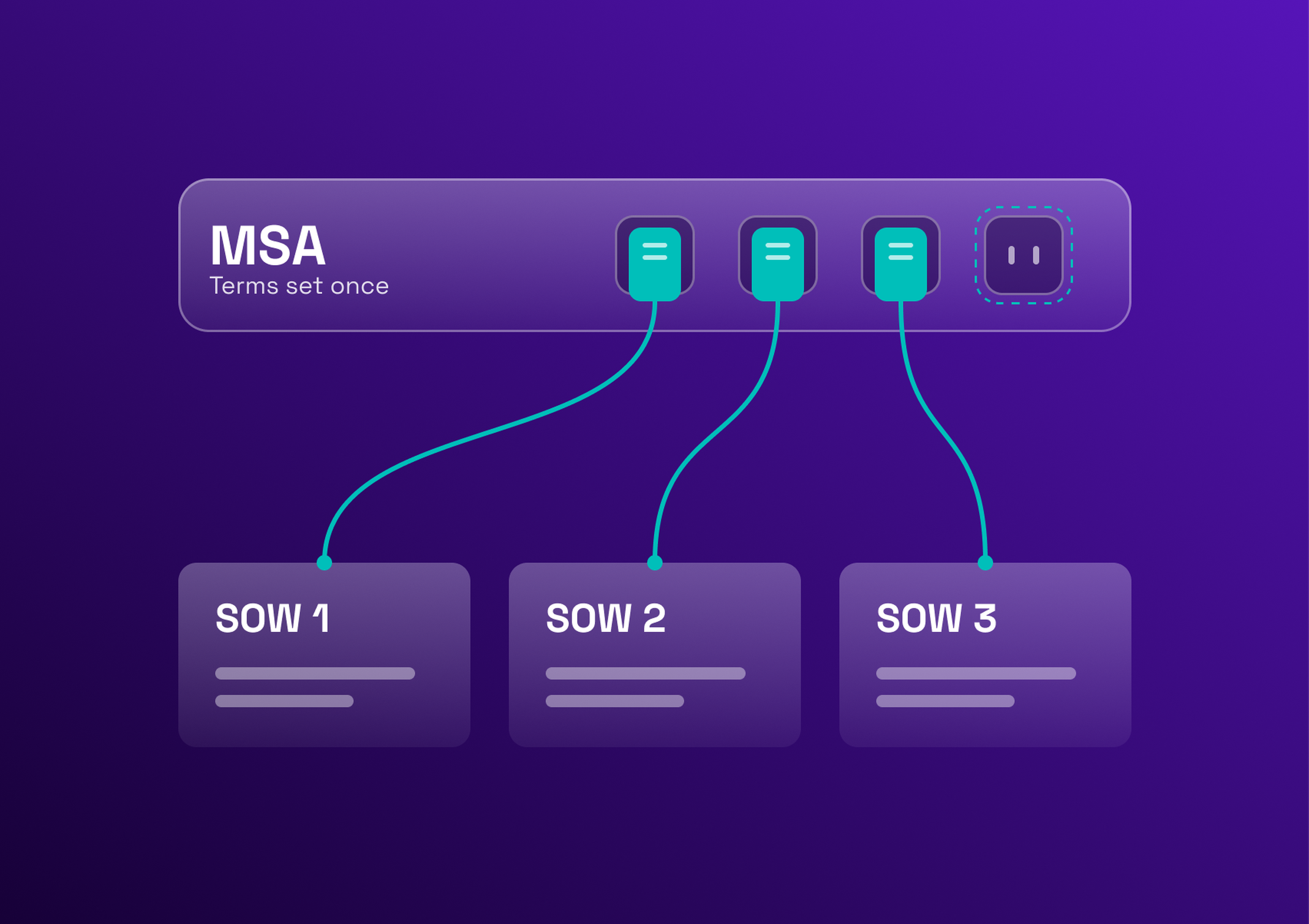
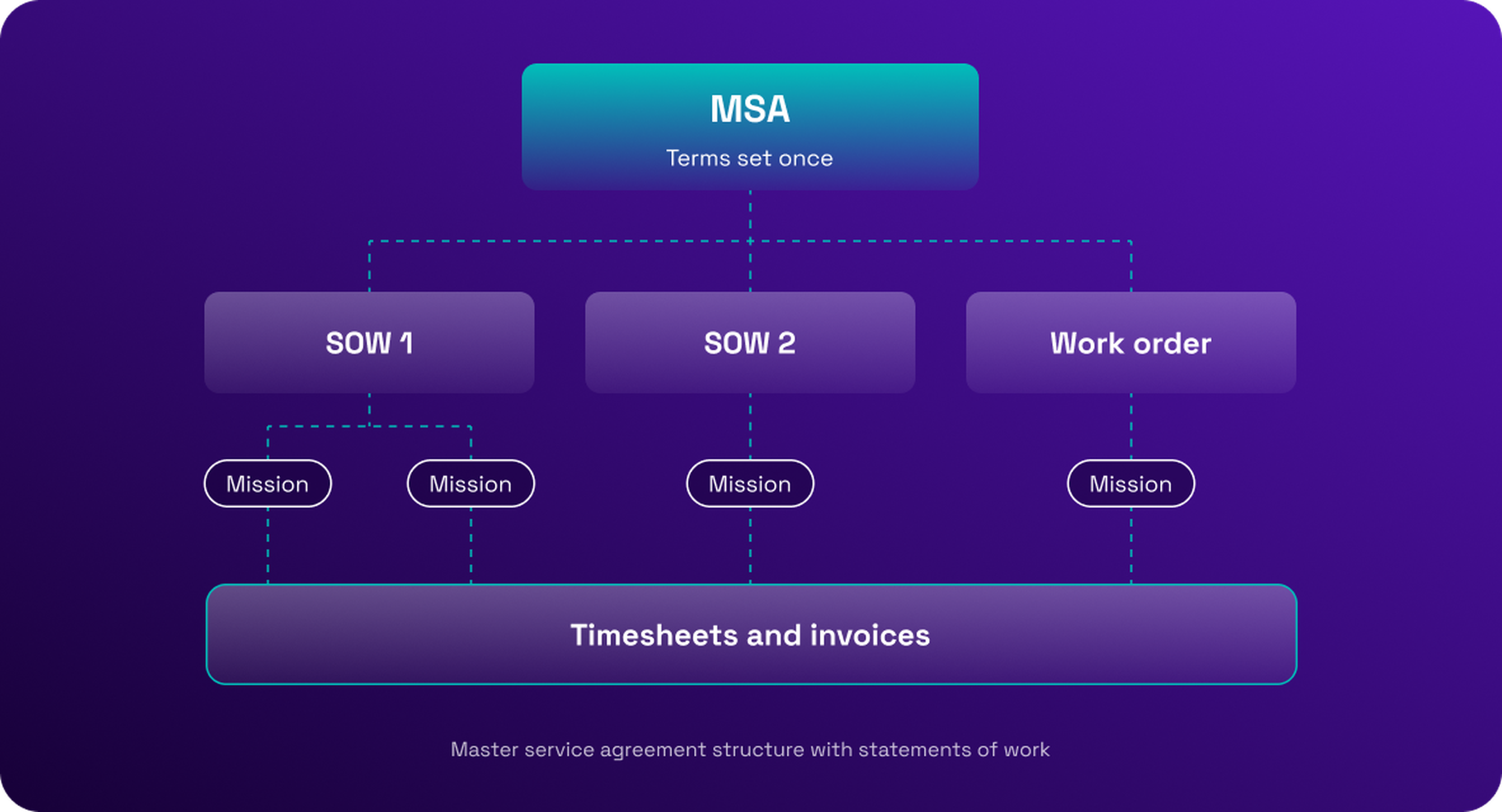
The MSA contract meaning, in procurement terms, is a separation between what stays the same and what changes with each engagement. The MSA holds the terms that do not change: liability, confidentiality, data protection, payment conditions, rate rules and exit rights. Each SOW or work order then covers one engagement, with its own scope, deliverables, price and timeline.
This is the umbrella model. A buyer negotiates the hard legal terms once, with one supplier, and every later order inherits them. It saves renegotiation on each mission and keeps terms consistent across business units. European buyers often use the term framework agreement (contrat-cadre) for the same idea.
MSA vs SOW vs SLA vs purchase order
Master service agreement vs statement of work is the comparison that confuses most teams, and it extends to work orders, SLAs, purchase orders and framework agreements. Each document does a different job.
| Document | Purpose | Scope | Duration | Who owns it |
|---|---|---|---|---|
MSA | Sets the general terms for all engagements with a supplier | The whole relationship | Several years, often with renewal | Procurement and legal |
SOW | Defines one engagement: scope, deliverables, timeline, price, acceptance | One project or engagement | The length of the engagement | The business manager, with procurement |
Work order | Orders a specific piece of work or a profile under the MSA, often a day-rate mission | One mission | The mission period | The business manager or procurement |
SLA | Sets service levels, how they are measured and the remedies | A defined service | Usually the term of the service | Procurement and the business |
PO | Commits budget and authorizes payment | A defined amount for a defined purchase | Until spent or closed | Procurement and finance |
Framework agreement | Sets prices and terms for repeated orders over a period, sometimes with several suppliers | A category of purchases | A set period | Procurement |
The documents stack. The MSA sits at the top and governs everything below it. A SOW or work order describes one engagement under it, an SLA often appears as a schedule to the SOW, and the PO releases the budget. A clause that says which document prevails if they conflict, an order-of-precedence clause, keeps the stack coherent. The guide on managing SOW-based procurement covers how SOWs are set up and run under a framework like this.
When should you use a master service agreement?
The MSA pays off when the same buyer orders from the same supplier repeatedly. It fits:
recurring IT or engineering consulting, where missions start and end throughout the year
staff augmentation, where consultants are ordered by profile and renewed
multi-entity or multi-country buying, where several legal entities order from the same supplier
approved supplier panels, where every supplier signs the same core terms
mixed day-rate and fixed-price work, where the MSA carries what is common to both
A single contract is enough for a one-off purchase from a supplier you do not expect to use again. Knowing when to use an MSA also means knowing when not to: for a single, low-value engagement, an MSA adds negotiation time without adding control.
Key clauses in a master service agreement
An MSA contains many clauses, but twelve cover most of what procurement needs to negotiate. The table sets out what each governs and what procurement should watch for.
| Clause | What it governs | Procurement watch-out |
|---|---|---|
Scope and ordering process | How services are requested, ordered and accepted | Say who can order and with what approval, and make the ordering process the only way to start work |
Rates and rate card review | The prices of profiles or services and how they change | Attach the rate card, fix rates for a period and set a revision mechanism with a cap |
Payment and invoicing | Invoice content, payment terms and disputed invoices | Invoice content, payment terms and disputed invoices |
Term, renewal and termination | Duration, renewal and exit rights | Avoid silent auto-renewal, set notice periods and say what happens to running SOWs at expiry |
Liability and indemnification | Who pays when something goes wrong, and up to what cap | Check the cap against the value at risk, and the exclusions from it |
Insurance | The coverage the supplier must hold | Specify the types and minimum levels, and require proof each year |
IP ownership | Who owns what is created | State who owns deliverables, and how pre-existing tools and know-how are treated |
Confidentiality | Protection of the information shared | Cover the supplier's staff and subcontractors, and the period after termination |
Data protection (DPA) | Processing of personal data on your behalf | Annex a data processing agreement wherever the supplier processes personal data |
Compliance and supplier checks | Legal and ethical requirements, and the documents proving them | Require compliance documents at onboarding and on a schedule, with audit rights |
Replacing consultants and non-solicitation | Substitution of staff and limits on hiring them | Set a replacement time and a handover, and check conversion fees |
Dispute resolution and governing law | How conflicts are handled and which law applies | Set a replacement time and a handover, and check conversion fees |
Four of these MSA clauses carry most of the procurement risk. The wording below is illustrative: it shows the idea, and it must be adapted and reviewed by legal before use.
Rates and indexation
Rates drift when nothing holds them. A rate card attached to the MSA, fixed for a period, with a cap on any revision, is the control. Illustrative wording: "The rates in Schedule A are fixed for twelve months from the effective date. Any revision requires written agreement and may not exceed the agreed index increase."
Termination and renewal
Auto-renewal that nobody tracks is a standing commitment. Notice periods and the fate of running SOWs should be explicit. Illustrative wording: "This Agreement renews only by written agreement of both parties. Either party may terminate on ninety days' written notice. SOWs in progress at termination continue until completion unless the buyer decides otherwise."
Liability caps
A cap that is too low leaves the buyer carrying the loss. Test it against the value of the services and the cost of a failure, and list what the cap does not cover. Illustrative wording: "Each party's total liability is limited to an agreed multiple of the fees paid in the previous twelve months. The cap does not apply to breaches of confidentiality or data protection, or to wilful misconduct."
Compliance
Compliance documents expire during an MSA that lasts years. The clause should say which documents are required, when they are renewed and what happens if they are not. Illustrative wording: "The supplier shall provide the compliance documents listed in Schedule C before the first mission starts and at the renewal intervals stated there. Failure to do so entitles the buyer to suspend new orders."
MSA terms for time-and-materials vs fixed-price engagements
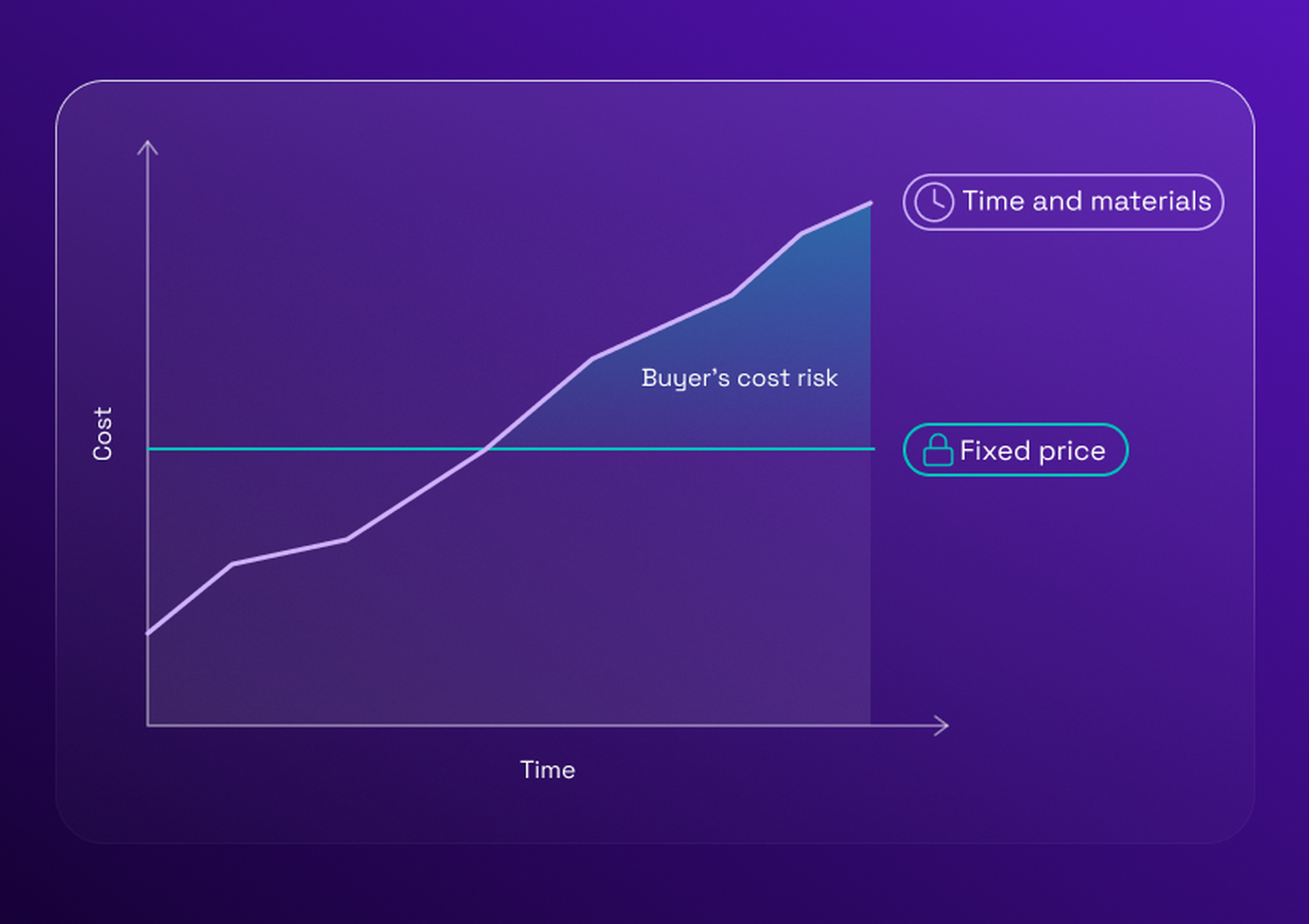
An MSA for consulting services has to carry two kinds of work, and the clauses that matter most are not the same. The day rate vs fixed price choice decides which ones do the work.
| Time and materials or day rate | Fixed price or SOW | |
|---|---|---|
Price basis | Rate card, day rates by profile and indexation | Price per SOW and the pricing of change requests |
Evidence of work | Timesheets and their approval | Deliverables and acceptance criteria |
People | Key personnel, replacement time and tenure limits | The supplier's team is its own business, with a limited say on key staff |
Change control | Approval of extensions and budget caps | The change request procedure |
Payment trigger | Approved time | Milestone acceptance |
Main risk | Co-employment, if staff are directed like employees | Delay and quality, covered by warranty and defect correction |
One MSA can carry both. The common core stays in the MSA, and each SOW or work order picks up the clauses that apply: rate rules and timesheet approval for day-rate missions, acceptance and warranty for fixed-price ones. The mistake is to write the MSA for one model and discover the gap with the other when the first order arrives.
Compliance clauses for contractors in Europe
When contractors work across Europe, four compliance points belong in the MSA or its annexes:
A data processing agreement as an annex. Article 28 of the GDPR requires processing by a processor to be governed by a binding contract that sets out the subject matter, duration, nature and purpose of the processing, the type of personal data and the categories of data subjects. The processor acts only on documented instructions and may use sub-processors only with authorization.
France's duty of vigilance. For contracts of €5,000 or more excluding VAT, the buyer must obtain and verify the supplier's vigilance certificate from URSSAF at signing and every six months. The MSA should oblige the supplier to provide it on schedule.
The risk of contractors being treated as employees. The Code du travail prohibits illicit labor lending and marchandage, a for-profit supply of labor that harms the worker or evades legal protections. The MSA should state that the supplier directs and supervises its own staff.
Cross-border VAT and invoicing. For B2B services between EU member states, the place of supply is generally where the customer is established, and the customer accounts for the VAT under the reverse charge, as set out in Articles 44 and 196 of Directive 2006/112/EC. The MSA should say which entity is invoiced and how VAT is treated.
These MSA compliance requirements are the ones most often missing from templates written for US or legal-team readers. The guide on contractor compliance requirements covers the documents to collect and the signals to watch. This is general information, not legal advice, and the clauses should be reviewed by legal for each country concerned.
6 common MSA mistakes procurement teams make
A vague ordering process: if anyone can start work by email, spend and terms escape the MSA.
No rate-card review mechanism: rates drift upward, or sit frozen until the supplier asks for a large increase.
An auto-renewal nobody tracks: the MSA rolls over, with terms nobody has revisited, because no one owned the date.
SOWs that contradict the MSA, with no order-of-precedence clause: each dispute becomes a debate about which document wins.
Compliance documents that expire unnoticed: they are collected at onboarding, then forgotten for the rest of the term.
Spending above the cap without approval: orders pile up past the commitment the MSA was meant to control, and the overrun shows up at invoicing.
Each of them is a failure after signature, not in the drafting of the master service agreement. That is where the next section picks up.
How to manage master service agreements after signature
Signature is the start of the work. The World Commerce & Contracting report Closing the Procurement Value Gap finds that organizations lose an average of 11% of contract value, and that the leakage happens after signature, in how contracts are turned into behavior, governance and relationships rather than in the drafting. Most organizations do not track this loss formally. Five practices keep that value:
Attach the MSA to the supplier record in your approved supplier list, so anyone placing an order sees the terms that apply.
Issue every SOW and work order from the MSA terms, never from a fresh template.
Enforce the rate card at order time and at invoicing, so no day is billed at a rate outside the card.
Alert on renewal dates and on the expiry of compliance documents, with a named owner for each.
Report spend against the cap, per supplier and per entity, before the cap is reached.
MSA management at scale is a data problem as much as a legal one. A vendor management system holds the supplier record, applies the framework agreement and rate card to each mission, and sends alerts on renewals and document expiry. The guide to building an approved vendor list covers the first step. At Equans, the project structured IT purchasing in two months.
Master service agreement checklist
The checklist below is free to use and not gated. Each line is a point to verify before signing an MSA.
The parties and the legal entities allowed to order are named.
The ordering process is defined and is the only way to start work.
The order of precedence between the MSA, the SOW, the work order and the PO is stated.
The rate card is attached, fixed for a period, with a revision mechanism and a cap.
Payment terms and the invoice requirements, including the PO reference, are set.
The term, the renewal rule and the notice periods are explicit, with no silent auto-renewal.
The treatment of running SOWs at expiry or termination is defined.
The liability cap and its exclusions are tested against the value at risk.
Insurance types, minimum levels and the proof required are specified.
Ownership of deliverables and treatment of pre-existing IP are stated.
Confidentiality covers staff and subcontractors, and survives termination.
A data processing agreement is annexed wherever personal data is processed.
Compliance documents, their renewal schedule and audit rights are listed.
Replacement of consultants, the handover and the non-solicitation rules are set.
An escalation path, the governing law and the venue are chosen on purpose.
Running MSAs in one place
A clear framework and a short checklist remove most of the risk at signature. A platform keeps the framework working afterwards, when orders, suppliers and entities multiply. See how procurement teams manage MSAs, SOWs and supplier compliance in one place.
Book a meeting with one of our experts for a personalized demo.