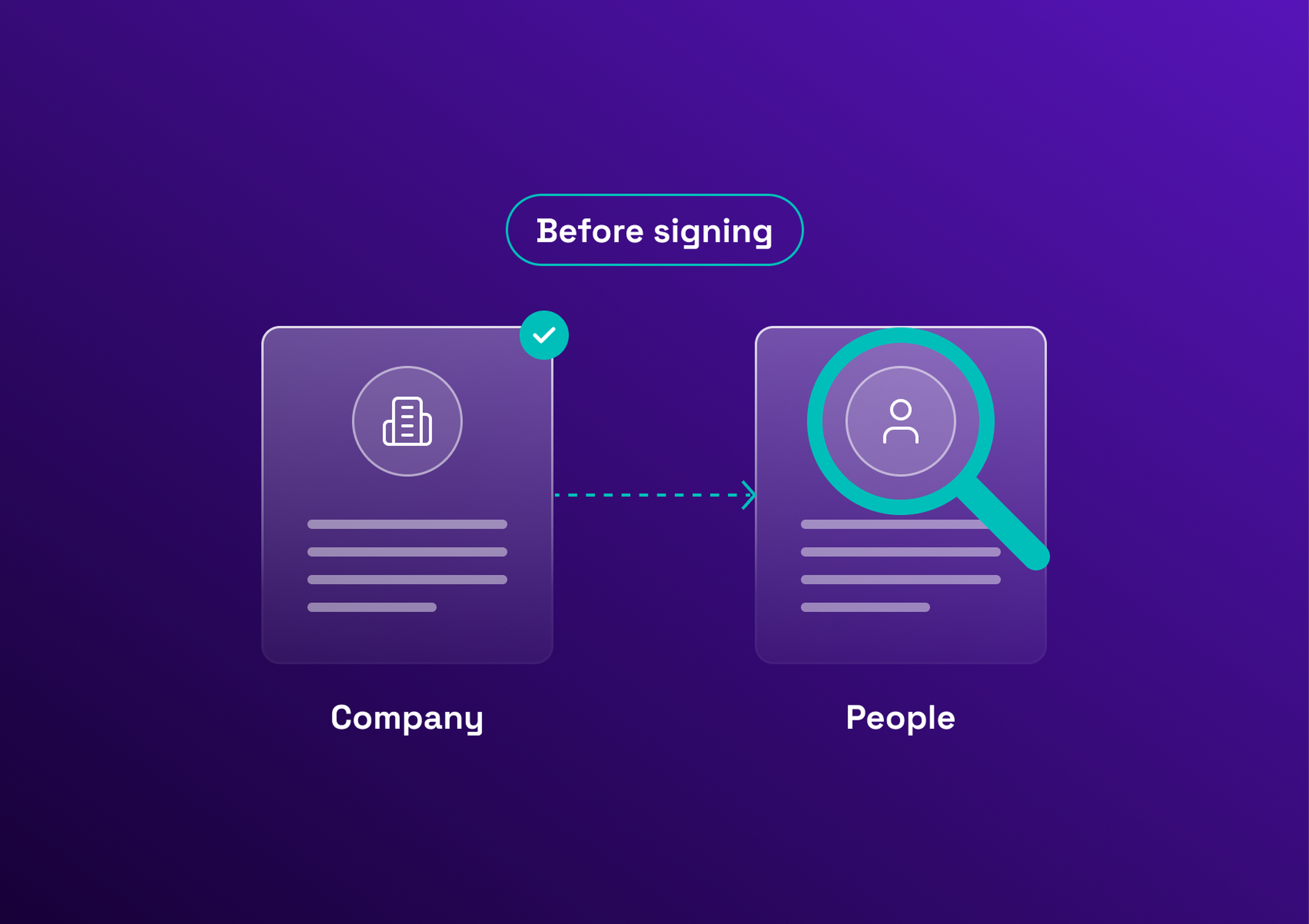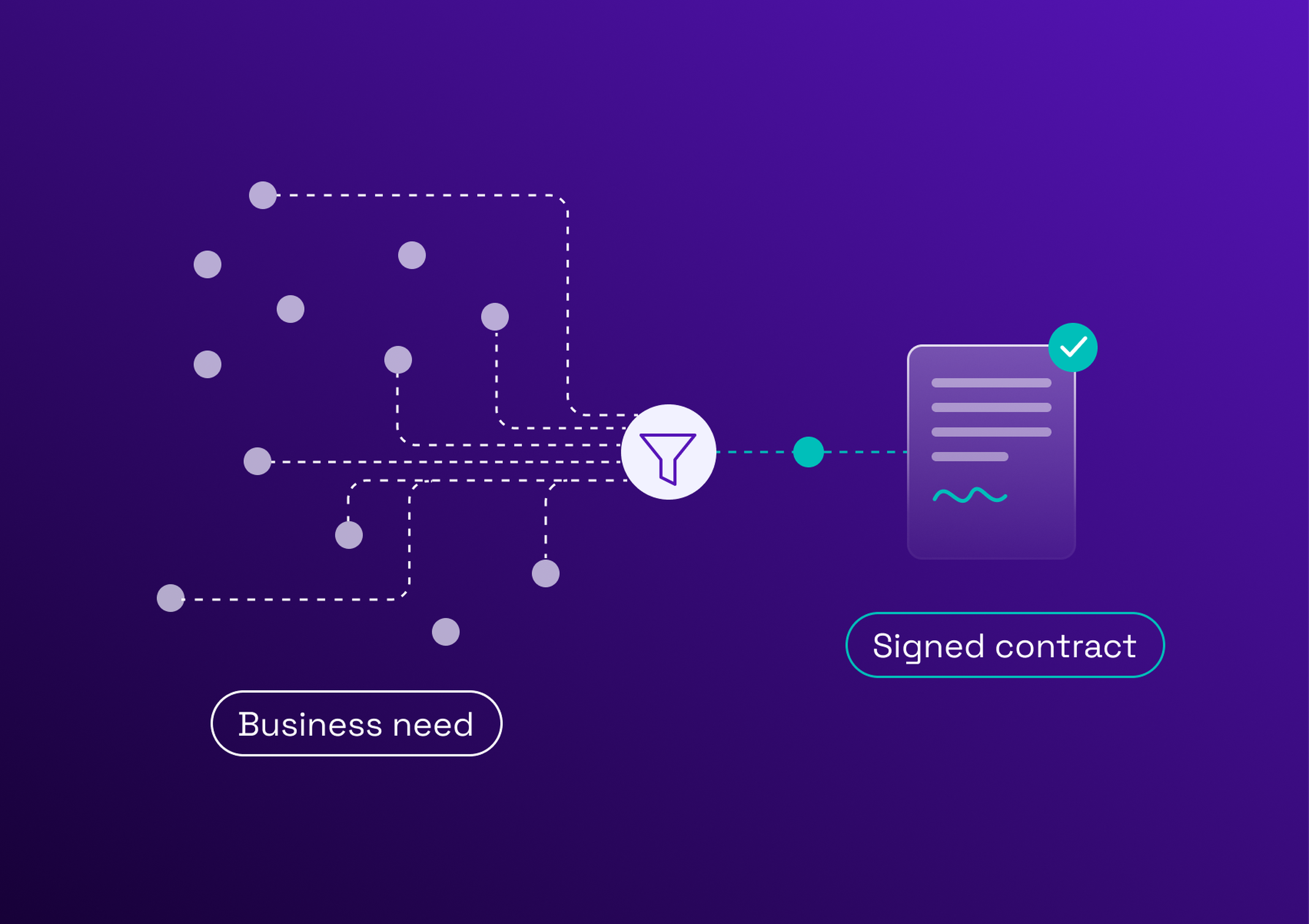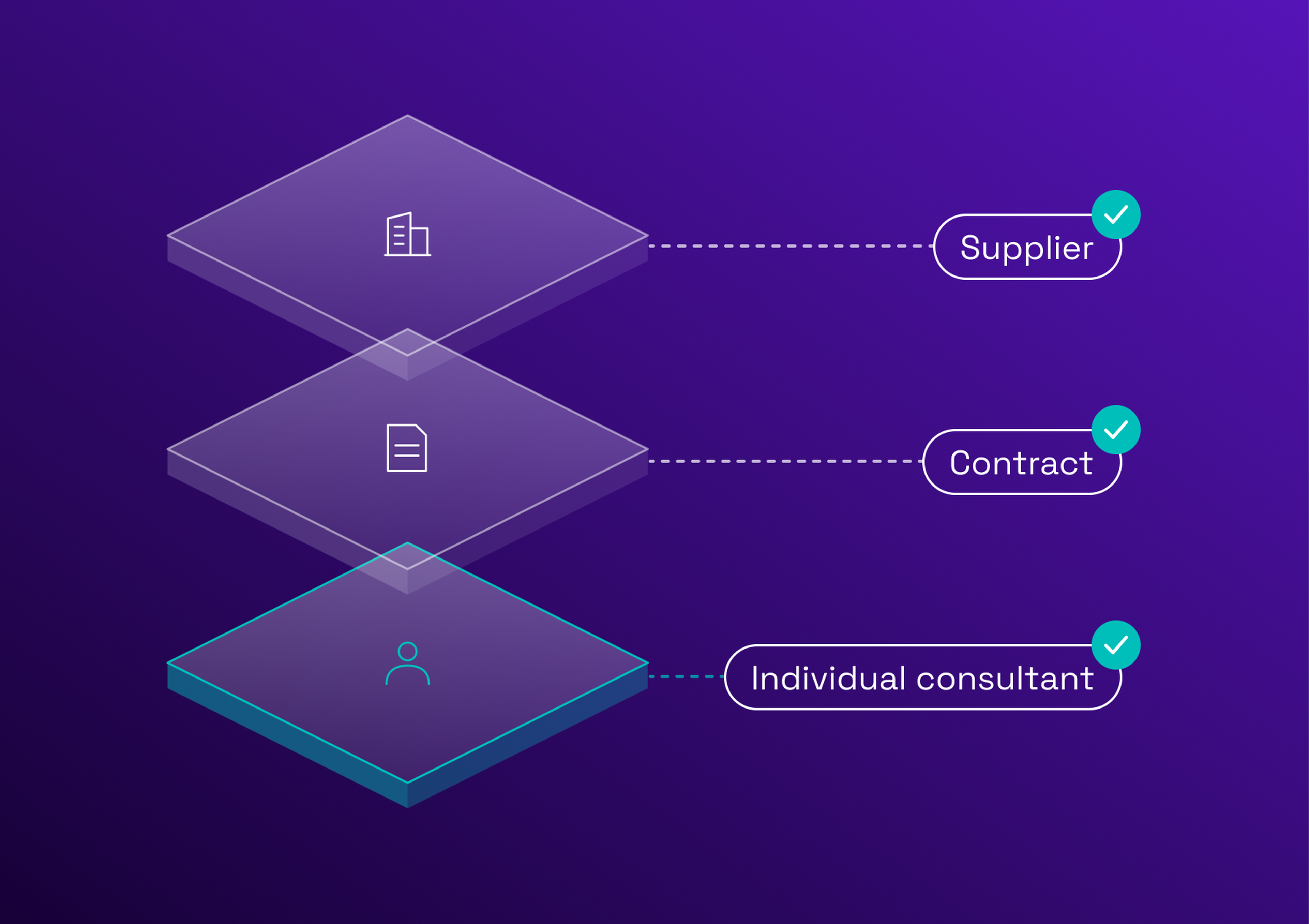
Vendor compliance is the process of checking that every supplier, and every person it sends you, meets your legal, contractual and security requirements, and keeping that proof valid for as long as the work lasts. For service suppliers, it has to happen at three levels: the company, the contract and the individual consultant. One level is never enough. A supplier can be fully compliant as a company while its contract is missing a clause, or while the consultant it placed on your site has lost the right to work. This guide sets out what to collect and keep valid at each level.
What is vendor compliance?
Vendor compliance means that each supplier can show, with documents that are current, that it is allowed to work for you and able to do so safely. It covers legal status, tax and social contributions, insurance, sanctions screening, security and data protection. Supplier compliance is not a one-time check at onboarding: every document has a validity period, and the file is only as good as its oldest expired item.
One note on scope. In retail, "vendor compliance" often means a supplier's obligations on shipping, labelling and delivery to a retailer. This article does not cover that meaning. It covers professional services: consulting, IT and engineering.
Vendor compliance vs. contractor compliance vs. third-party risk management
Three topics sit close together and answer different questions. Third party vendor compliance is the evidence layer, and the other two use it.
| Who it applies to | The question it answers | Who usually owns it | |
|---|---|---|---|
Vendor compliance | Every service supplier | Does this supplier, its contract and its people have valid proof on file? | Procurement, with legal and finance |
Contractor compliance | Individual contractors on a mission | Is this person engaged and managed in a compliant way? | Procurement and HR, with the business |
Third-party risk management | The whole supplier base | Which suppliers expose us to the most risk, and what do we do about it? | Risk, security and procurement |
Each has its own guide: the third-party risk management framework covers risk scoring, and the contractor compliance checklist is organized by engagement phase. This article stays on one question: what to collect, and what to keep valid.
Why vendor compliance is harder for service suppliers
A goods supplier ships a product, and compliance mostly concerns the company. A service supplier sends people, and four things change.
People on your premises. Consultants work on your site or in your systems, under your safety rules and your policies. Their situation matters as much as their employer's.
Access to systems and data. A consultant often receives credentials, and the supplier may process personal data on your behalf. SecurityScorecard's 2025 report, which analyzed 1,000 breaches, found that 35.5% of the breaches in 2024 were third-party related. Many vendor compliance risks that reach your data go through a person with access.
Subcontracting chains. A supplier may pass a mission to a subcontractor, who may pass it on again. Your contract is with the first company, while the person working for you may be three links away, with none of your checks applied.
Status changes during a mission. A work permit expires, a clearance lapses, a consultant moves from one role to another, or a mission runs past its planned end. A check done at the start says nothing about the end.
Vendor compliance requirements at three levels
The table below is the centerpiece of this guide. It lists the vendor compliance documents to collect at each level, the typical validity, who owns it and what should happen if it lapses. Validity periods vary by country and by document, so they are labeled as typical unless a law sets them.
| Level | Document or check | Typical validity | Owner | If it lapses |
|---|---|---|---|---|
Supplier | Registration extract, tax and social certificates | Extract yearly, certificates six months in France (set by law) | Procurement, finance | Block new missions |
Supplier | Insurance certificate | Usually 12 months | Procurement, risk | Block new missions, escalate |
Supplier | Sanctions screening | At onboarding, then at a fixed rhythm | Compliance | Stop work, escalate |
Supplier | Security certifications, such as ISO 27001 | Usually three years, with yearly audits | IT security | Reassess access |
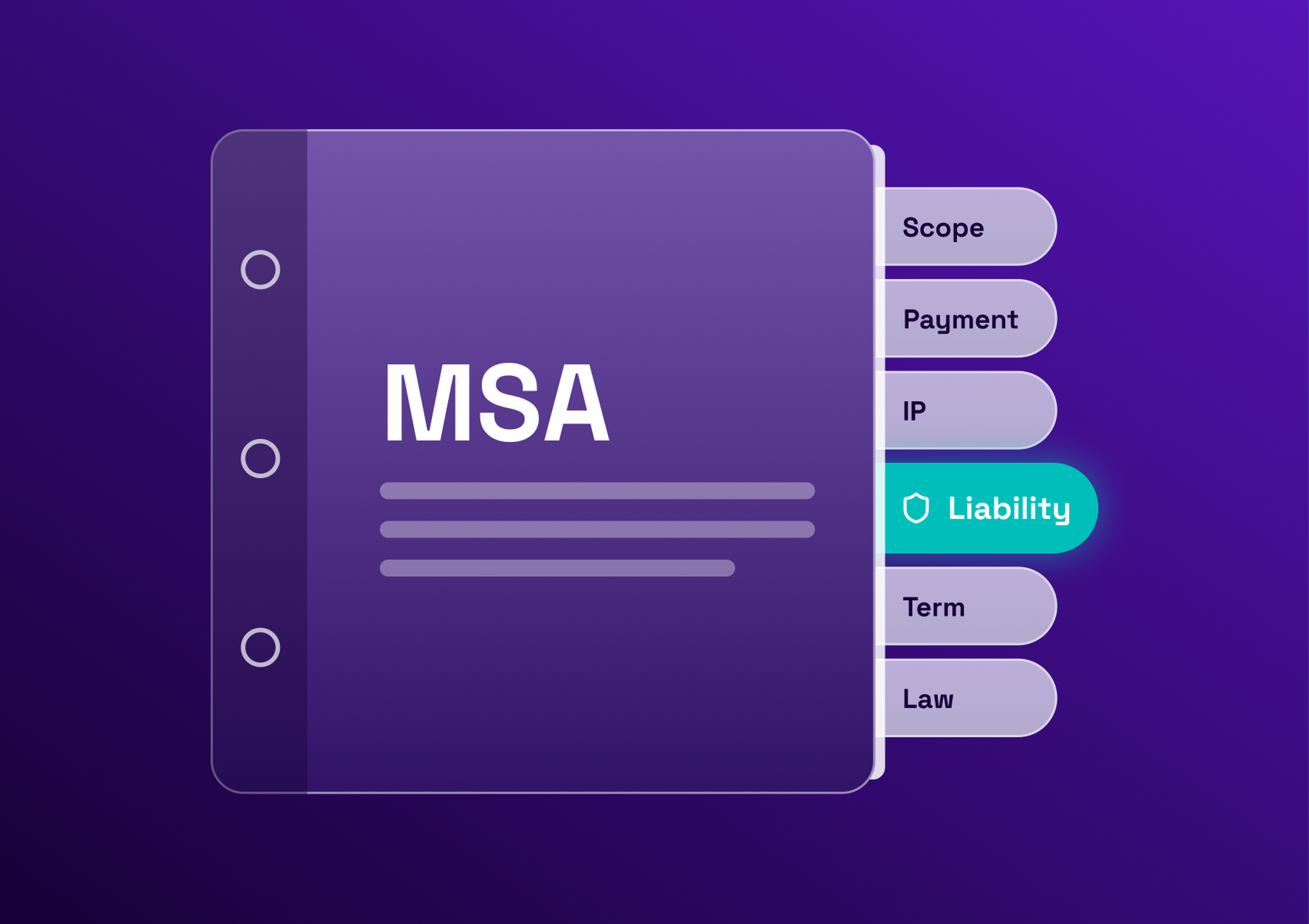
Contract | Signed MSA, SOW and NDA | Term of the contract and of each mission | Procurement, legal | No work starts or continues |
Contract | Data processing agreement (DPA) | Life of the contract, reviewed when processing changes | Legal, data protection | Stop data access |
Contract | Subcontracting authorization and audit rights | Per subcontractor and mission, and for the contract term | Business owner, procurement, legal | Remove the subcontractor, fix at renewal |
Consultant | Right to work and status determination | Until the permit expires, and status at the start and on role change | Supplier provides, procurement and legal verify | Pause until redone |
Consultant | System access rights | Mission length, reviewed at renewal | IT, business manager | Revoke access |
Consultant | Clearances, where required | As set by the issuing body | Security | Remove from the sensitive scope |
Supplier entity
This is the level most guides stop at: registration, tax and social contribution certificates, insurance, sanctions screening and security certifications. It tells you the company is legitimate. It tells you nothing about the people it sends.
Contract or engagement
The MSA and SOW define what is allowed, and the DPA and NDA define how information is handled. Subcontracting authorization and audit rights are the two clauses that make the next level possible: without them, a buyer cannot see or check who is actually doing the work. The guide on building an approved vendor list explains how the supplier-level approval feeds the contract stage.
Individual consultant
A compliant supplier can still put a non-compliant person on a mission. The right to work, a status determination where the law requires one, access rights and clearances each need their own proof and their own expiry date. The worker misclassification risks guide covers status in depth.
Compliance regulations that apply to service suppliers
Several rules shape what supplier files must contain. The table lists the ones with a direct effect on service suppliers. It is general information, not legal advice, and legal counsel should confirm which rules apply to your organization. Other regimes, such as anti-corruption laws, supply chain due diligence laws and sanctions rules, may also apply and are not covered here.
| Rule | Who it applies to | What it means for supplier files | Source |
|---|---|---|---|
UK failure to prevent fraud, since 1 September 2025 | Large organisations | Due diligence on people who provide services for you | GOV.UK guidance |
France, contractor vigilance (L8222-1, R8222-1) | Contracts of €5,000 excl. VAT or more | Vigilance certificate at signing, then every six months, authenticity checked | Code du travail, Urssaf |
DORA, since 17 January 2025 | Financial entities | Register of ICT third-party arrangements, including critical subcontractors | EUR-Lex, Regulation (EU) 2022/2554 |
NIS2, Article 21(2)(d) | Essential and important entities | Supply chain security with direct suppliers and service providers | EUR-Lex, Directive (EU) 2022/2555 |
GDPR, Article 28 | Controllers using processors | A DPA, and authorization of sub-processors | EUR-Lex, Regulation (EU) 2016/679 |
The sources are the GOV.UK guidance, the French Code du travail (articles L8222-1 and R8222-1, with the Urssaf guidance on its vigilance certificate), the NIS2 Directive, DORA and the GDPR. The third-party risk management framework covers each rule in more depth.
How to build a vendor compliance program in 6 steps
A vendor compliance program turns the matrix above into routine. Vendor compliance management comes down to six steps.
Map your obligations. List the rules that apply to you by country and sector, and the contractual requirements you already impose.
Tier suppliers by risk. Not every supplier needs the same file. The matrix in the third-party risk management framework shows how to tier them, and it is not repeated here.
Set the requirements per tier. For each tier, decide which documents are mandatory and how often they are renewed.
Write them into contracts. A requirement that is not in the contract cannot be enforced. Add the documents, the renewal duty, subcontracting authorization and audit rights.
Automate collection and renewal. Ask for documents through one channel, track expiry dates as data, and send reminders before they lapse.
Audit and act on lapses. Review the files at a set rhythm, and apply the consequence every time.
A consequence ladder makes the last step concrete, so that a lapse is never ignored:
Reminder: the supplier is asked to renew, with a deadline.
Block new missions: no new SOW is signed until the document is valid again.
Escalate: the business owner and procurement leadership are informed.
Exit: the supplier is removed from the panel if the gap is not closed.
Vendor compliance checklist by renewal cadence
This vendor compliance checklist is organized by how often each item must be refreshed. This differs deliberately from the contractor article, which follows the phases of an engagement.
Once, at onboarding
Company registration extract
Signed MSA, NDA and DPA
Sanctions screening
Subcontracting rules accepted and audit rights agreed
Security certifications on file
A named owner for the supplier file
Every six months
Tax and social contribution certificates, where the law requires it
Sanctions re-screening
Review of open lapses and reminders
Annually
Insurance certificate
Security certification status
Review of the supplier's tier and performance
Renewal date of the MSA
On change
New subcontractor: authorization and the supplier-level documents
New consultant: right to work, status determination, access rights and clearances
New country: local rules, right to work and status tests
New data processing or new AI tool: update to the DPA
Common vendor compliance mistakes
These vendor compliance issues appear most often:
Checking only at onboarding, so documents expire without anyone noticing.
Stopping at the entity level, and never checking the contract or the person.
Accepting self-declarations with no evidence, so the file says "compliant" and proves nothing.
Having no owner for lapses, so a reminder is sent and nothing follows.
Rebuilding files just before an audit, which means the proof is gathered after the fact.
How a VMS supports supplier compliance management
A vendor management system does not make a supplier compliant. It keeps the evidence in one place, where a buyer can see it. Vendor compliance software of this kind can hold the documents for each supplier, contract and mission, track their expiry dates and keep a record of every action, which makes an audit a matter of retrieving rather than reconstructing.
Two customer stories show the effect. At Forvia, reconsolidating data during audits was a recurring and very complex task, and traceability was an objective of the project. Centralizing the data and simplifying workflows saves the team 4 man-days per month, according to its customer story. At Amadeus, bringing a contractor on board went from 5 to 8 weeks to 2 weeks: a gain in speed, not in compliance, but it shows what one process in one place changes.
Software has limits. It cannot decide which rules apply to you, judge whether a document is genuine, or replace a legal opinion. It also depends on the supplier sending the right documents. Its job is to make the proof visible and the gaps impossible to ignore.
Putting vendor compliance in one place
Vendor compliance holds together only when the three levels, the renewal dates and the owner of each lapse are visible in the same place. To see where your own process stands, assess your procurement maturity, or see how Eleven VMS works. This guide is general information, not legal advice.
Book a meeting with one of our experts for a personalized demo.