Third-party risk management (TPRM) is the process of identifying, assessing and controlling the risk an organization takes on through its external suppliers. Most guides on this topic are written for software and data vendors. This one focuses on the suppliers most programs overlook: consultants, IT service providers, engineering firms and freelancers, where the risk isn't a data breach alone, it's a person working inside your systems, your reporting lines and your compliance perimeter.
What is third-party risk management (TPRM)?
TPRM runs across the full life of a supplier relationship, from selection to offboarding, rather than at ooarding alone.
A third party covers more ground than "vendor" usually implies:
software and data vendors
service providers, including consultants and IT or engineering firms
individual contractors and freelancers
subcontractors working under one of your direct suppliers
distributors and resellers
TPRM overlaps with, but isn't the same as, vendor management or supplier performance management. Vendor management covers the whole commercial relationship: sourcing, contracting, renewal. Supplier performance management tracks whether a supplier delivers well. TPRM is narrower and risk-specific: it asks what could go wrong through this relationship, cybersecurity, compliance, financial, operational, and what controls reduce that exposure, whether or not the supplier is performing well on delivery.
Why third-party risk management matters in 2026
The scale of the exposure keeps growing, and the data backs that up rather than just asserting it. Verizon's 2025 Data Breach Investigations Report, analyzing over 22,000 incidents, found third-party involvement in 30% of breaches, double the 15% recorded the year before. ENISA's Threat Landscape 2025 report, covering 4,875 incidents across the EU, now ranks supply chain compromise as one of the most impactful threat categories specifically because of how it cascades across interconnected organizations.
Beyond security, the business case has shifted too. Outsourced intellectual services, consulting, IT delivery, engineering, now represent a growing share of external spend at most enterprises, and board-level accountability for that spend is rising alongside it. A cybersecurity incident traced back to a subcontractor nobody vetted, or a compliance failure discovered mid-audit, lands on the same leadership desk regardless of which supplier tier it originated from.
The hidden risks of service suppliers and contractors
This is where most TPRM programs have a blind spot: they're built around software procurement, and people-based suppliers carry a different risk profile entirely.
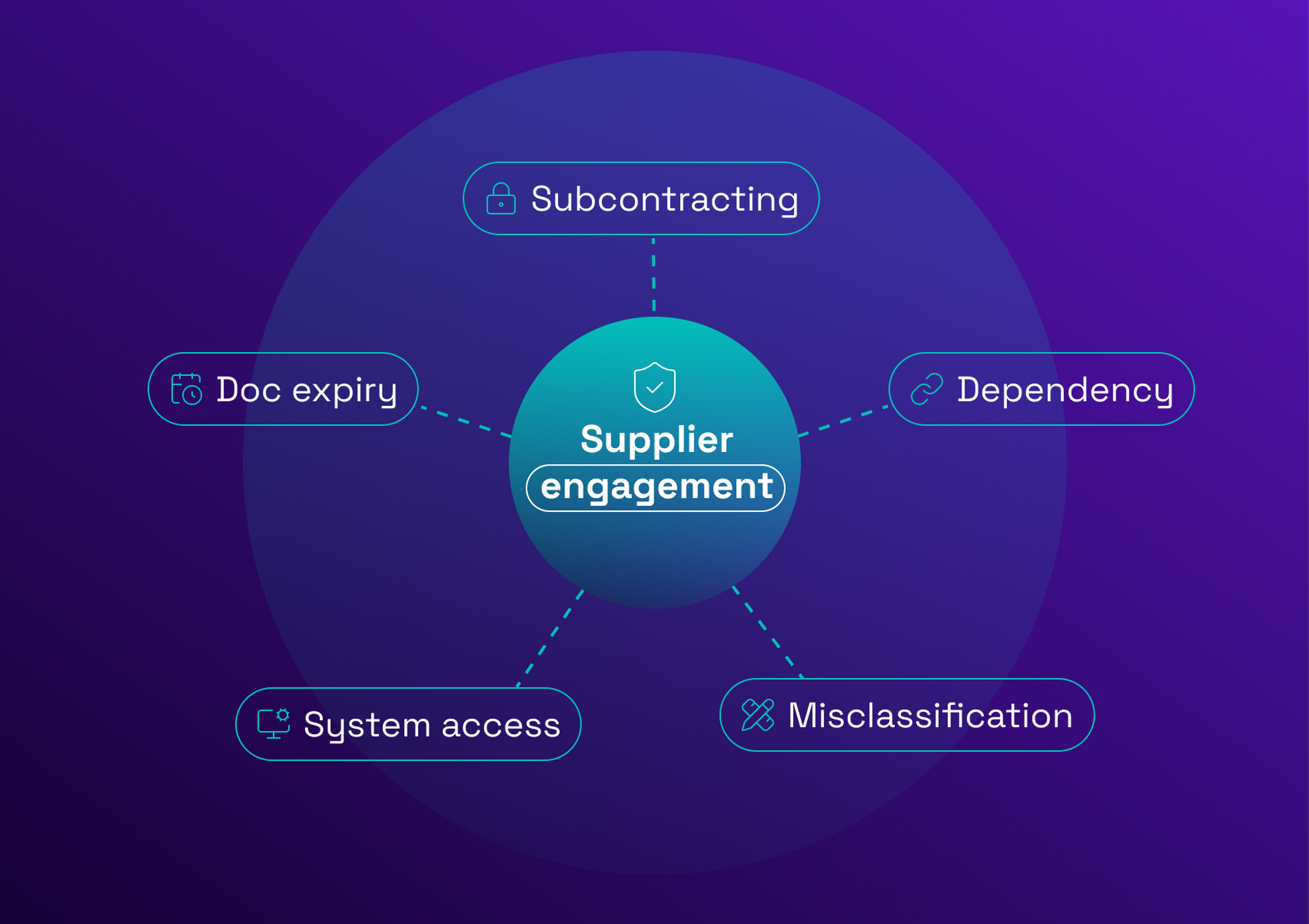
Access to your systems and data
A consultant working inside your environment typically gets credentials, a badge, sometimes a company email address. That access needs the same discipline at offboarding that it gets at onboarding, and in practice it rarely does: a contract ending doesn't automatically mean access ends.
Misclassification and co-employment exposure
A long-tenured, closely-directed contractor can start to look like an employee to a regulator, regardless of what the contract says. Managing a contingent workforce well means tracking tenure and direction as a compliance signal, not just a delivery metric.
Subcontracting chains, or fourth-party risk
Your consulting firm subcontracts part of the engagement to a specialist you've never heard of, let alone vetted. That specialist now has access, knowledge or deliverable responsibility inside your program, and your due diligence on the prime supplier tells you nothing about them.
Supplier dependency and concentration
When too much critical spend, or too much irreplaceable knowledge, sits with one firm, losing that relationship isn't just a sourcing inconvenience, it's an operational risk.
Compliance document expiry
Insurance certificates, tax registrations and social-security documents all have expiry dates, and a mission that started fully compliant can quietly become non-compliant mid-engagement if nobody's tracking those dates.
Other types of third-party risk
Beyond the risks specific to service suppliers, the standard risk categories still apply and are worth a quick map of ownership.
| Risk type | Example | Typically owned by |
|---|---|---|
Cybersecurity | A supplier's compromised credentials expose your systems | IT security |
Operational | A critical supplier fails to deliver, disrupting your operations | Business owner, procurement |
Financial | A supplier's financial instability threatens delivery mid-contract | Procurement, finance |
Compliance and regulatory | A supplier fails a required certification or screening | Legal, compliance |
Reputational and ESG | A supplier's labor practices or environmental record becomes public | Legal, communications |
Geopolitical | A supplier's operations are disrupted by sanctions or regional instability | Procurement, legal |
The third-party risk management lifecycle
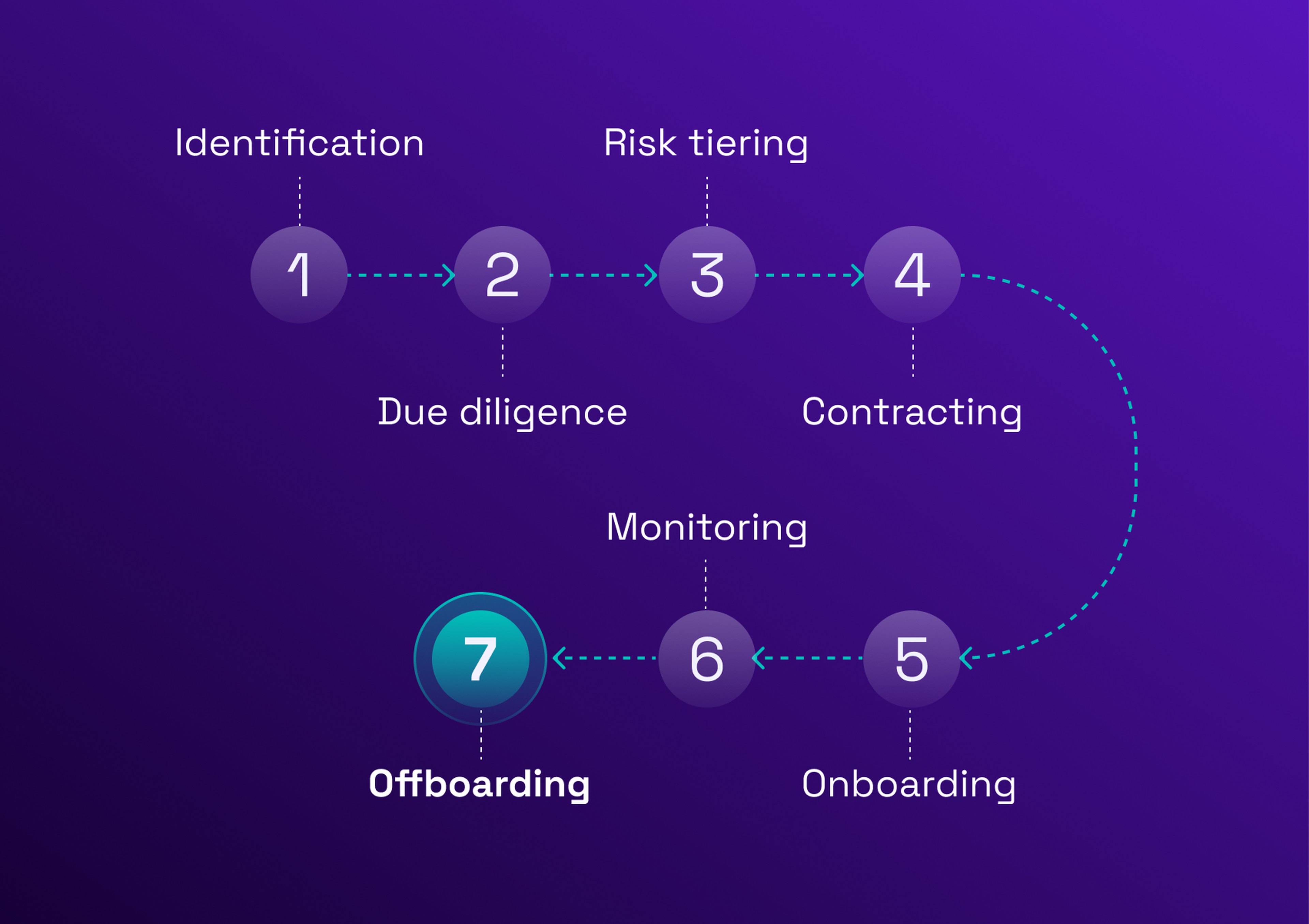
Supplier identification and inventory
You can't manage risk in a supplier base you can't see. This starts with a complete inventory, including subcontractors where visibility allows, not just direct, contracted suppliers.
Due diligence and qualification
Before a supplier is engaged, verify what the relationship actually requires: financial standing, insurance, security posture, references, and for service suppliers specifically, the qualifications of the people who'll actually do the work.
Risk tiering
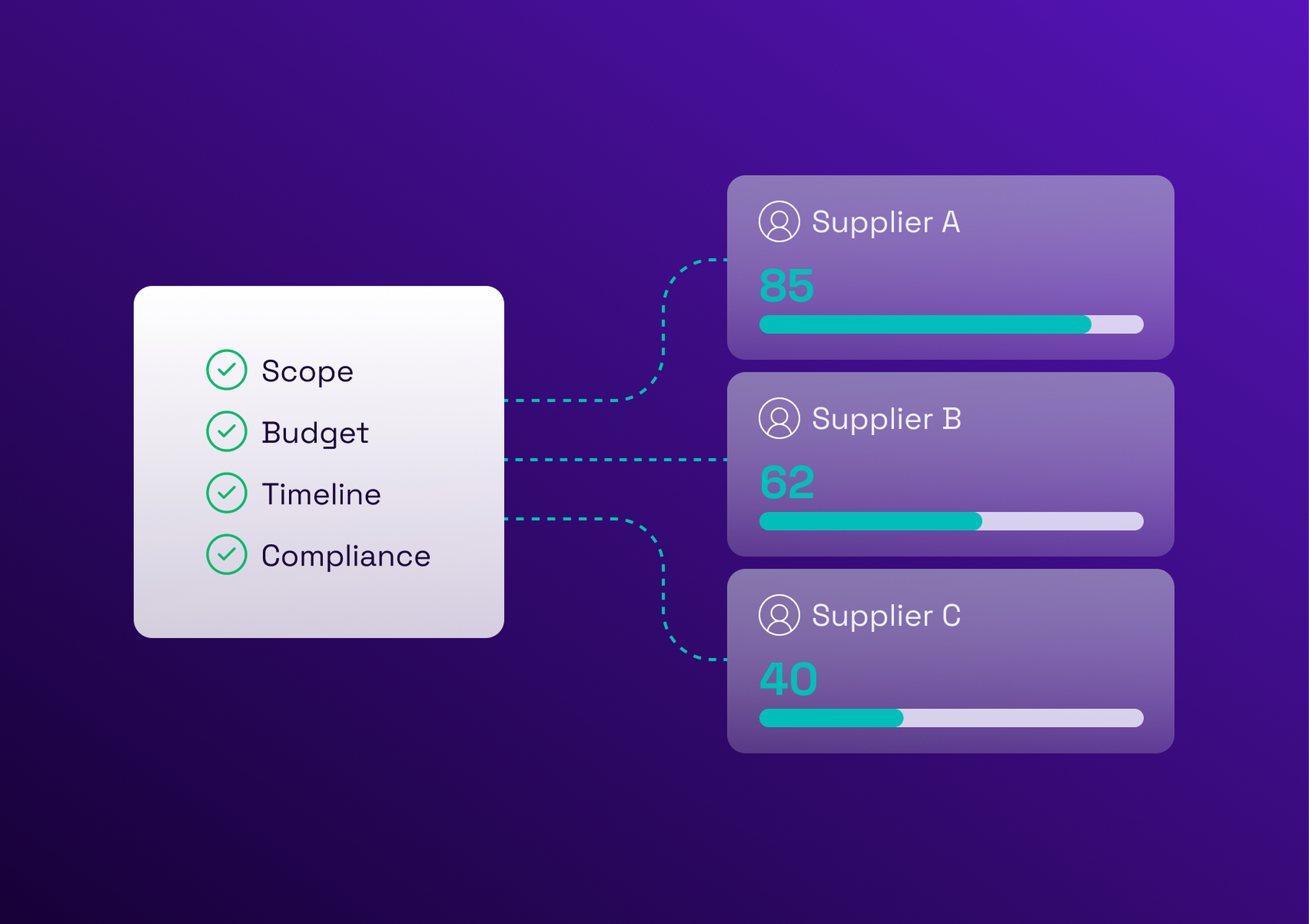
Not every supplier deserves the same scrutiny. Score each one against a consistent set of criteria and assign a tier, covered in detail below, so review effort is proportional to actual risk rather than applied uniformly.
Contracting
Risk clauses, audit rights and subcontracting approval belong in the contract itself, not as a side agreement. A supplier that can subcontract without approval has effectively handed you fourth-party risk you never agreed to.
Onboarding and compliance document collection
Documents get collected and verified before work starts, not requested reactively when someone asks for them during an audit.
Ongoing monitoring and performance reviews
Risk doesn't stay static after onboarding. Reviews on a set cadence, plus event-based triggers, catch what changed since the last check rather than assuming nothing did. Tracking supplier performance alongside risk, rather than as a separate exercise, is what keeps this step from becoming a box-ticking review.
Offboarding
Access revocation and knowledge transfer both belong here, and both are routinely rushed or skipped. An offboarded supplier with live system access is not a closed relationship, it's an open one nobody's tracking anymore.
How to tier your suppliers by risk: a scoring matrix
A practical way to score suppliers for services procurement specifically: four criteria, 1 to 3 points each.
| Criterion | 1 point | 2 points | 3 points |
|---|---|---|---|
Access to systems or data | None | Limited, read-only | Broad or privileged access |
Business criticality | Low, easily deferred | Moderate, some disruption if delayed | High, core to operations |
Annual spend | Low | Moderate | High |
Substitutability | Easily replaced | Some switching cost | Hard or slow to replace |
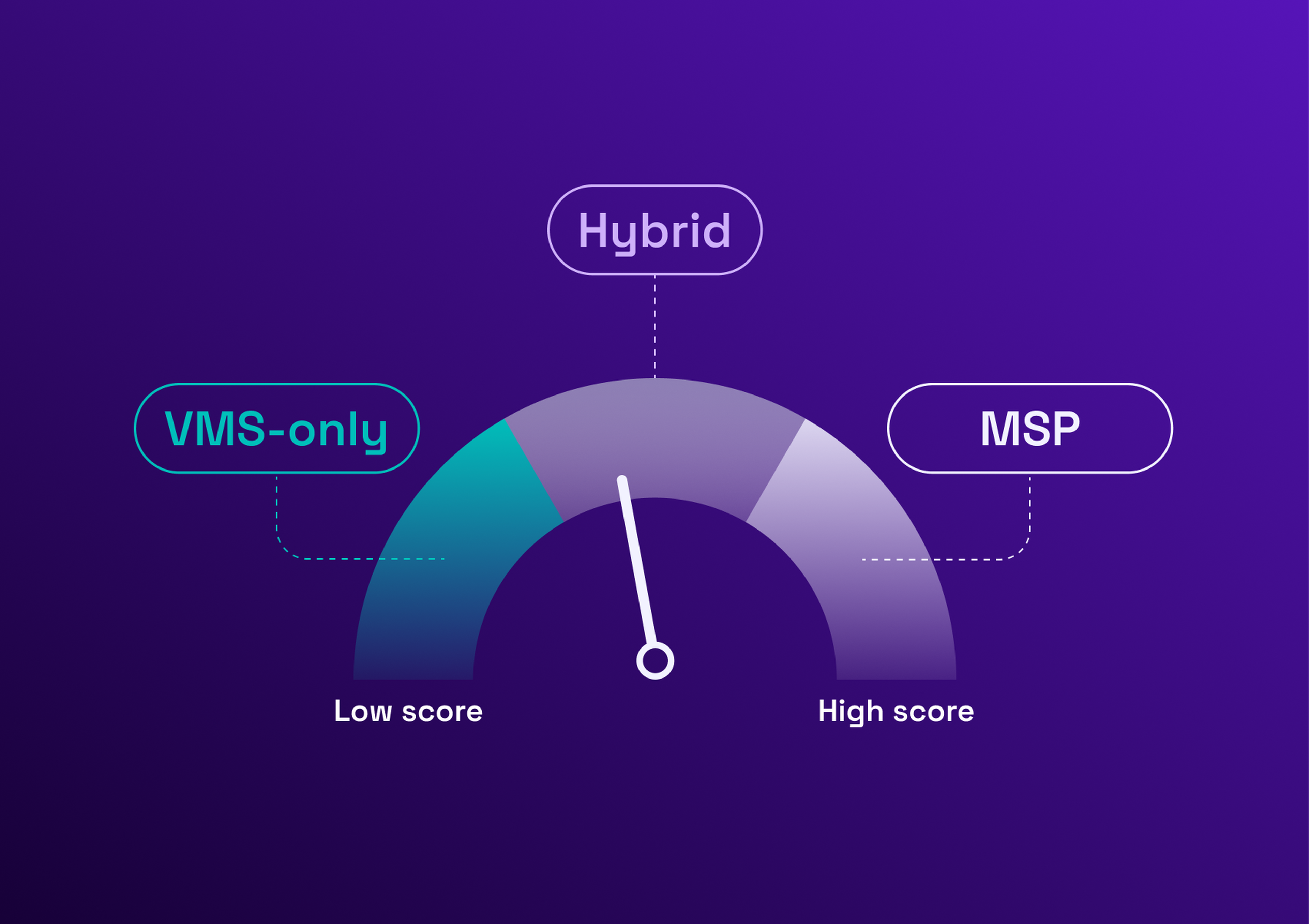
Total the four scores. A total of 4 to 6 points is Tier 3, low risk, reviewed roughly annually with baseline documents on file (insurance certificate, company registration extract such as a Kbis or equivalent, social and tax compliance certificates). 7 to 9 points is Tier 2, standard, reviewed every 6 to 12 months with a fuller document set (NDA, security questionnaire, financial strength assessment, etc.). 10 to 12 points is Tier 1, critical, reviewed quarterly or on any material change, with the full document set plus named ownership and audit rights actively exercised, not just contractually available.
Building a third-party risk management framework
Who owns TPRM? Ownership is typically shared, not singular: procurement usually owns the process and supplier relationships, legal owns contract terms and regulatory exposure, IT security owns technical risk and access controls, and business owners are accountable for the risk they accept when they bring a supplier in. What fails most often isn't the absence of any one of these roles, it's the absence of a single point that ties them together.
Policy essentials worth having in writing:
a defined tiering methodology, applied consistently
minimum due diligence requirements per tier
a review cadence per tier, with named ownership
an escalation path when a supplier fails a check
a documented offboarding and access-revocation procedure
Aligning this with existing frameworks rather than building from scratch helps: ISO 27001 covers information security management broadly, and NIST's frameworks offer structured risk-assessment methodology, both worth referencing rather than reinventing.
EU regulations that shape your TPRM program
For organizations operating in Europe, several regulations now touch third-party risk directly, each with a different scope and a different set of teeth.
| Regulation | Applies to | What it requires regarding third parties |
|---|---|---|
DORA (Regulation (EU) 2022/2554) | Financial entities in the EU | Documented due diligence before contracting, ongoing monitoring, a register of ICT third-party arrangements, and a tested exit strategy for each critical provider |
NIS2 (Directive (EU) 2022/2555) | Essential and important entities across 18 sectors | Supply chain security as part of the broader cybersecurity risk-management obligation |
GDPR, Article 28 | Any organization processing personal data through a processor | A written contract with the processor, and evidence that the processor offers sufficient guarantees for data protection |
CSDDD (Directive (EU) 2024/1760, as amended by Omnibus I) | Very large companies (over 5,000 employees and over €1.5 billion net worldwide turnover) | Due diligence on adverse human rights and environmental impacts across the value chain, including suppliers; applies from 26 July 2029 |
Sources: DORA, EUR-Lex · NIS2, EUR-Lex · GDPR guidance, EDPB · CSDDD, EUR-Lex
This is general information, not legal advice. Applicability and specific obligations depend on your organization's size, sector and where it operates, and should be confirmed with counsel.
KPIs to measure your third-party risk program
| KPI | What it tells you |
|---|---|
% of suppliers tiered | Whether the risk-scoring process actually covers your supplier base, or just the suppliers someone remembered to score |
% of compliance documents up to date | How much of your documented compliance posture is currently true versus quietly expired |
Average time to onboard | Whether due diligence is a genuine gate or a bottleneck people route around |
% of spend with Tier 1 suppliers | How concentrated your critical exposure is |
% of offboardings with access revoked within 24 hours | Whether offboarding is enforced or just documented as a policy |
Supplier performance score | Delivery quality and reliability, tracked alongside risk rather than instead of it |
Risk indicators are most useful read alongside the broader procurement KPIs the team already tracks.
How a VMS supports third-party risk management
A vendor management system doesn't replace the judgment calls in tiering or due diligence, but it's built to keep the process running consistently rather than relying on someone remembering to check. In practice, it provides:
one register of suppliers and engagements, instead of records scattered across teams
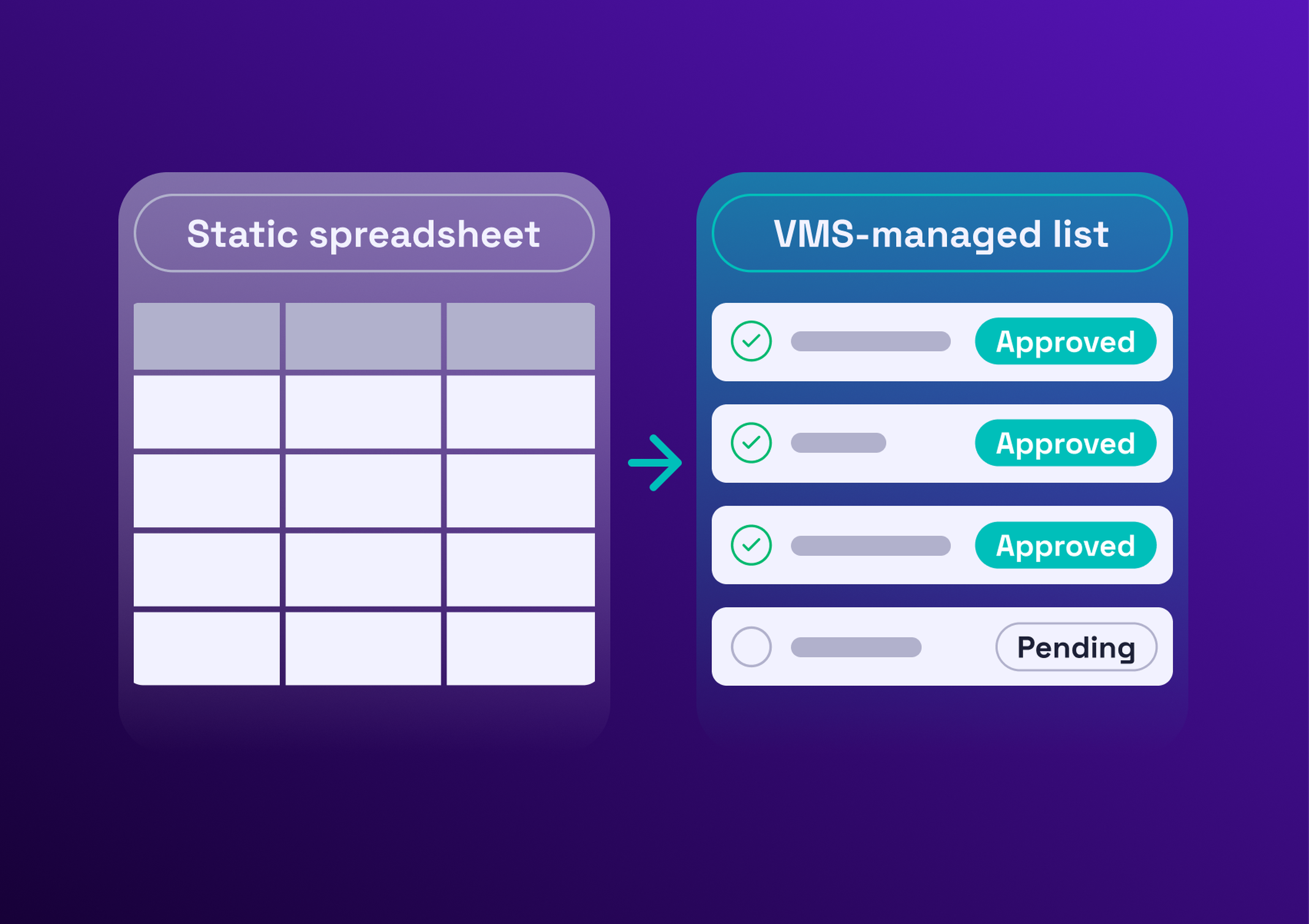
a dynamic supplier listing that keeps the supplier panel current against defined evaluation criteria, rather than an ad hoc spreadsheet
automated alerts for renewals and compliance-document expiry, so a lapse gets caught before it becomes a gap
a complete audit trail per engagement
integrations with the ERP and procurement tools already in place, SAP, Coupa and Workday among them, so supplier and spend data doesn't live in two disconnected places
When Inetum set out to centralize and digitalize the management of its external workforce, strengthening compliance was one of three stated objectives for the project, alongside centralizing engagements and automating sourcing and timesheet approval. The result: stronger compliance and more secure timesheet validation, reported alongside increased visibility into engagements and costs.
Eleven VMS has worked in this space for 12 years, across 75 enterprise clients and 50 countries, and holds ISO 27001, CyberVadis and EcoVadis certifications.
Book a meeting with one of our experts for a personalized demo.