VMS vs MSP means understanding that a vendor management system (VMS) is software you, or an MSP on your behalf, use to manage external suppliers: sourcing, contracts, time tracking, invoicing. A managed service provider (MSP) is an outsourced team that runs the program for you, using that software as its system of record. You can run a VMS without an MSP. Most MSPs run a VMS. The two aren't really competing options, they answer different questions, which is exactly why the comparison trips people up.
VMS vs MSP at a glance
| VMS | MSP | |
|---|---|---|
What it is | Software | Outsourced service team |
Who runs it day to day | Your internal team | The MSP's team |
Cost model | License or subscription | A percentage of spend, see below |
Who owns the data | You | Depends on the contract, see below |
Control over supplier choice | Full, yours to decide | Shared, MSP typically manages the panel |
Contract length | Software contract, often annual | Program contract, often multi-year |
Time to deploy | Weeks to a few months | Often longer, a full program stand-up |
Best for | Internal teams that want control plus tooling | Teams that lack capacity or want one accountable partner |
Typical scale | Any size, scales with usage | Usually larger programs, enough spend to justify the fee |
A VMS and an MSP sit at different layers of the same stack: the VMS is the technology, the MSP is who's operating it day to day. For how an MSP program actually works, from operating models to implementation through core functions, our full MSP guide covers that in depth; this piece focuses specifically on which setup fits your situation.
What a VMS does, and what it doesn't
A VMS handles the operational backbone of external-workforce and services spend:
supplier sourcing and a structured supplier listing
RFQs and RFPs, distributed and compared in one place
contract and rate-card management
tracking assignments and missions against scope
approving timesheets and deliverables
invoicing and spend reconciliation
reporting and KPIs across the program
What it doesn't do: it doesn't negotiate supplier relationships for you, and it doesn't run the program. The software gives you the data and the workflow; someone, your team or an MSP's, still has to make the sourcing calls, manage supplier relationships day to day, and own the outcomes. What a VMS actually is, in more depth, covers the full feature set.
What an MSP does, and what it doesn't
An MSP takes on the operational running of the program: supplier management and rationalization, rate benchmarking, compliance and classification checks, reporting, and the day-to-day relationship with the supplier panel. For the mechanics of how a program actually runs once an MSP is in place, how an MSP program works walks through it step by step.
The limits are the flip side of the benefit: less direct control over sourcing decisions, a fee that scales with spend, and a dependency on the provider that gets more consequential the longer the relationship runs, especially if the data and contracts live inside their systems rather than yours.
How VMS and MSP costs really compare
MSP fees are quoted as a percentage of spend, but the percentage does not always measure the same thing, so two figures are not always comparable. Under a supplier-funded model, an MSP fee typically falls between 1.5% and 4% of spend, as detailed in the MSP funding models. Under a client-funded model, the client pays a management fee directly, flat or variable, rather than the fee being absorbed into supplier bill rates. A figure that looks higher can reflect a different accounting, such as markup bundled into bill rates rather than a standalone MSP fee, or a program structure that includes additional services.
Three funding models explain most of the variation:
Supplier-funded. The MSP's fee comes out of the supplier's margin. No direct line item for the client, but it can compress supplier rates over time.
Client-funded. The client pays the MSP a management fee directly. More transparent, and the cost is visible rather than buried in rates.
Markup built into bill rates. Less a distinct fee than a structural feature, the rate the client sees already has the MSP's margin folded in, which is why two programs with the same "headline" supplier rate can have very different underlying economics.
A worked example, €10M of annual external services spend under three setups:
| Setup | Approximate annual cost | What it covers |
|---|---|---|
VMS run in-house | Cost-efficient: a software fee (license, usage-based or other model) plus your internal team cost | Software plus your own headcount to run the program |
MSP with its own bundled VMS | €150,000 to €400,000 (1.5% to 4% of spend) | Program management and technology bundled together |
MSP operating on your own VMS | MSP fee, often at the lower end of the range, plus your existing VMS license | Program management layered onto technology you already own |
Calculate the ROI of your own spend profile for a number specific to your program rather than a generic range.
Who owns the VMS, and your data?
When an MSP supplies its own bundled VMS, your supplier history, negotiated rates, contracts and performance data live inside their system. Change MSPs, or bring the program in-house, and that data doesn't automatically come with you in a usable form, if it comes at all. A client-owned VMS flips that: the MSP operates on your platform, and the data stays yours regardless of who's running the program on any given day.
The practical effect shows up in negotiating power too. An MSP that also owns your data has less incentive to make switching easy, while a client-owned VMS keeps that leverage with you.
Three questions worth asking before signing an MSP contract:
If we leave, do we receive our supplier history, rates and contract data in a usable, portable format, and within what timeframe?
Is the VMS the MSP's own platform, or ours, and does that change if the relationship ends?
Who has the contractual right to approach our suppliers directly if we switch providers?
VMS vs MSP for statement-of-work and consulting services
Most MSP content assume temp staffing: hourly workers, filled fast, managed on volume. That's genuinely where MSPs are strong. Consulting, IT and engineering services bought by statement of work or fixed price are a different problem: governance has to track deliverables and milestones, not hours, and rate benchmarking has to account for scope and seniority rather than a flat hourly card.
For high-volume, repeatable hourly staffing, an MSP's scale and supplier relationships genuinely add value. For statement-of-work and intellectual-services spend, running it in-house on a VMS, built specifically for services procurement, usually gives more control over exactly the things that matter most for that category: deliverable acceptance, milestone tracking, and rate benchmarking against day rate or fixed price rather than a generic hourly bill rate.
When to choose a VMS, an MSP, or both
Choose a VMS alone if
your internal procurement team has the capacity to run sourcing and supplier management directly
external spend is concentrated in statement-of-work or fixed-price services rather than high-volume hourly staffing
you want full control over supplier relationships and data
your supplier base is manageable without dedicated program staff
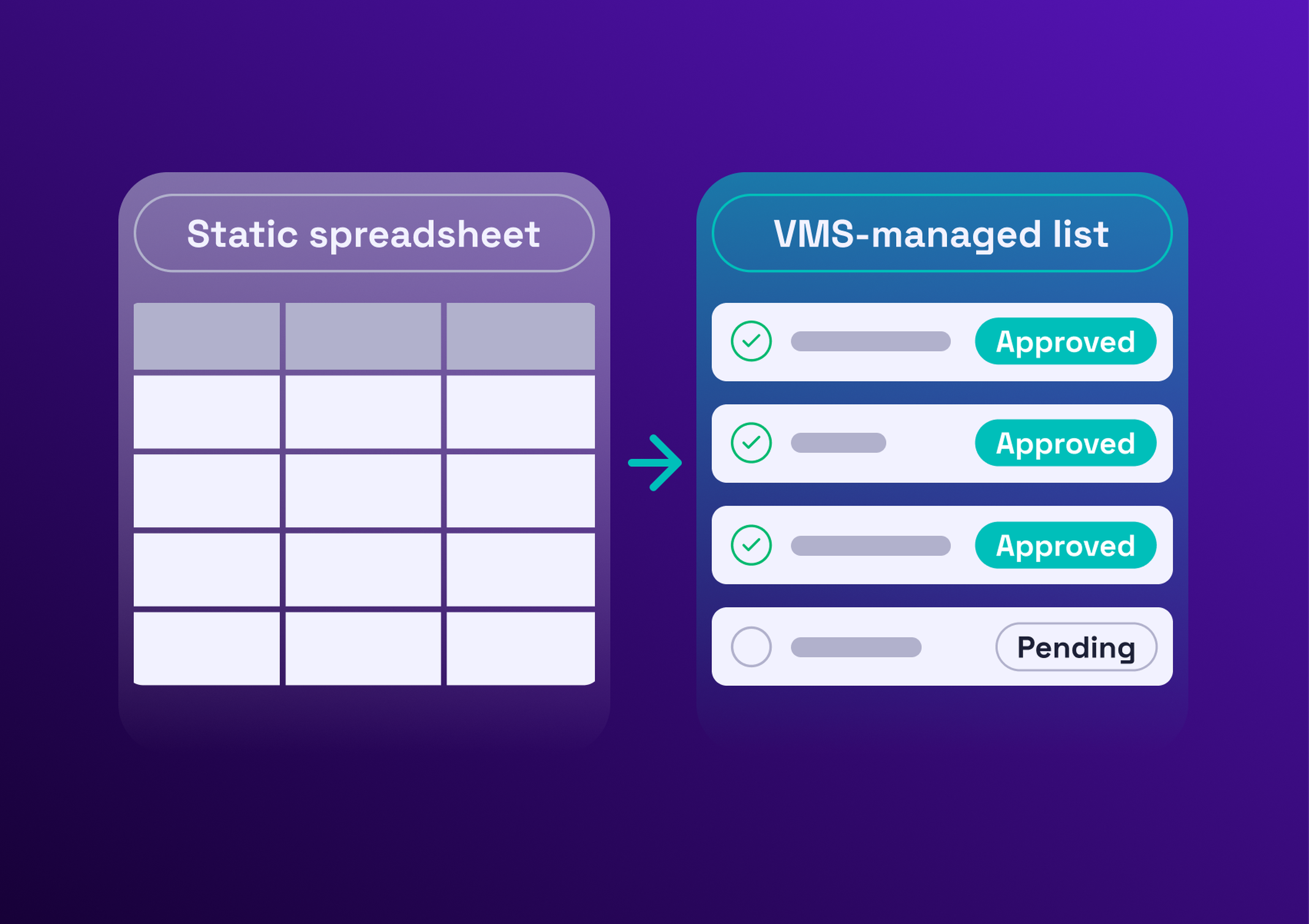
you're consolidating from spreadsheets and need structure before deciding whether to add a service layer
Choose an MSP if
internal procurement capacity can't cover the program's operational load
spend is concentrated in high-volume, repeatable hourly staffing
you want a single accountable partner rather than managing dozens of supplier relationships directly
you're scaling into multiple countries faster than your internal team can build local expertise
compliance exposure across a large supplier base needs dedicated, specialized management
Combine both if
your spend splits meaningfully between hourly staffing and statement-of-work services, each suiting a different model
you want an MSP's operational capacity without losing data ownership, by having them operate on your own VMS
the program spans enough countries and suppliers that neither pure in-house nor pure outsourced coverage fits every category
you're mid-transition between models and running both deliberately during the switch
Decision matrix: score your organization
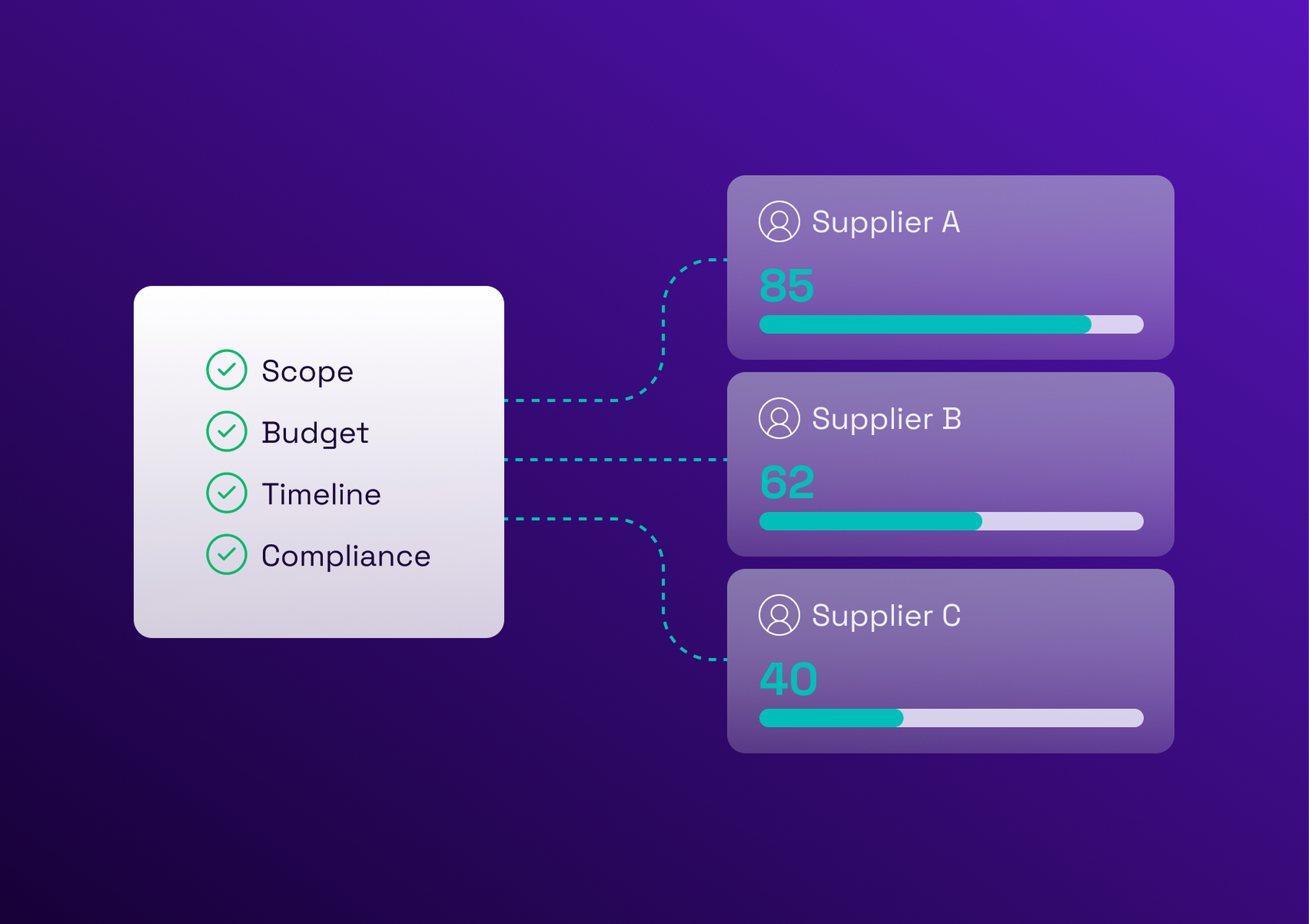
Score your organization on six criteria, 1 to 3 points each.
| Criterion | 1 point | 2 points | 3 points |
|---|---|---|---|
Annual external spend | Under €5M | €5M to €25M | Over €25M |
Number of active suppliers | Under 20 | 20 to 75 | Over 75 |
Share of spend that's statement-of-work vs. hourly | Mostly statement-of-work | Roughly split | Mostly hourly staffing |
Internal procurement headcount dedicated to this spend | 2 or more FTE | 1 FTE | Less than 1 FTE |
Number of countries | 1 | 2 to 5 | 6 or more |
Compliance exposure (classification, co-employment risk) | Low | Moderate | High |
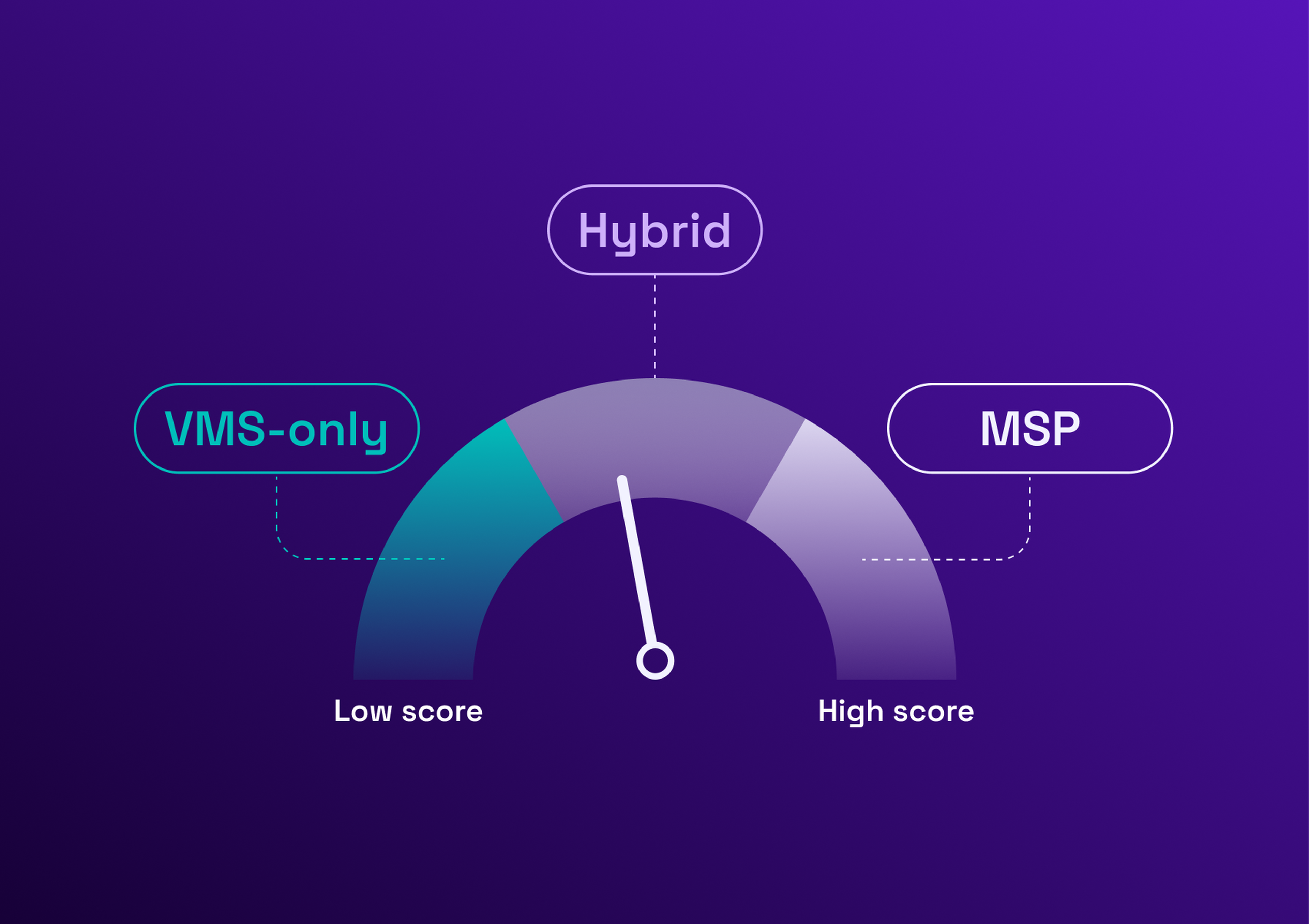
Total the six scores. 6 to 10 points points toward VMS-only: your internal capacity and spend profile suit running the program directly. 11 to 14 points points toward a hybrid setup, an MSP operating on your own VMS, or an MSP for part of the portfolio while statement-of-work spend stays in-house. 15 to 18 points points toward a full MSP program: scale, supplier count and compliance complexity generally outweigh what an internal team can cover alone.
Assess your procurement maturity for a fuller picture beyond this six-criteria snapshot.
Switching models: MSP to in-house VMS, and back
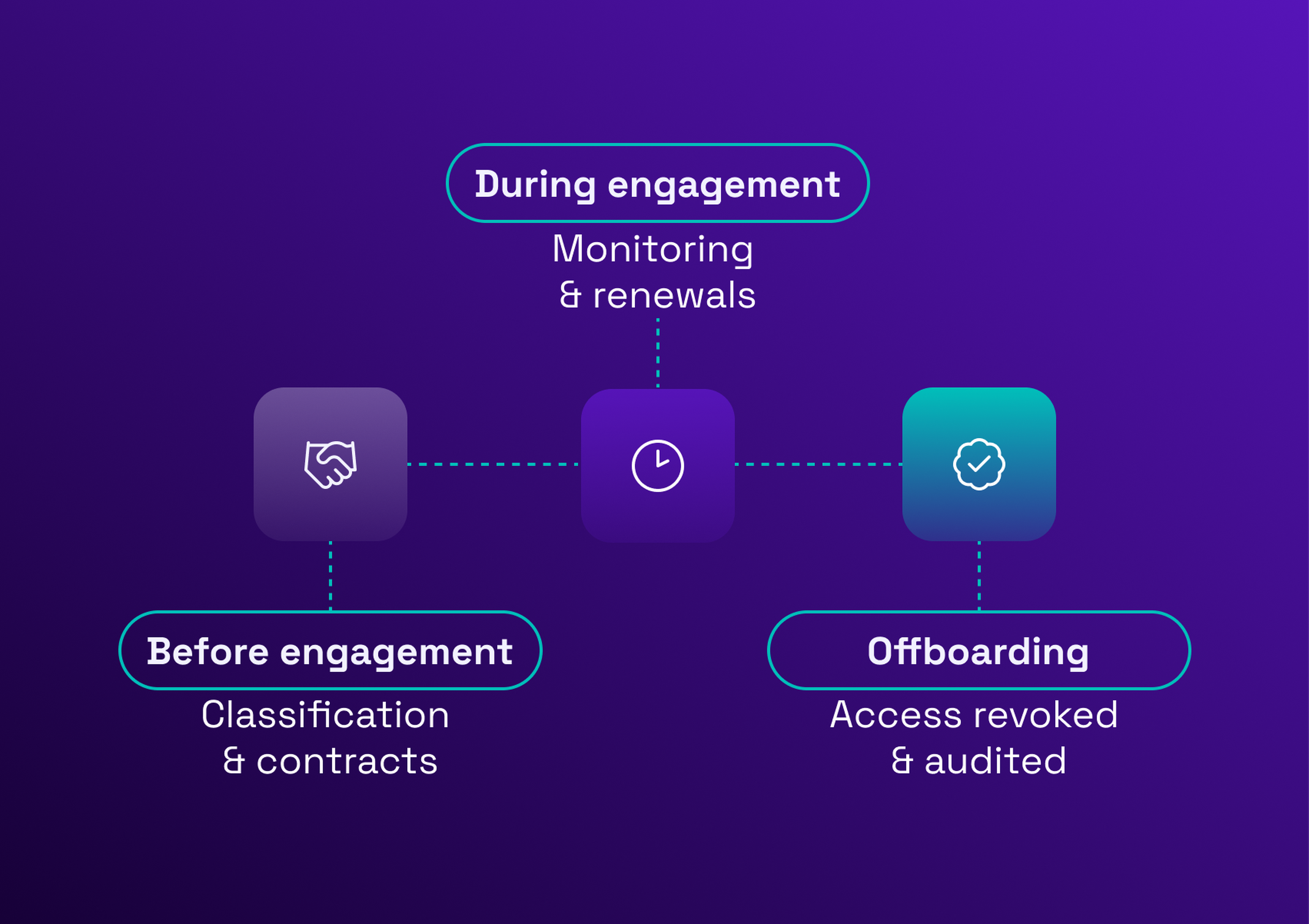
Moving between models is a real project, not a configuration change, and it tends to go wrong when treated as the latter. The same discipline covered in VMS change management applies here, and the same failure modes covered in common VMS project mistakes are worth checking against before committing to a timeline.
Audit contracts and data. Know exactly what supplier contracts, rate cards and performance history exist, and in what format, before committing to a timeline.
Keep supplier continuity. Suppliers shouldn't experience a gap in how they're engaged or paid during the transition; re-contracting takes real time, which needs to be planned, not discovered.
Run old and new in parallel. A hard cutover on a live program is where data gets lost and suppliers get confused. A parallel period, even a short one, catches problems before they affect delivery.
Handle change management deliberately. Hiring managers and category owners who are used to one model need to actually adopt the new one, not just be informed it's changing.
Set a realistic timeline. Programs of meaningful size generally need months, not weeks, to switch cleanly. Compressing this is where most of the actual risk in switching lives.
Compliance considerations in Europe
Running a program across Europe adds obligations that a US-centric comparison doesn't surface. Disguised employment and unlawful labor-lending rules, which exist in various forms across EU member states, create exposure when a contractor is directed too much like an employee, regardless of which model, VMS-only or MSP, is running the program; the model changes who operationalizes the controls, not who ultimately carries the legal risk. GDPR applies to supplier and worker personal data moving through either a client-owned or MSP-owned VMS, and a client-owned system generally gives more direct control over data residency and retention decisions. Deployments spanning several countries also mean compliance requirements that differ by jurisdiction need a consistent process to apply them, which is harder to guarantee when a program is run ad hoc versus through a structured VMS or MSP engagement. Deploying a VMS internationally covers that multi-country rollout in more depth.
This is general information, not legal advice. Compliance obligations vary by country and should be confirmed with counsel for your specific footprint.
Eleven VMS works either way
Eleven VMS has worked in this space for 12 years, across 75 enterprise clients and 50 countries, as the technology layer whether a program is run internally or through an MSP. As Olivier Chouillou, Category Buyer in charge of Contractors at Parrot, puts it: "Thanks to Eleven VMS, mastering our KPIs, and daily rates in particular, has let us manage our spend better and generate savings."
Book a meeting with one of our experts for a personalized demo.