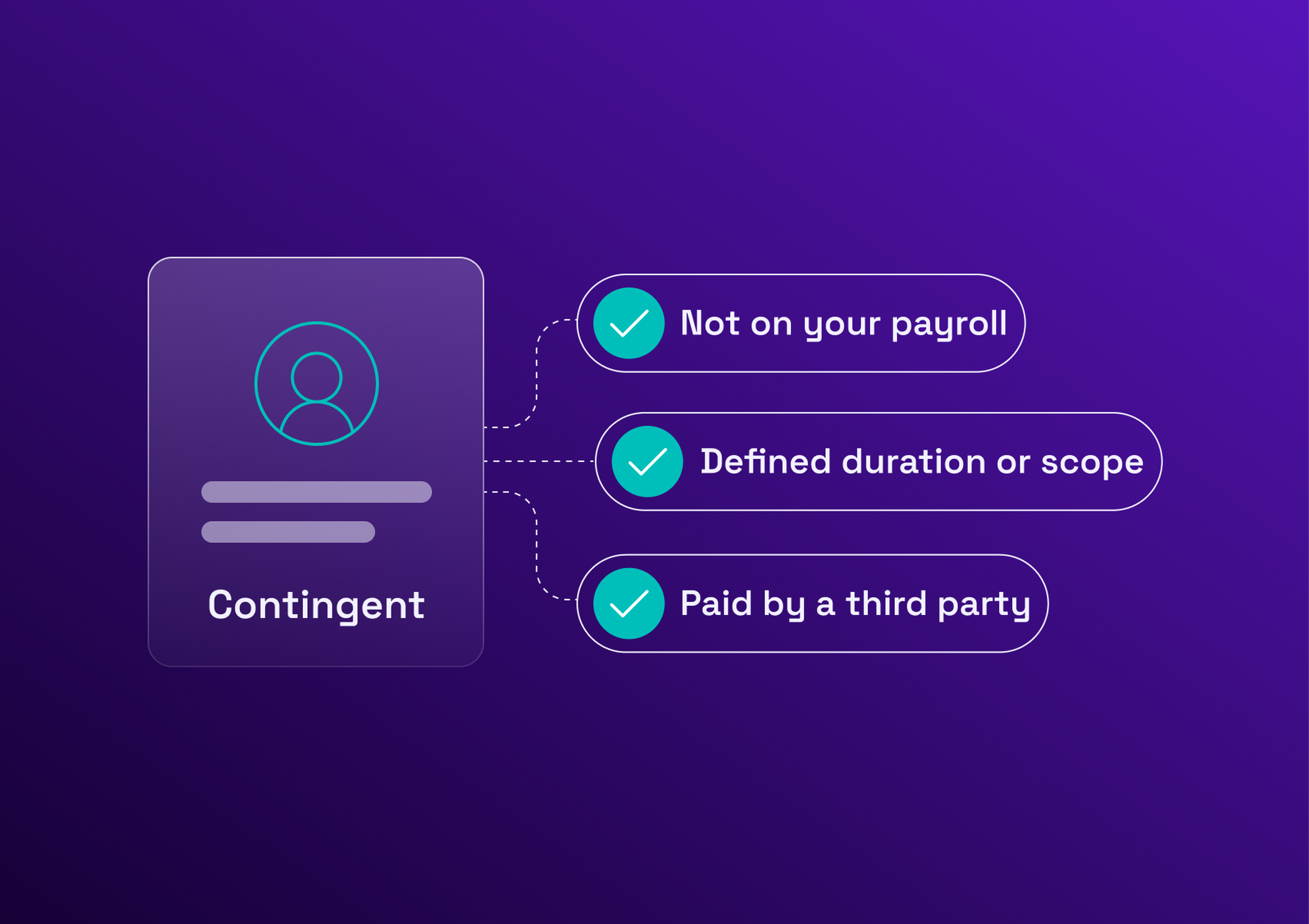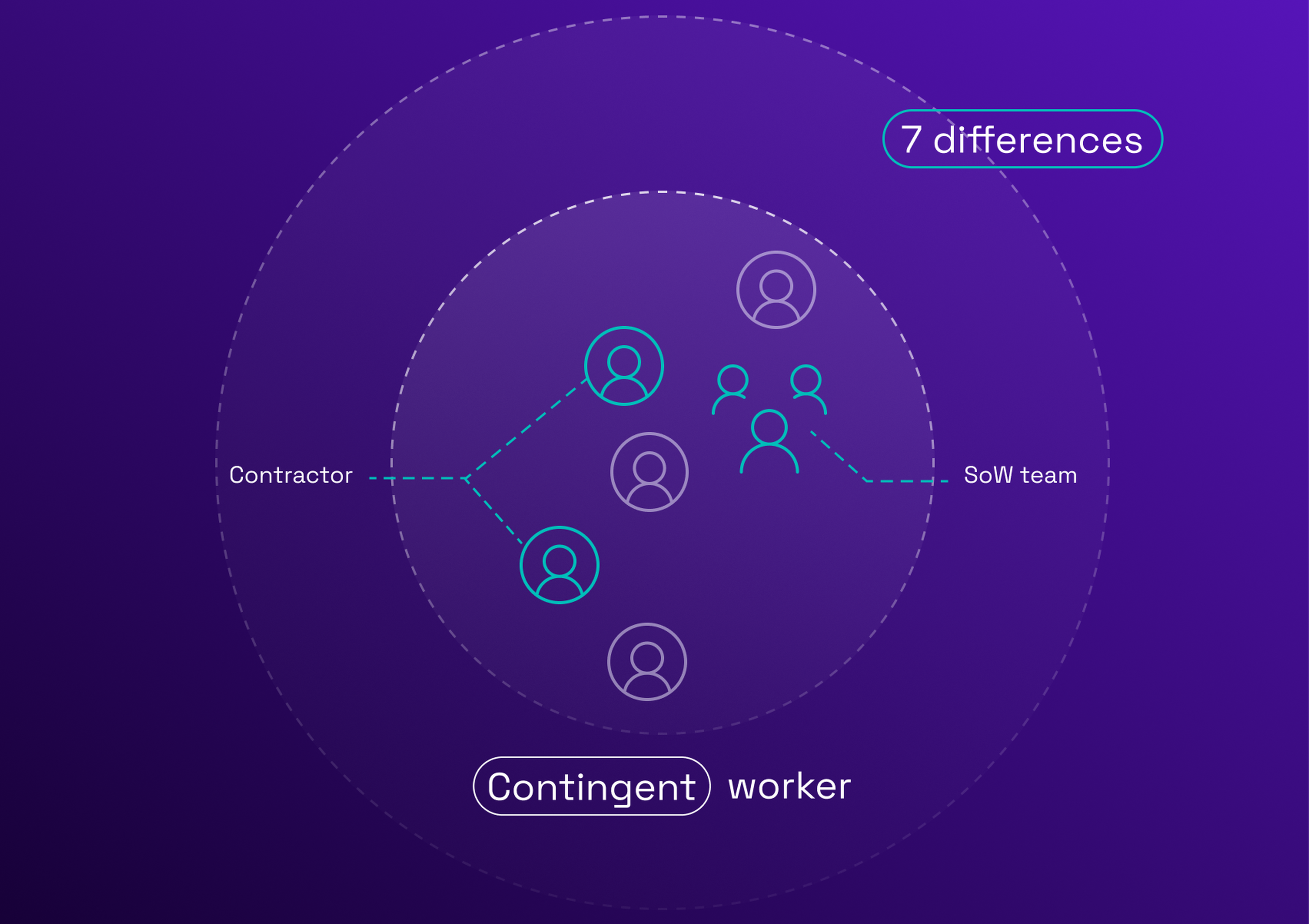
A contractor is one type of contingent worker, which is the short answer to the contingent worker vs contractor question. "Contingent worker" is the umbrella term for anyone who works for you without being on your payroll: temps, freelancers, consultants and SOW teams. A contractor is engaged for defined work under a commercial agreement, directly or through a vendor.
The distinction matters for three reasons: classification risk, who manages the work day to day, and how the spend is tracked. This guide sets out seven differences side by side, how classification rules differ in the US, the UK, France and the EU, and a decision matrix to choose the right model for each need.
Is a contractor a contingent worker?
Yes. The test for being a contingent worker is not being on your payroll, and contractors meet it, whether they are self-employed or employed by a vendor. The reverse does not hold: temps and agency workers are contingent workers but not contractors, because they are employed by an agency and directed by the client's manager.
One confusion is worth clearing up. A "contract employee" on a fixed-term contract who sits on your payroll is an employee, not a contingent worker, even though the word contract appears in the title. The question to ask is always whether the person is on your payroll. The comparison of a contingent worker vs independent contractor follows from that: an independent contractor is one of the several kinds of contingent worker.
What is a contingent worker?
A contingent worker is someone who works for an organization without being one of its permanent employees. The relationship is tied to a need, a project or a period, rather than to an open-ended job. Five types make up the contingent workforce:
Temporary workers: agency temps, employed by the agency and placed with the client for a period.
Freelancers: self-employed individuals who sell their skills assignment by assignment.
Independent contractors: self-employed professionals engaged directly for defined work, who invoice the client.
Vendor-supplied consultants: consultants employed by a consulting or IT services firm and billed to the client.
SOW teams: groups delivered by a supplier against a statement of work, paid on deliverables.
Each type is bought and managed differently, which is why a company that treats them as one group loses track of them. The full picture of how to run all five is in the guide to managing a contingent workforce. This page stays focused on one question: where contractors fit, and how they differ from the rest.
What is a contractor?
A contractor, sometimes called a contract worker, is a worker or supplier engaged under a commercial agreement for defined work, rather than under an employment contract. Two situations are very different in practice, and most guides cover only the first.
Independent contractor
An independent contractor is self-employed. They control how the work is done, use their own tools, invoice the client directly and are responsible for their own taxes and social contributions. Freelancers are the same thing in most cases: the word freelancer is more common for short, project-by-project work. The arrangement holds only if the contractor stays genuinely independent.
Contractor supplied by a vendor
In IT, engineering and consulting, most contractors are not self-employed. They are consultants employed by a consulting or IT services firm, who work for the client and are billed by day rate or under a statement of work. The vendor is their employer, so the classification question looks different: the risk is not that the consultant is really the client's employee on paper, but that the client manages them as if they were. This is the most common case in buying intellectual services, and it is where compliance problems tend to build up unnoticed.
Contingent worker vs contractor: side-by-side comparison
A contingent worker is a category and a contractor is a type, so the table compares the two columns on the points where they differ in practice.
| Difference | Contingent worker (any type) | Contractor | |
|---|---|---|---|
1 | Legal relationship | Any non-payroll arrangement: employed by an agency or a vendor, or self-employed | A commercial agreement for defined work, either self-employed or employed by a vendor |
2 | Benefits and payroll taxes | Carried by the employer: the agency for temps, the vendor for consultants, the worker if self-employed. The client pays for them indirectly, through the rate | None from the client. Independent contractors pay their own taxes and social contributions, and a vendor covers its own consultants. Reclassification as employment can shift these costs to the client |
3 | Who directs the work | Varies: temps are usually directed by the client's manager, consultants by their own firm | The contractor or the vendor, against an agreed scope. Direction by the client is the main classification risk |
4 | Typical duration | From days to years, often open-ended for temps | Defined by the mission or the SOW, but renewals can stretch it well beyond the original plan |
5 | Pricing model | Hourly or day rate, with an agency markup | Day rate (time and materials) or fixed price (SOW), invoiced by the contractor or the vendor |
6 | Main compliance risk | Co-employment and misclassification, depending on the type | Misclassification for independent contractors, illicit labor lending for vendor-supplied consultants |
7 | Who owns the spend and how they are bought | Often HR or the staffing agency channel, bought through an agency, a managed service provider or direct | Often procurement, bought direct, through a vendor panel or under a statement of work |
These seven differences come down to one idea: a contractor is defined by an outcome and a commercial agreement, a temp by hours and direction. The questions that matter are who directs the work, how the person is classified, and who owns the spend. Worker classification is where a wrong answer costs the most.
How classification rules differ by country
Regulators test the same thing everywhere: whether the relationship works like employment, whatever the contract says. The tests differ by country.
United States
The IRS applies a common-law test that groups the evidence into behavioral control, financial control and the relationship of the parties. The Department of Labor applies an economic-reality test under the Fair Labor Standards Act. In February 2026, the DOL proposed to rescind its 2024 rule and restore a test that gives weight to two core factors: control over the work, and the worker's opportunity for profit or loss. Comments closed in April 2026, and the proposal had not been finalized at the time of writing. In the meantime, the DOL announced in May 2025 that it would not apply the 2024 rule in its own enforcement. California applies the ABC test, which is generally stricter.
For scale, the Bureau of Labor Statistics measured contingent work and independent contracting separately in July 2023. 6.9 million people held contingent jobs, 4.3% of total employment, and 11.9 million were independent contractors, 7.4% of total employment. The two measures overlap and cannot be added up. BLS also defines contingent work narrowly, as a job not expected to last, which is why its count is smaller than the business use of the term.
United Kingdom
Under the IR35 off-payroll rules, medium and large clients have been responsible since April 2021 for deciding whether a contractor working through their own company is inside or outside IR35. A wrong decision shifts the unpaid tax and National Insurance contributions to the client.
France and the EU
In France, a contract can be reclassified as employment when the facts show a lien de subordination: the contractor takes orders, follows schedules and works inside the client's organization. For vendor-supplied consultants, two offenses apply when a supplier does little more than provide staff. The Code du travail prohibits illicit labor lending (prêt de main-d'œuvre illicite) and marchandage, a for-profit supply of labor that harms the worker or evades legal protections. Both the supplier and the client can be held liable.
At EU level, the Platform Work Directive, Directive (EU) 2024/2831, must be transposed by member states by 2 December 2026. It introduces a rebuttable presumption of employment for people working through digital labor platforms when the facts show control and direction. Its scope is platform work, so it does not apply directly to a consultant placed by an IT services firm, but it shows where regulation is heading.
| Country | Main test | Who carries the risk | Penalty example |
|---|---|---|---|
United States | IRS common-law control test, DOL economic-reality test, California ABC test | The company engaging the worker | Back taxes and interest. In California, $5,000 to $15,000 per violation for willful misclassification, $10,000 to $25,000 for a pattern or practice |
United Kingdom | IR35 off-payroll rules | The client, which issues the status determination | Unpaid income tax and National Insurance contributions, plus interest |
France | Subordination, illicit labor lending, marchandage | The supplier and the client | Up to two years' imprisonment and a €30,000 fine for individuals, up to €150,000 for companies |
European Union | Platform Work Directive: presumption of employment for platform work | The platform | Set by each member state in its transposition law |
Penalty examples: California Labor Code § 226.8(b) and (c), and Code du travail, articles L8234-1 and L8243-1. This is general information, not legal advice. Rules and thresholds change, and classification depends on the facts of each engagement.
Which should you use? A decision matrix
The right model depends on what you need and how you intend to manage it.
| If you need | Best fit | Why |
|---|---|---|
Extra hands managed by your team | Temp or staff augmentation | You direct the work day to day, while the agency or vendor remains the employer |
Specialist skills for a defined outcome | Contractor on fixed price or SOW | The supplier owns the delivery and the direction, and you accept deliverables |
An ongoing service with service levels | Managed service | The supplier runs the service and commits to service levels |
A role that is ongoing, full-time and under your direction | Employee | The relationship is employment in substance, so filling it with a contingent worker carries the highest classification risk |
Temps and staff augmentation fit the first need, where you direct the work. Pricing is part of the choice. A fixed-price statement of work moves delivery risk to the supplier and calls for acceptance criteria; a day-rate engagement keeps flexibility and calls for tighter control of hours and renewals. The day rate vs fixed price comparison covers that trade-off in detail. As a rule of thumb, if you cannot describe the outcome and you plan to direct the person, a SOW contractor is the wrong tool.
5 common mistakes when managing contingent workers and contractors
Directing contractors' day-to-day work like employees: setting schedules, handing out tasks and reviewing performance create co-employment risk, whatever the contract says.
Renewing missions with no tenure limit: a consultant renewed for 24 months or more starts to look like an employee, even though each renewal looked harmless.
Collecting no compliance documents at onboarding: certificates and insurance are then missing exactly when an audit asks for them. The contractor compliance checklist lists what to collect.
Letting HR and procurement each track only part of the external workforce: no one has the full view of who works for the company, under which contract.
Paying different rates for the same profile across vendors: without a shared reference, rates drift upward and comparisons become impossible.
How to manage both in one system
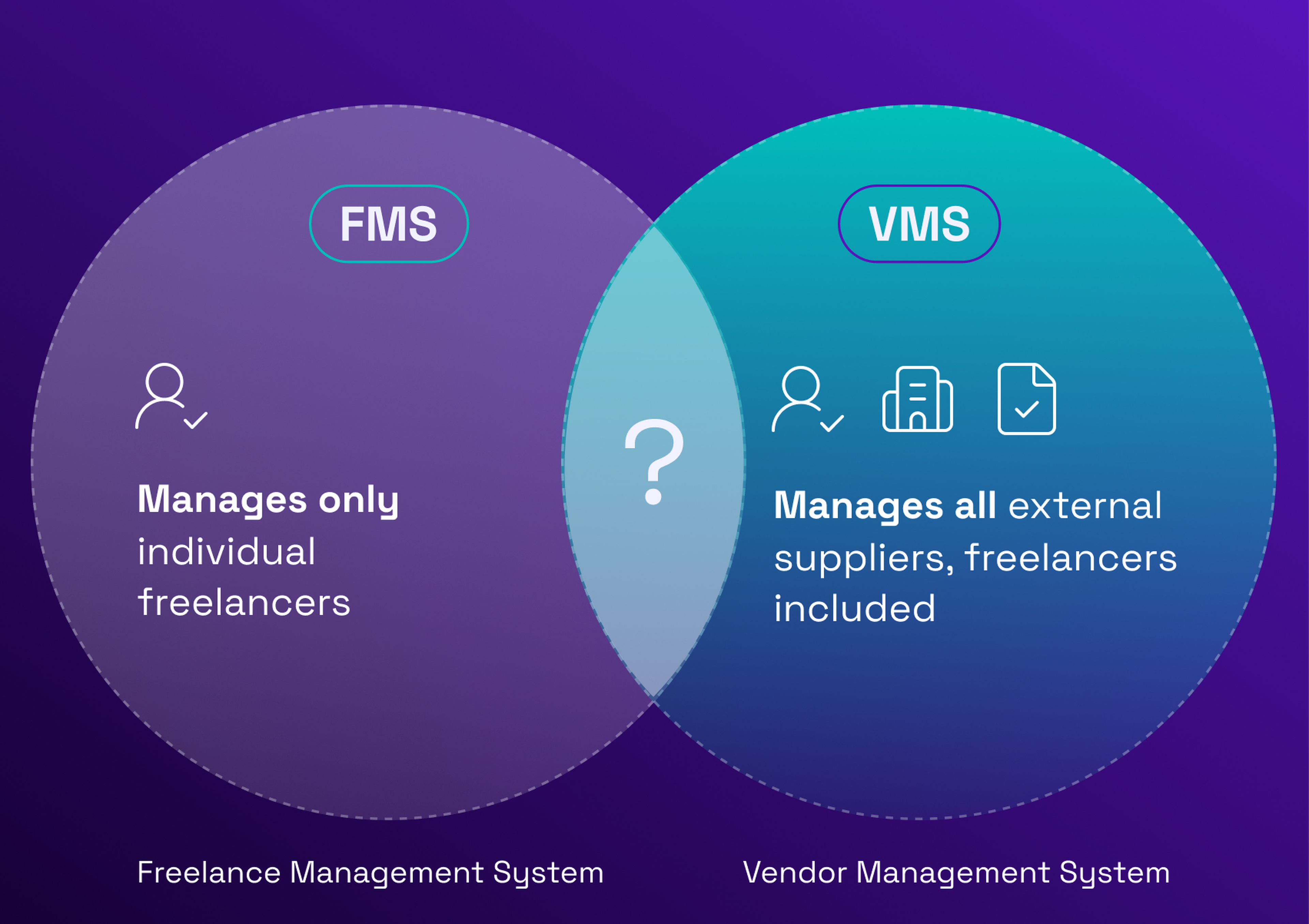
Contingent workers and contractors share one problem: they sit outside the systems built for employees. A vendor management system brings them into one process, with:
one list of approved suppliers, so every engagement starts from a known, compliant source
compliance documents checked at onboarding, with alerts before they expire
alerts when a mission's length crosses a threshold, to catch tenure drift early
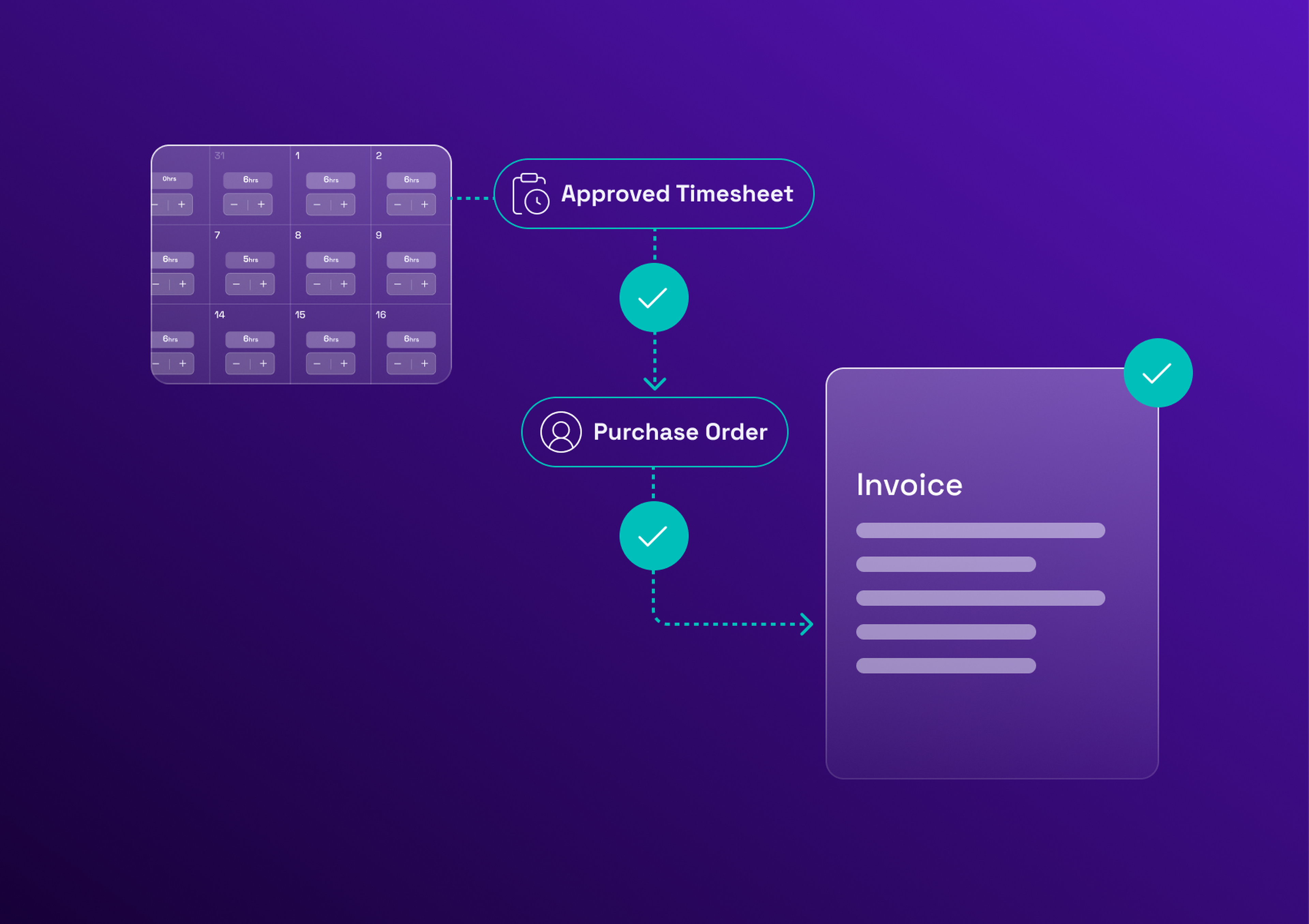
timesheet approval for day-rate work and milestone approval for fixed-price work
one view of spend across all types of external workers
At Equans, the project structured IT purchasing in two months. This is what contingent workforce management looks like when the distinctions in this guide are built into the process rather than remembered by individuals.
Book a meeting with one of our experts for a personalized demo.