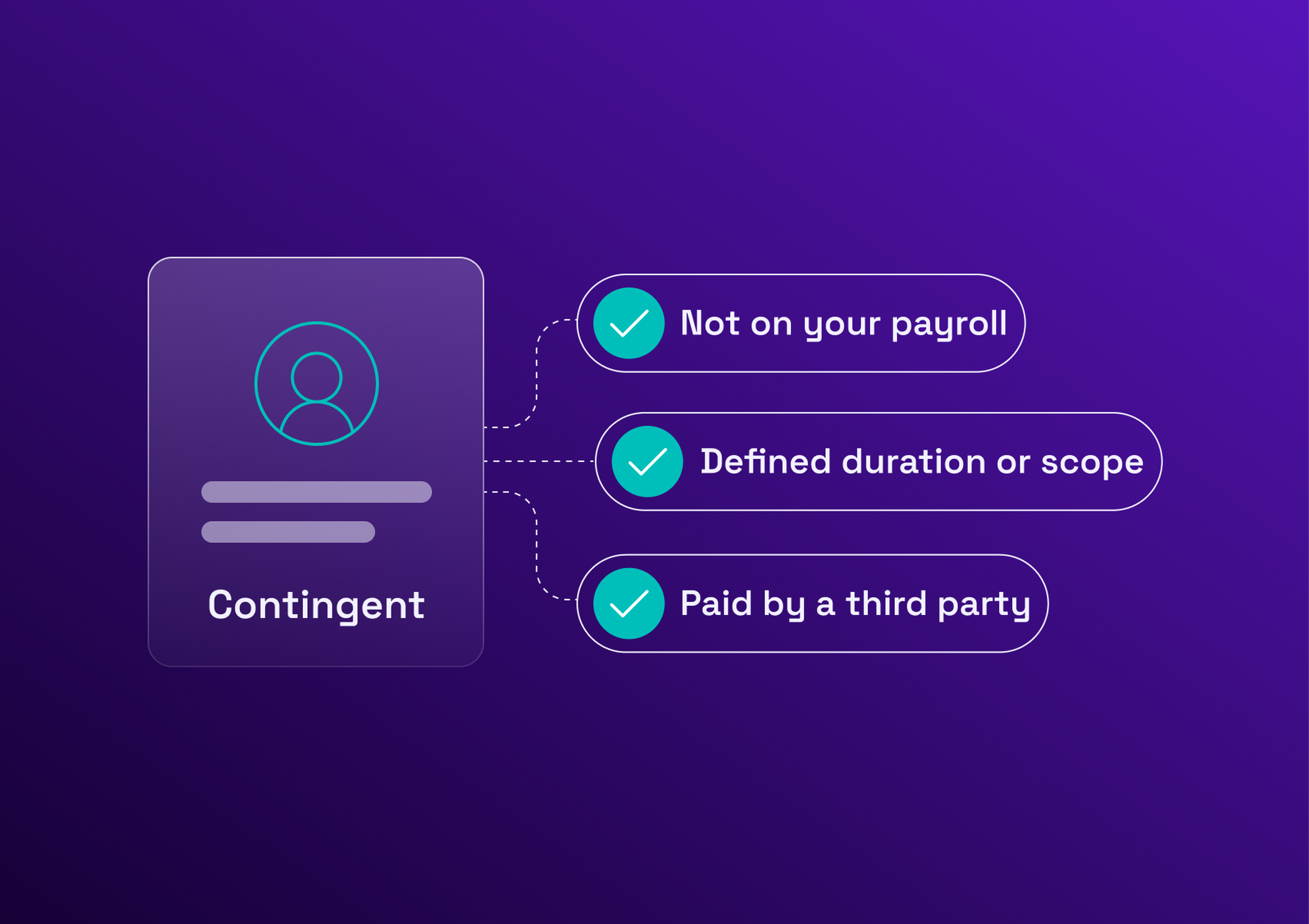
A contingent worker is someone who works for your organization without being on your payroll, for a defined duration or scope, and who is paid through a third party or by invoice. Consultants placed by a consulting firm, agency temps, interim managers and freelancers are all examples.
For procurement teams, the category matters because this work is bought, not hired. It goes through suppliers, statements of work and day rates rather than HR contracts, and it makes up a growing share of the people working inside the company. Managing it well is part of managing a contingent workforce.
What does contingent worker mean?
In practice, what are contingent workers? A person is a contingent worker when three conditions hold:
they are not on your payroll
they are engaged for a defined duration or scope
they are paid through a third party or by invoice
The meaning rests on the word "contingent": the role exists only as long as the business need does. When the project ends, the engagement ends, which is what separates a contingent worker from a permanent employee. The three conditions also explain why the category is wider than "freelancer": a consultant placed by a firm and an agency temp both meet them, even though neither is independent.
The category is not marginal. Staffing Industry Analysts' 2025 buyer survey found that contingent and external workers already make up an average of 21% of organizations' workforce, with buyers expecting 26% within ten years.
Examples of contingent workers
Six situations cover most of what companies buy:
| Worker type | How they're engaged | Typical contract | Who pays them | Example |
|---|---|---|---|---|
IT consultant placed by a consulting firm | Through the firm, on a mission | Day rate (time and materials) between the client and the firm | The consulting firm, which invoices the client | A data engineer placed for nine months on a reporting project |
Engineering team delivering under a statement of work | By a supplier, against deliverables | Fixed price under a statement of work | The supplier, which invoices on milestones | A team building an application to a defined scope |
Interim manager | Through an interim management firm, or directly | Fixed-term mission, often at a day rate | The firm, or the manager's own company | A transformation lead covering a vacant role for six months |
Agency temp | By a staffing agency | Assignment between the client and the agency | The agency, which is the legal employer | A temp covering a seasonal peak |
Independent freelancer | Directly by the client | Service contract, at a day rate or fixed price | The freelancer invoices the client | A freelance designer on a campaign |
Consultant engaged through an umbrella company (portage salarial in France) | Through the umbrella company | Three-party agreement | The umbrella company, which employs the consultant | An independent consultant in France working through portage salarial |
Each model changes how the worker is sourced and governed. Types of contingent workers are described in the contingent workforce guide, and models such as staff augmentation or a managed service provider add their own rules.
Interns are generally not contingent workers: they are on an internship or training agreement, not engaged to deliver a paid service under a contract or a statement of work.
Contingent worker vs employee vs contractor vs temp
The differences come down to who the employer is, who directs the work and who pays.
| Employee | Contractor | Agency temp | |
|---|---|---|---|
Employer of record | Your organization | The contractor, self-employed or through their own company | The staffing agency |
Contract type | Employment contract | Service contract, with you or with a supplier | Assignment between you and the agency |
Benefits | Provided by your organization | None from you; the contractor covers their own | Provided by the agency, under local rules |
Who manages the day-to-day work | Your manager | The client for day-rate work, the contractor for deliverable-based work | The client, within the assignment terms |
How they're paid | Payroll | Invoice, at a day rate or fixed price | The agency invoices you and pays the worker |
Which budget pays | Headcount budget | External services budget | External services or temporary labor budget |
On the contractor vs contingent worker question, a contractor is one kind of contingent worker, not a separate category. Are contingent workers employees? Yes, but of someone else: an agency, a consulting firm or their own company, and not yours.
How contingent workers are paid
Two models cover most engagements, and the choice changes who carries the risk:
Time and materials (day or hourly rate). The client pays for time worked, usually per day, against approved activity reports or timesheets. The risk sits with the client: delivery is not guaranteed, and an engagement can drift in scope and duration without a defined end.
Fixed price (statement of work). The supplier commits to deliverables for a set price, paid on milestones. The risk shifts to the supplier, but the scope has to be defined precisely up front, or changes turn into disputes.
The trade-offs of each model are covered in day rate vs fixed price.
The lifecycle of a contingent worker, from request to offboarding
Procurement sees a contingent worker as a process that runs from the first request to the day access is removed:
Need and budget approval. A business manager raises a request with the scope, the duration and the budget, and it is approved before any supplier is contacted.
Sourcing from approved suppliers. The request goes to suppliers that are already qualified, from an approved vendor list, rather than to whoever the manager already knows.
Proposal or RFP. Suppliers respond with profiles and prices. For larger scopes, a formal RFP makes the responses comparable (see how to write an RFP for services).
Contract. A day rate or a statement of work, with the rate, the scope, and the terms on subcontracting and replacement agreed in writing.
Onboarding and system access. The worker receives the access, equipment and documents the mission requires, each with an end date attached.
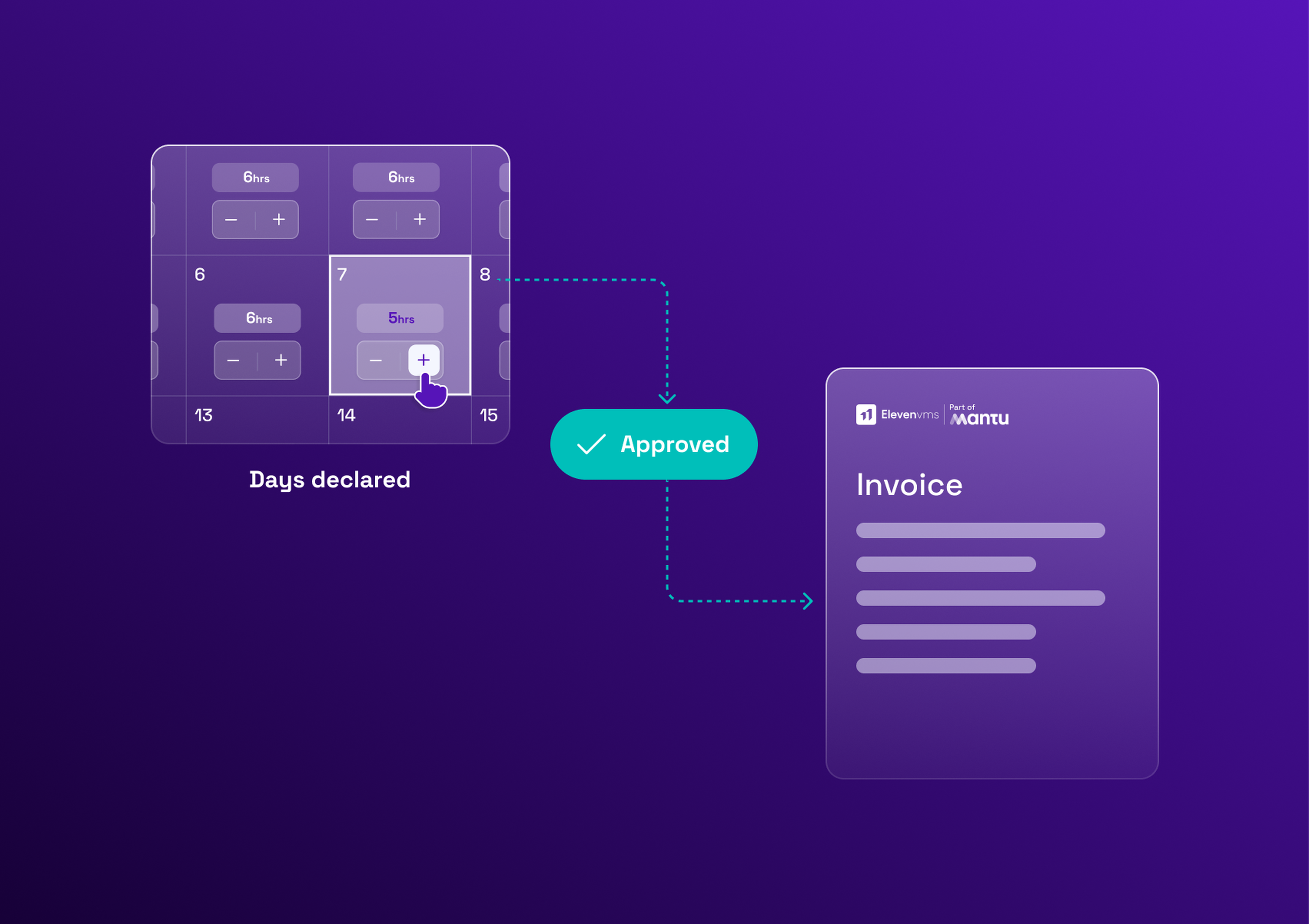
Timesheet or deliverable approval, and invoicing. The business manager approves time or deliverables, which are checked against the purchase order and the rate, then invoiced. This is the monthly cycle of the source-to-pay process.
Extension or offboarding. The mission is extended through an explicit decision, or it ends with access removed and knowledge handed over.
Contingent workers in Workday, SAP and Oracle: HR system record vs VMS
Contingent worker in Workday and other HR systems
HR systems such as Workday, SAP SuccessFactors and Oracle HCM hold a contingent worker record. It typically contains:
the identity of the person
their manager and their location
their access
their start and end dates
That record exists so the organization knows who is working inside it, even though the person is not an employee.
What sits elsewhere
The commercial side of the engagement sits somewhere else:
the supplier and the rate
the purchase order and the contract
the invoices
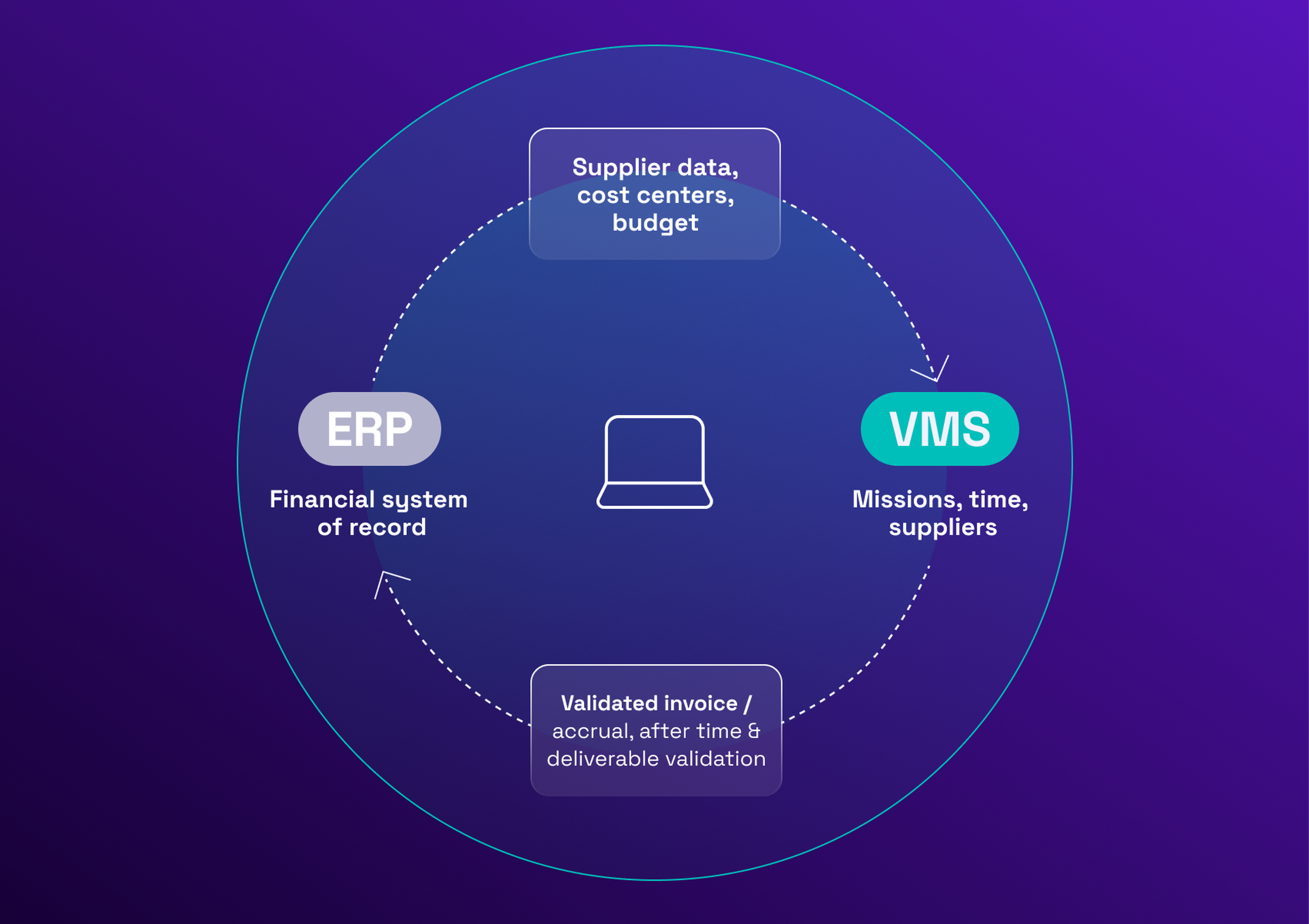
It usually lives in a purchasing system, in spreadsheets, or in a vendor management system. The two views have to be connected. Otherwise a person can hold access with no valid contract behind them, or a contract can run on after the person's access was removed. The procurement integration guide covers how the systems are connected.
Contingent worker terms in different countries
The concept travels, the vocabulary and the rules do not.
| Country | Common terms | Main classification rule |
|---|---|---|
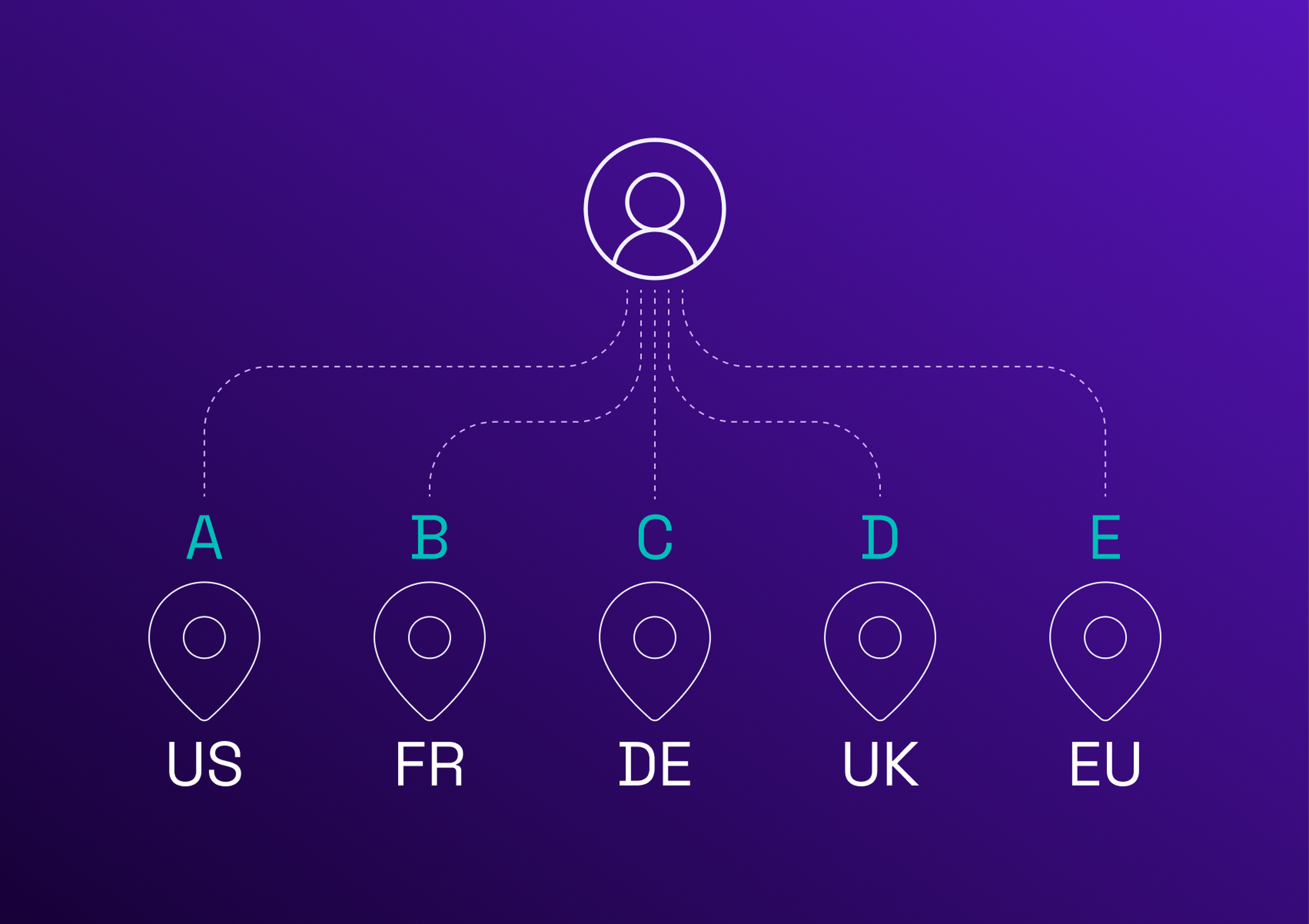
United States | 1099 contractor, independent contractor, staffing-agency worker | Facts-based tests: the IRS common-law test (behavioral control, financial control, relationship of the parties) and an economic reality test for wage-and-hour rules |
United Kingdom | Contractor, off-payroll worker, agency worker | IR35 off-payroll working rules: for most medium and large clients, the client decides whether the engagement is inside or outside IR35 |
France | Prestataire, intérimaire, portage salarial | Courts look at the reality of the relationship, mainly subordination. Undeclared work (travail dissimulé) and unlawful labor lending (prêt de main-d'œuvre illicite) are prohibited |
Germany | Freelancer (Freiberufler), agency worker (Leiharbeitnehmer) | Disguised self-employment (Scheinselbstständigkeit) is assessed on the facts, such as integration into the client's organization and subjection to its instructions. Agency workers fall under the AÜG, with an 18-month limit for assignments to the same client, subject to exceptions in collective agreements |
European Union | Platform worker | The Platform Work Directive (EU) 2024/2831, to be transposed into national law by 2 December 2026, introduces a presumption of employment where a digital labor platform directs and controls the work |
Sources: IRS, independent contractor vs. employee · GOV.UK, off-payroll working (IR35) · Légifrance, article L8221-1 · Légifrance, article L8241-1 · AÜG, § 1 · EUR-Lex, Directive 2024/2831
This is general information, not legal advice. Classification depends on the facts of each engagement and on local law, and should be confirmed with legal counsel.
Risks of engaging contingent workers (and how to avoid them)
Four risks come up most often, each with a simple fix:
Misclassification. A contingent worker directed like an employee can be treated as one. The fix is to define the scope and the acceptance of the work, and to keep day-to-day direction with the supplier when the model is deliverable-based.
Assignments running too long. Long tenure and repeated extensions are a classification signal. The fix is an end date on every engagement and an explicit approval for each extension.
System access not removed. A contract ending does not end access. The fix is to tie access removal to the end date and to check it at offboarding.
Rates drifting without control. The same role gets booked at different rates by different managers. The fix is a rate card and a single request process.
The contractor compliance guide covers these risks in detail.
Managing contingent workers at scale
For organizations building a contingent worker program, the contingent workforce guide covers types, governance and models. To see where your own process stands, assess your procurement maturity.
Book a meeting with one of our experts for a personalized demo.