A freelance management system (FMS) is software that centralizes how a company sources, onboards, contracts, pays and tracks independent freelancers, replacing the spreadsheets, email approvals and scattered contracts that build up as freelance use grows.
The catch is scope. An FMS suits direct relationships with individual freelancers, but most large companies also buy from consultancies, IT services firms and staffing suppliers, and that spend sits outside a freelancer-only tool. A vendor management system covers all of it under one procurement process. This guide explains what an FMS does, which features matter, how it differs from a VMS, and how to decide between them.
Freelance management system definition and scope
An FMS is the system of record for a company's direct freelancer relationships. It replaces:
spreadsheets listing who is working, at what rate and until when
email chains for approving time and expenses
contracts and compliance documents scattered across shared drives
Several teams use it, each for a different part of the cycle: procurement for rates and terms, HR for onboarding and status, the managers who engage freelancers for approvals, and finance for payment. Vendors also call the category a freelancer management system, and the scope is the same.
FMS vs freelance marketplace vs employer of record
Three categories get confused, and they solve different problems:
| Category | What it does | Employment relationship |
|---|---|---|
FMS | Manages freelancers a company already works with: onboarding, contracts, time, payment, compliance | Directly between the client and the freelancer |
Freelance marketplace | Helps clients find and hire freelancers, usually with matching and payment handled by the platform for a fee | Hired through the platform's terms |
Employer of record (EOR) | Legally employs the worker on the client's behalf and handles payroll, benefits and local employment compliance | The worker is employed by the EOR |
An FMS manages relationships a company already has. A marketplace helps create them, and an employer of record changes who legally employs the person.
Why companies move freelancer management out of spreadsheets
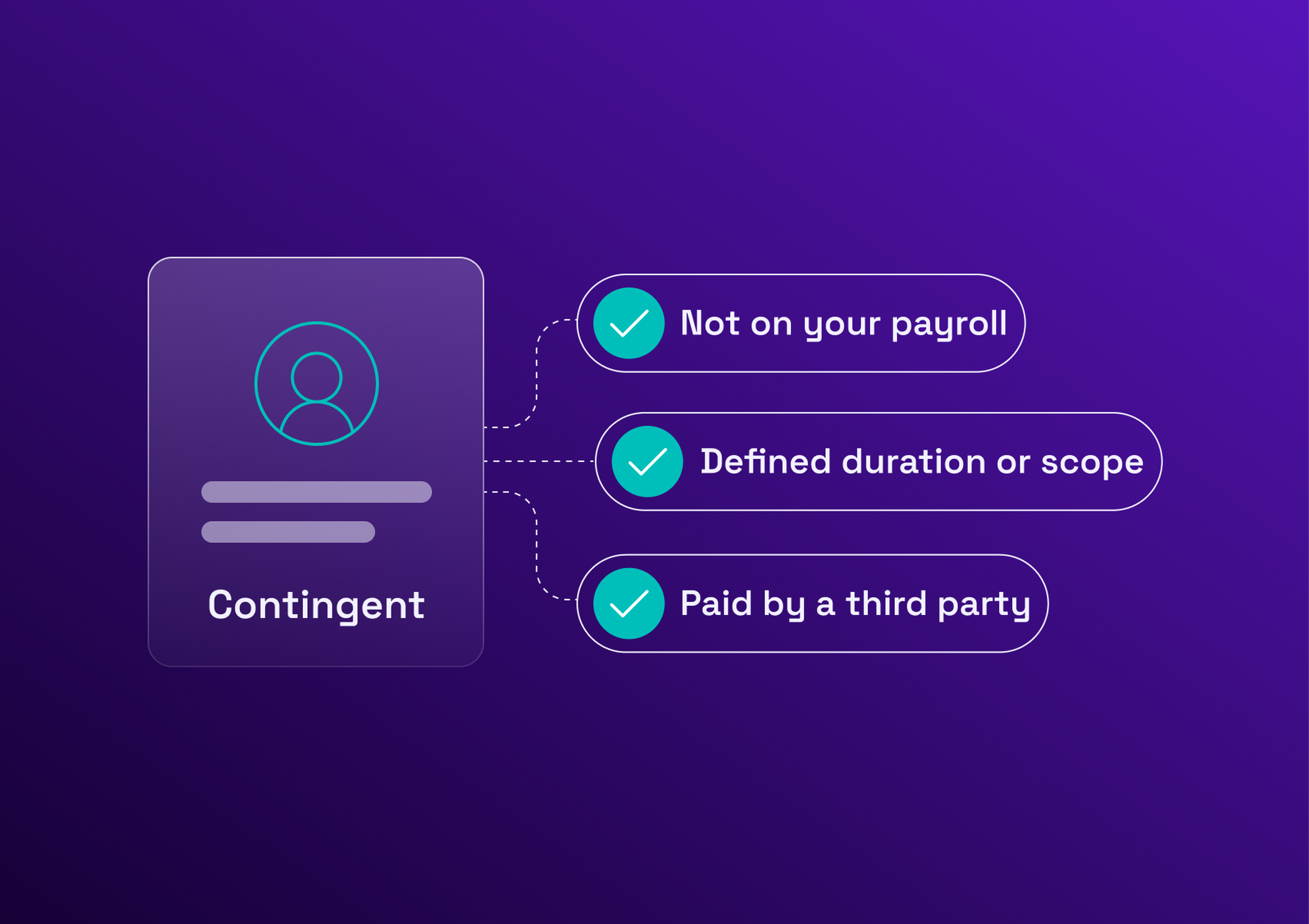
The external workforce keeps growing. Staffing Industry Analysts' 2025 buyer survey found that contingent and external workers already make up an average of 21% of organizations' workforce, with buyers expecting 26% within ten years. In the EU, Eurostat's national accounts put self-employed persons at 14.2% of total employment in 2025.
Spreadsheets cope with a handful of freelancers. Past that, six problems tend to appear:
hidden spend: freelancers engaged by different managers at different rates, with no consolidated view
unapproved hires: engagements that start before budget or procurement approval
duplicate suppliers: the same freelancer or firm registered several times under different names or teams
expired compliance documents: insurance or tax certificates that lapse mid-engagement with nobody tracking the dates
invoice disputes: hours billed that do not match what was approved
no view of tenure: long engagements that quietly start to look like employment
Independent contractor management in spreadsheets hides these gaps until an audit or a dispute exposes them. External workforce visibility, knowing who is working, under what terms and at what cost, is what a system restores.
Core features of a freelance management platform
Seven feature areas cover most of what freelancer management software does. The table shows why procurement cares about each and the question to put to a vendor.
| Feature | Why procurement cares | Question to ask the vendor |
|---|---|---|
Sourcing and talent pools | A known pool shortens requests and keeps engagements within approved parties | Can requests be restricted to approved freelancers and suppliers? |
Onboarding and compliance documents | Missing or expired documents are where audit findings start | Which documents are collected per country, and who is alerted at expiry? |
Contracts, SOWs and rate cards | Rates and scope are agreed once and applied consistently | Are rate cards enforced at request, or only reported afterward? |
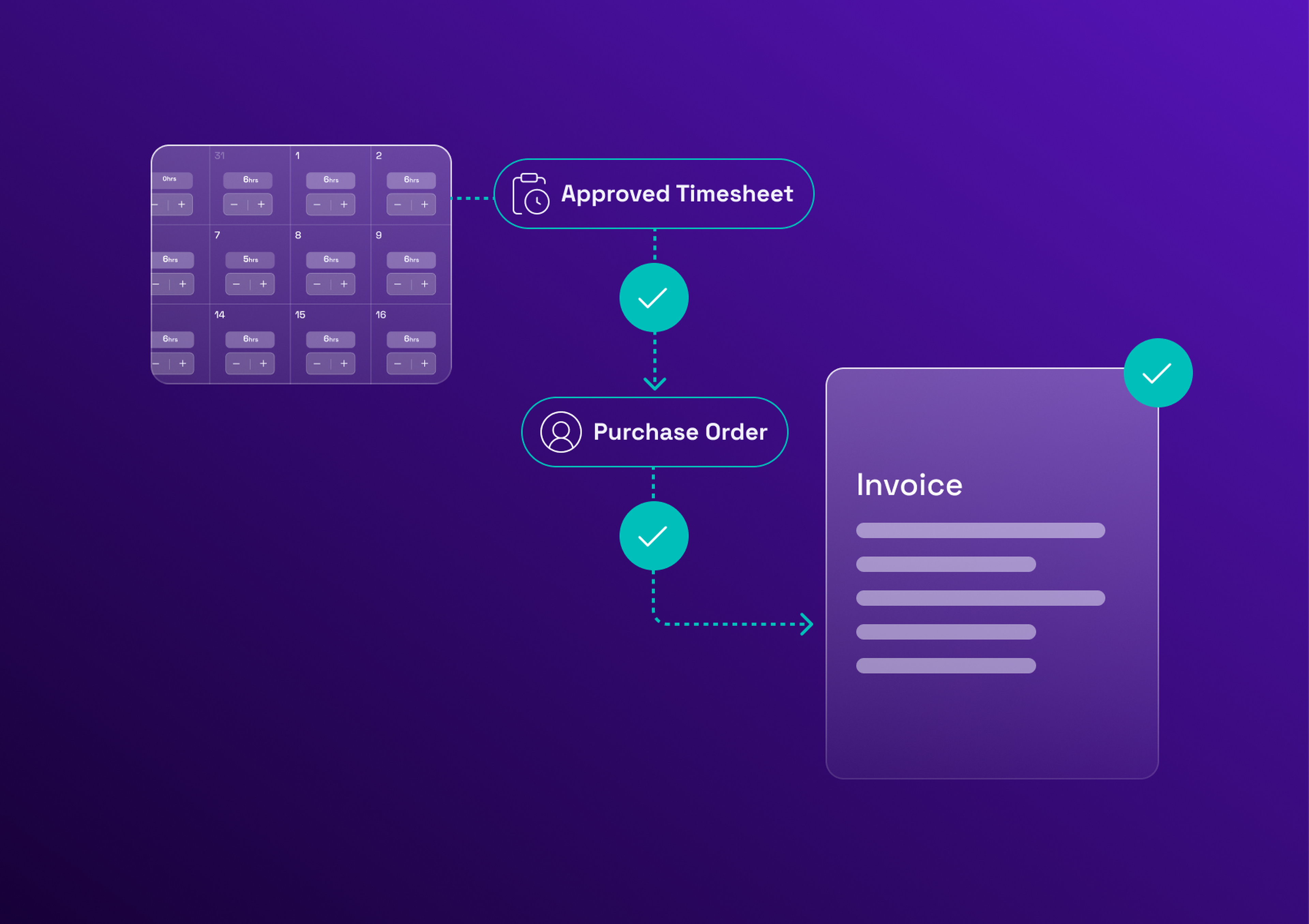
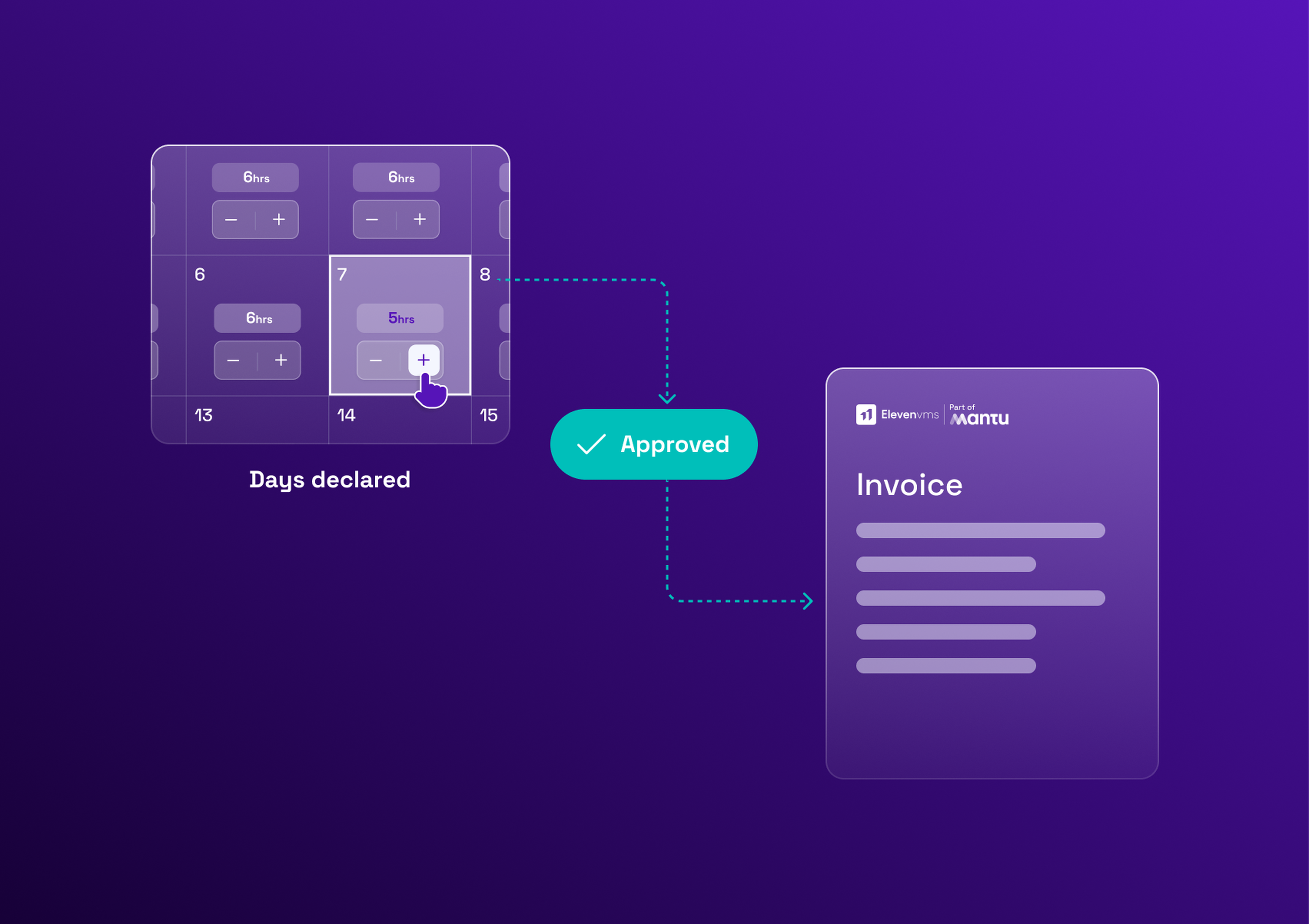
Timesheets and deliverable validation | Approved time and accepted deliverables are what justify payment | Does approval check against the contract, the PO and the remaining budget? |
Invoicing and payments | Invoices should match approved work before money leaves | Is the invoice matched to approved time before payment? |
Spend analytics and reporting | Spend under management needs one view across engagements | Can reports be cut by supplier, cost center, country and tenure? |
Integrations (ERP, HRIS, e-procurement) | Data should not be rekeyed between finance, HR and procurement systems | Which systems connect through API, and how long does it take? |
Each feature area below also notes whether a VMS covers it.
Sourcing and talent pools
An FMS typically offers a pool of freelancers the company has already worked with or approved. A VMS covers this through supplier panels and structured RFPs, with a pool made of suppliers as well as individuals.
Onboarding and compliance documents
Both collect documents at onboarding and flag expiry. A VMS applies the same discipline to every type of supplier, not only freelancers.
Contracts, SOWs and rate cards
A VMS covers this too, with day-rate and fixed-price engagements governed differently: approved days for the first, approved milestones for the second.
Timesheets and deliverable validation
Both handle timesheet approval. A VMS also validates milestones and deliverables for fixed-price and SoW work, which a freelancer-only tool is less likely to cover.
Invoicing and payments
An FMS often pays freelancers directly. A VMS typically validates the invoice and hands it to the ERP, which keeps payment where finance already controls it.
Spend analytics and reporting
A VMS reports across freelancers, consultancies and SoW suppliers, which is where the full picture of external spend comes from.
Integrations (ERP, HRIS, e-procurement)
Both connect to ERP and HRIS. For a VMS, the ERP link also carries supplier master data in one direction and validated invoices back in the other.
Freelance management system vs VMS: what's the difference?
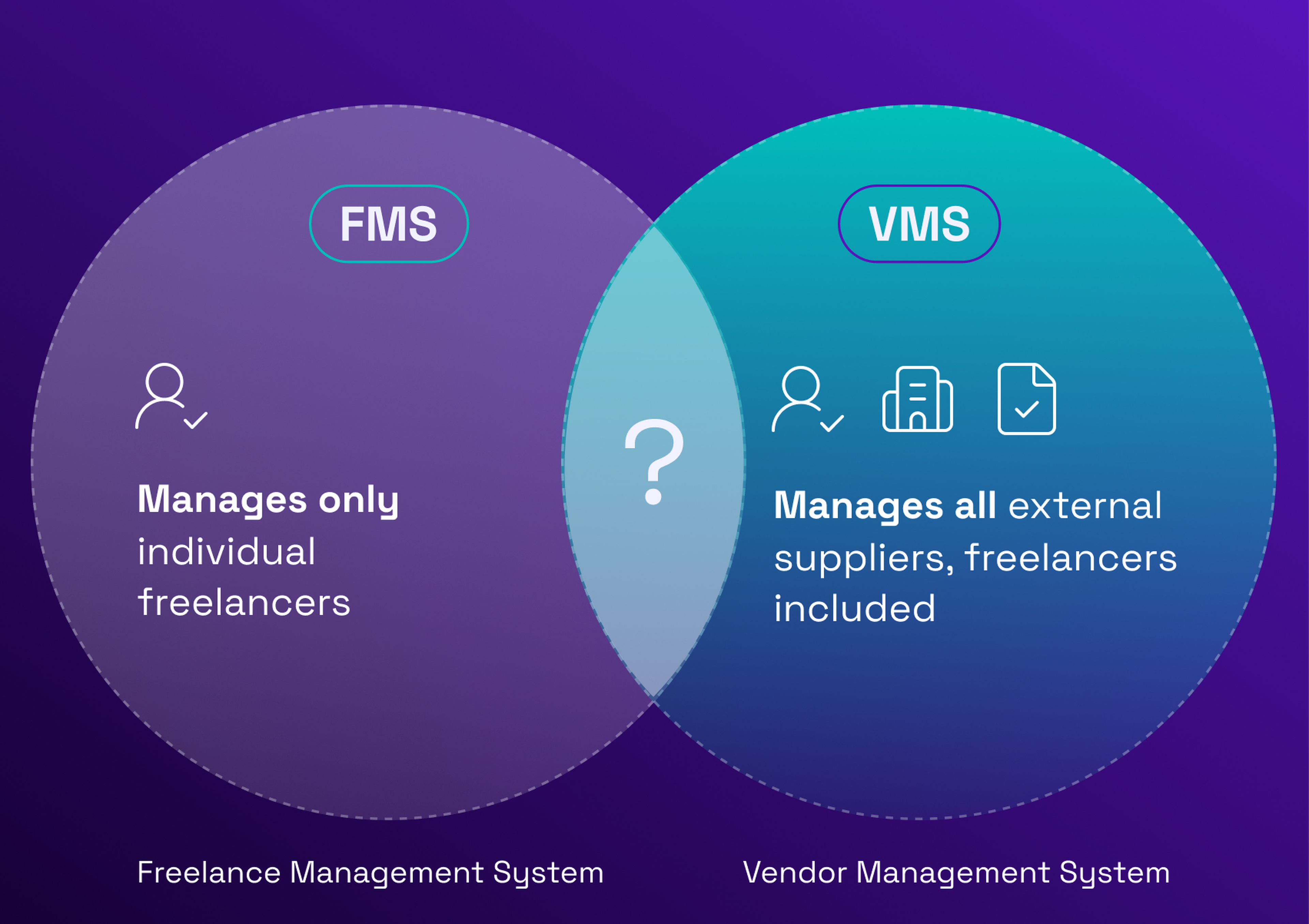
An FMS manages individual freelancers directly. A VMS manages all external service suppliers, often including freelancers, under one procurement process, from sourcing and contracts to time validation and invoice control.
| FMS | VMS | |
|---|---|---|
Who you contract with | Individual freelancers, directly | Suppliers of every kind: consultancies, staffing firms, SoW suppliers and often freelancers |
Typical volume | Many individual engagements | Missions and supplier relationships at enterprise scale |
Engagement models | Day rate or project-based contracts with individuals | Day rate, fixed price and SoW across suppliers |
Compliance focus | Each freelancer's status and documents | Supplier compliance, subcontracting, documents and tenure across all suppliers |
Main buyer | HR or talent teams, sometimes procurement | Procurement, with operations and finance |
Scope of spend visibility | Freelancer spend | All external services spend |
Fit for multi-country groups | Depends on the tool's country coverage | Designed to apply one process across countries and entities |
The overlap is real: both handle contracts, onboarding documents and time approval. The difference is the scope of what they manage. An FMS covers one type of external worker. A VMS supports contingent workforce management across every type, which matters when freelancers are only one slice of the spend.
Do you need an FMS, a VMS or both?
Two questions decide it: how external spend splits between freelancers and suppliers, and how many countries or entities are involved.
| Share of external spend | One or two countries | Several countries or entities |
|---|---|---|
Mostly freelancers | An FMS is usually enough | An FMS with strong country compliance, or a VMS that supports direct contractors |
A mix of freelancers and suppliers, or mostly suppliers | A VMS that also handles freelancers | A VMS that also handles freelancers, with one process across countries |
Three scenarios show how this plays out:
A scale-up hiring freelancers directly. Most spend goes to individuals in one or two countries, and an FMS fits.
A large group buying IT, engineering and consulting services from mixed suppliers. A VMS that also handles freelancers covers the whole external spend in one process. Eleven VMS is built for this scenario.
A hybrid. Some freelancers are engaged directly while most spend goes to suppliers: a VMS plus a light freelancer layer, or a single VMS that supports direct contractors.
Compliance risks of engaging freelancers in Europe
Engaging freelancers across Europe carries different risks in each country. Four come up most often:
| Country | Main risk | What it means in practice |
|---|---|---|
France | Obligation de vigilance, illegal labor lending (prêt de main-d'œuvre illicite), délit de marchandage, portage salarial | For contracts of €5,000 or more excluding VAT, the client must obtain and verify the contractor's URSSAF vigilance certificate at signing and every six months. Supplying labor for profit can breach the rules on labor lending and marchandage when it harms the worker or evades legal protections. Portage salarial is a lawful three-party model where the worker is employed by the portage company |
United Kingdom | IR35 off-payroll rules | For most medium and large clients, the client decides whether an engagement is inside or outside IR35 |
Germany | Scheinselbstständigkeit (false self-employment) | A freelancer who works on instructions and is integrated into the client's work organization can be treated as employed for social security purposes, whatever the contract says |
European Union | Platform Work Directive (EU) 2024/2831 | To be transposed into national law by 2 December 2026; introduces a presumption of employment for digital labor platform work where the facts indicate control and direction |
Sources: URSSAF, attestation de vigilance · Légifrance, article L8231-1 · Légifrance, article L8241-1 · GOV.UK, off-payroll working (IR35) · SGB IV, § 7, Deutsche Rentenversicherung · EUR-Lex, Directive 2024/2831
The common thread is that classification depends on how the work is organized, not on the label in the contract. A freelancer directed day to day, integrated into a team and engaged for years on the same work looks like an employee in most of these frameworks. That is the core of worker misclassification risk.
This is why controls matter more than contract wording: tracking tenure, documenting scope and acceptance, and collecting compliance documents on a schedule. The contractor compliance checklist goes through them. The directive's transposition deadline also makes this section worth revisiting after 2 December 2026, as national rules will change.
This is general information, not legal advice. Classification depends on the facts of each engagement and on local law, and should be confirmed with legal counsel.
How to choose a freelance management system: 8 questions to ask
Eight questions separate tools that fit a procurement need from tools that fit an HR need:
Which engagement models does it support? Day rate, fixed price and SoW should each be handled, since approvals and risks differ.
Which compliance documents are automated, country by country? Collection and expiry alerts should reflect local requirements.
Can it manage freelancers and suppliers in one tool? Otherwise the external spend splits across two systems.
Which ERP and e-procurement integrations are standard? Rekeying invoices and supplier data defeats the purpose.
How do approval workflows work? Time, deliverables and budget checks should route to the right approver, with a backup.
Does it alert on tenure? Long engagements need a flag before they become a classification issue.
How deep is the reporting? Spend by supplier, cost center, country and rate should be available without exports.
How long does deployment take, and is the tool multilingual? A multi-country rollout needs local-language interfaces and a realistic timeline.
The criteria for choosing a VMS cover the same evaluation for the broader category.
Common mistakes when rolling out freelancer management
Buying an HR tool for a procurement problem. If the goal is control of external spend, a tool built around talent management leaves the spend question open.
Leaving supplier spend out of scope. Freelancers are often a small part of external spend, and consultancies and SoW suppliers stay in spreadsheets.
No single request process for managers. If managers can engage freelancers outside the system, the system only shows part of the picture.
Skipping change management. Managers who approve time and deliverables decide whether the data is reliable, so adoption needs planning. The change management guide for a VMS applies equally here.
Ignoring tenure limits. Without alerts, long engagements pass unnoticed until they raise a classification question.
Managing freelancers and suppliers together
For external spend that goes beyond freelancers, a vendor management system covers freelancers, consultancies and SoW suppliers in one process. The wider management side is covered in managing a contingent workforce. Calculate your VMS ROI to estimate what centralizing that spend is worth.
Book a meeting with one of our experts for a personalized demo.