VMS vs ERP is less a choice between two systems than a question of which one does which job. An ERP is the financial system of record for the whole company. A vendor management system (VMS) is the operating system for buying external services, from sourcing to mission tracking. The ERP records what was spent. The VMS controls how it was spent. Neither replaces the other; they sit at different layers of the same stack, and the confusion in most comparisons comes from treating them as competing options rather than complementary ones. This guide covers what each system actually does, where the ERP genuinely falls short on external services, and how the two connect in practice.
What is an ERP, and what does it do for procurement?
An ERP (enterprise resource planning system) is the company's central financial and operational system, covering finance, purchase orders, accounts payable, supplier master data, and often HR, all built around standard, repeatable transactions. The ERP procurement module handles what a transaction needs structurally: a purchase order raised, approved, matched to an invoice, posted to the right cost center and general ledger line.
That structure covers:
purchase order creation and approval workflows
accounts payable and payment runs
supplier master data, the core record of who a supplier is
cost center and general ledger posting
standard, repeatable procurement for goods and defined services
It's built for transactions that look the same every time. That's precisely what it's good at, and precisely where it starts to strain once the thing being bought is a person's time against a scope that shifts: a consulting mission doesn't arrive, pass inspection and close the way a pallet of parts does.
What is a vendor management system (VMS)?
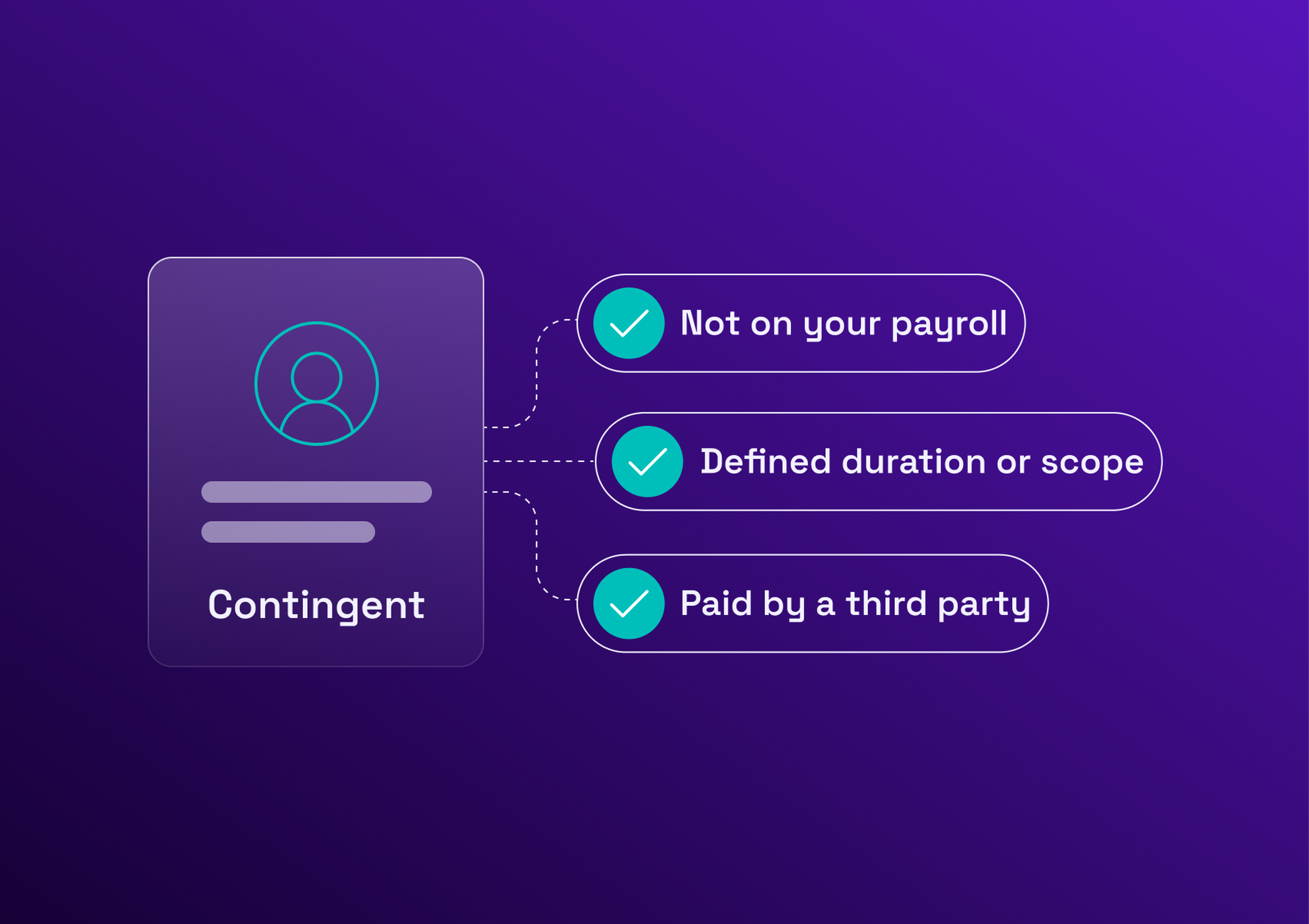
A vendor management system is software built to manage external workforce and services spend specifically: sourcing, contracting, time and deliverable tracking, supplier ranking, and renewals, for work that's bought by mission or statement of work rather than by purchase order alone.
Two meanings of "VMS": goods suppliers vs. external services
The term gets used two different ways, and it causes real confusion in search results and in software evaluations alike. Some platforms, often sold alongside procurement or supply-chain software, use "vendor management system" to mean a goods-supplier master-data and compliance tool, tracking supplier records, certifications and onboarding for physical goods vendors. The VMS this article means is built for a different category entirely: external services, contingent workforce and intellectual services, where the object being managed is a mission or a statement of work, not a part number. Searching for "vendor management system" without that distinction in mind is a common source of evaluating the wrong category of tool entirely, since the two meanings solve genuinely different problems.
VMS vs ERP: side-by-side comparison
| ERP | VMS | |
|---|---|---|
Primary user | Finance, IT, central procurement | Procurement, operational managers, hiring managers |
Core object | Purchase order, invoice | Mission, statement of work |
Supplier sourcing and RFPs | Limited, often handled outside the system | Built in, with structured comparison |
Supplier ranking | Not typically tracked | Core feature, performance-based |
Time and deliverable validation | Not designed for this | Built in, milestone and timesheet validation |
Fixed-price vs. day-rate handling | Treated as a generic line item | Each priced and governed differently by design |
Operational users outside procurement | Rarely log in directly | Primary users for approvals and tracking |
Change requests mid-engagement | Requires a new PO or manual rework | Built-in scope-change and renewal workflow |
KPIs | Spend and payment data | Mission-level: cycle time, rate compliance, delivery performance |
Deployment time | Months to a year or more (median of 9 months in 2026, 15.5 months in 2024) | 4 to 8 weeks, services-focused |
Who owns the system | Finance or IT | Procurement or operations |
Sources: Panorama Consulting Group, The 2026 ERP Report · Panorama Consulting Group, The 2024 ERP Report
The pattern across every row is the same: the ERP is built around the transaction, the VMS is built around the relationship and the work itself. Neither set of features makes the other one unnecessary.
Where ERPs fall short on external services
Missions aren't purchase orders
A purchase order is a fixed commitment. A consulting mission renews, extends, and changes scope mid-flight, none of which a PO structure handles gracefully. Each change technically needs a new or amended PO, which means either a slow, manual rework cycle in the ERP, or, more often in practice, scope drift that never gets reflected in the system at all.
Timesheets and deliverables live outside the ERP
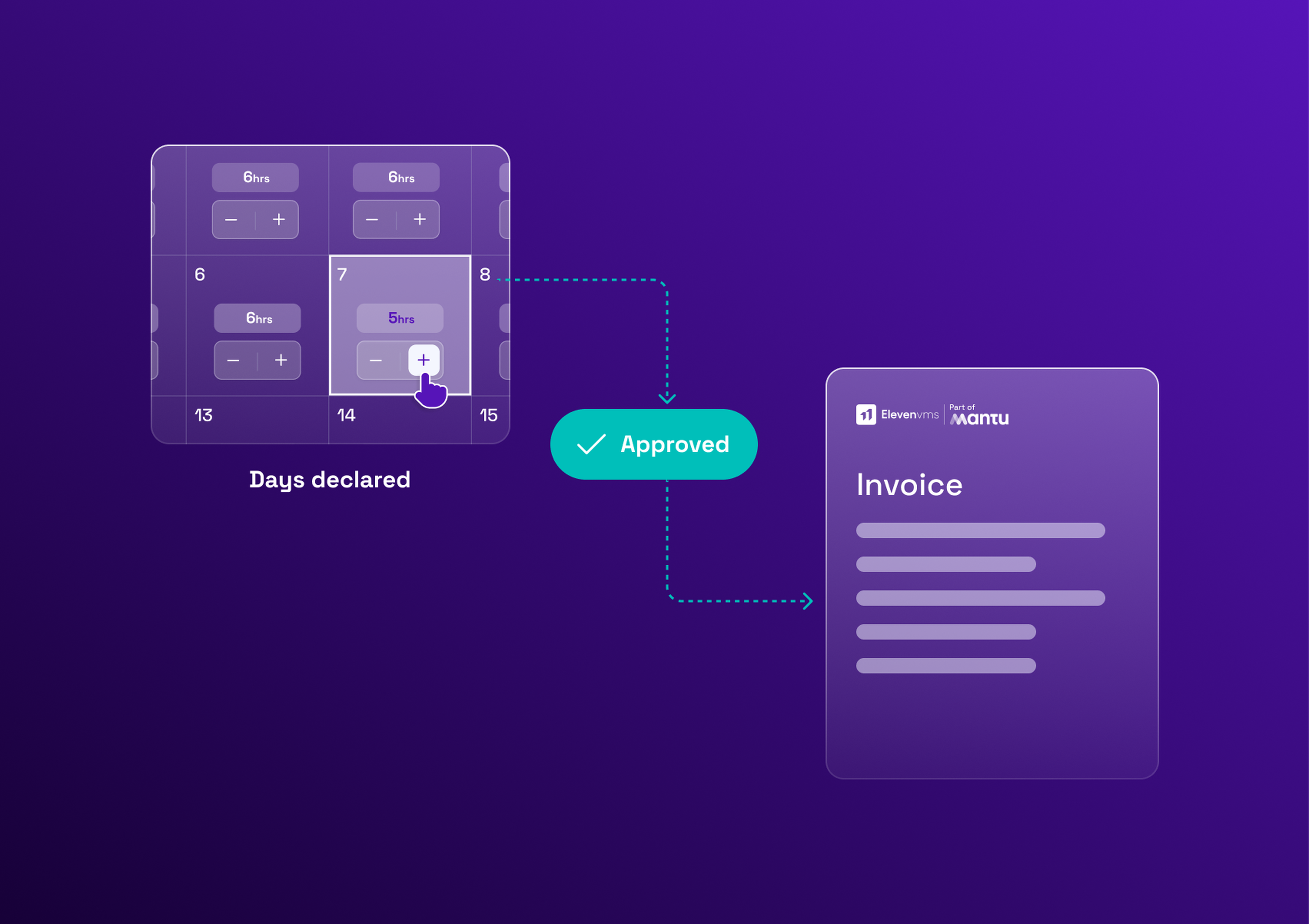
An ERP validates that an invoice matches a PO. It doesn't validate that the hours billed match a timesheet, or that a deliverable in the case of SoW management was actually accepted against the statement of work. That validation happens in email, in spreadsheets, or not at all, which is exactly where services spend becomes hard to audit.
Operational managers won't log into SAP
This is an adoption problem as much as a functional one. The people who actually need to approve a contractor's timesheet or sign off a milestone are hiring managers and project leads, not finance staff, and most organizations have learned, often the hard way, that those managers won't reliably use a full ERP interface for a task that takes two minutes. Low adoption outside the ERP's core finance users is one of the most consistent reasons services spend ends up poorly tracked.
No supplier competition or performance history
An ERP's supplier master data records who a supplier is, not how they've performed. There's no structured way to compare suppliers on a new mission, or to see that one supplier consistently delivers late while another doesn't, without pulling that history together manually from outside the system.
Where a VMS is not the system of record
A VMS isn't trying to replace the ERP's core financial function. What stays in the ERP:
general ledger posting and the company's books of record
tax calculation and compliance reporting
payment runs and treasury
consolidated company-wide financial reporting
accounting-level audit and controls
The VMS feeds validated data into these processes; it doesn't run them.
How VMS and ERP work together: the integration flow
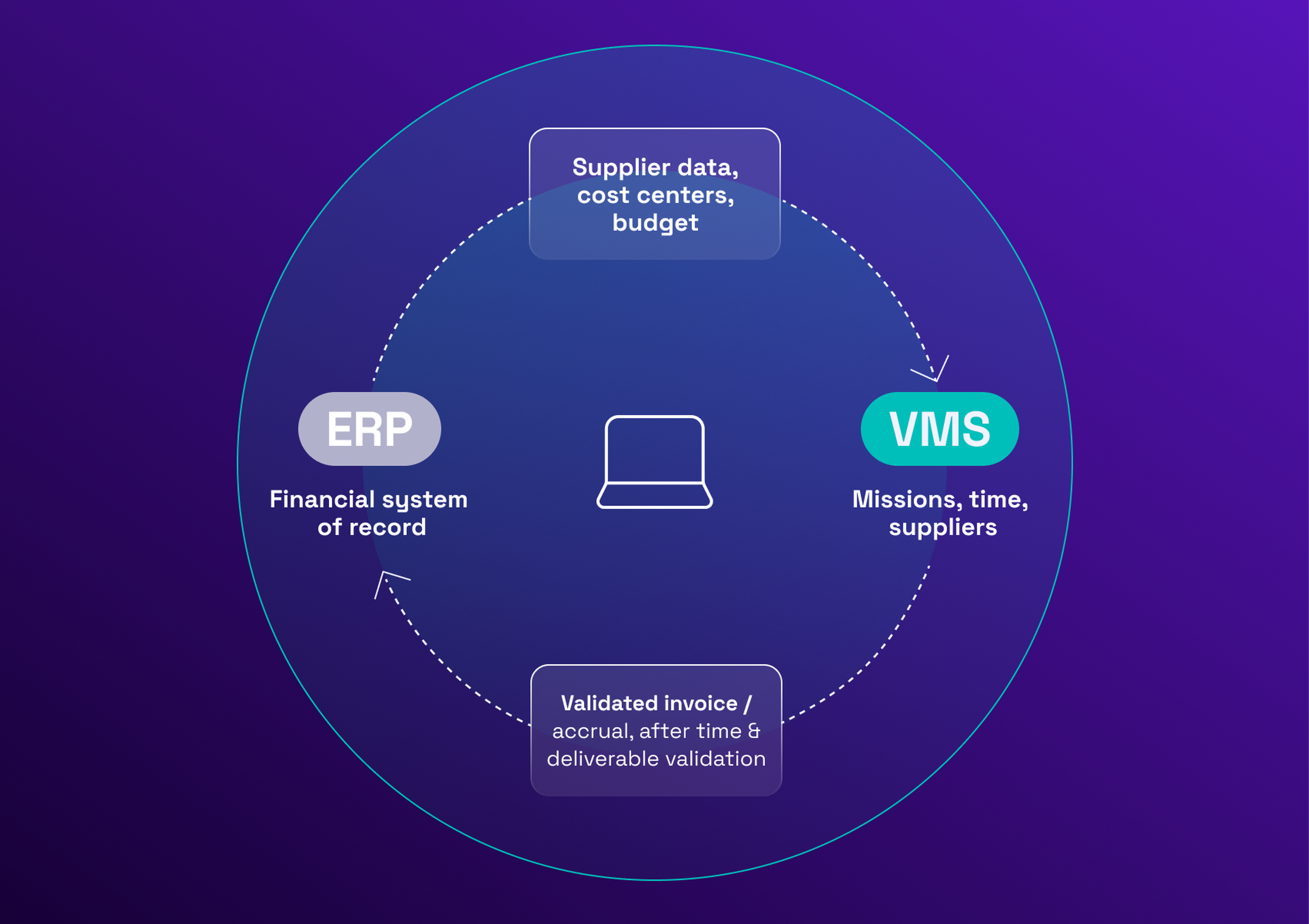
The two systems exchange data in a loop, not a one-way handoff. The ERP sends supplier master data, cost centers and budget to the VMS, the data the VMS needs to know who's approved to work and what's available to spend. The VMS then handles everything the ERP isn't built for: the request, sourcing, mission tracking, time and deliverable validation, and invoice pre-check. Once an invoice or accrual is validated on the VMS side, it goes back to the ERP for what the ERP does best: posting and payment.
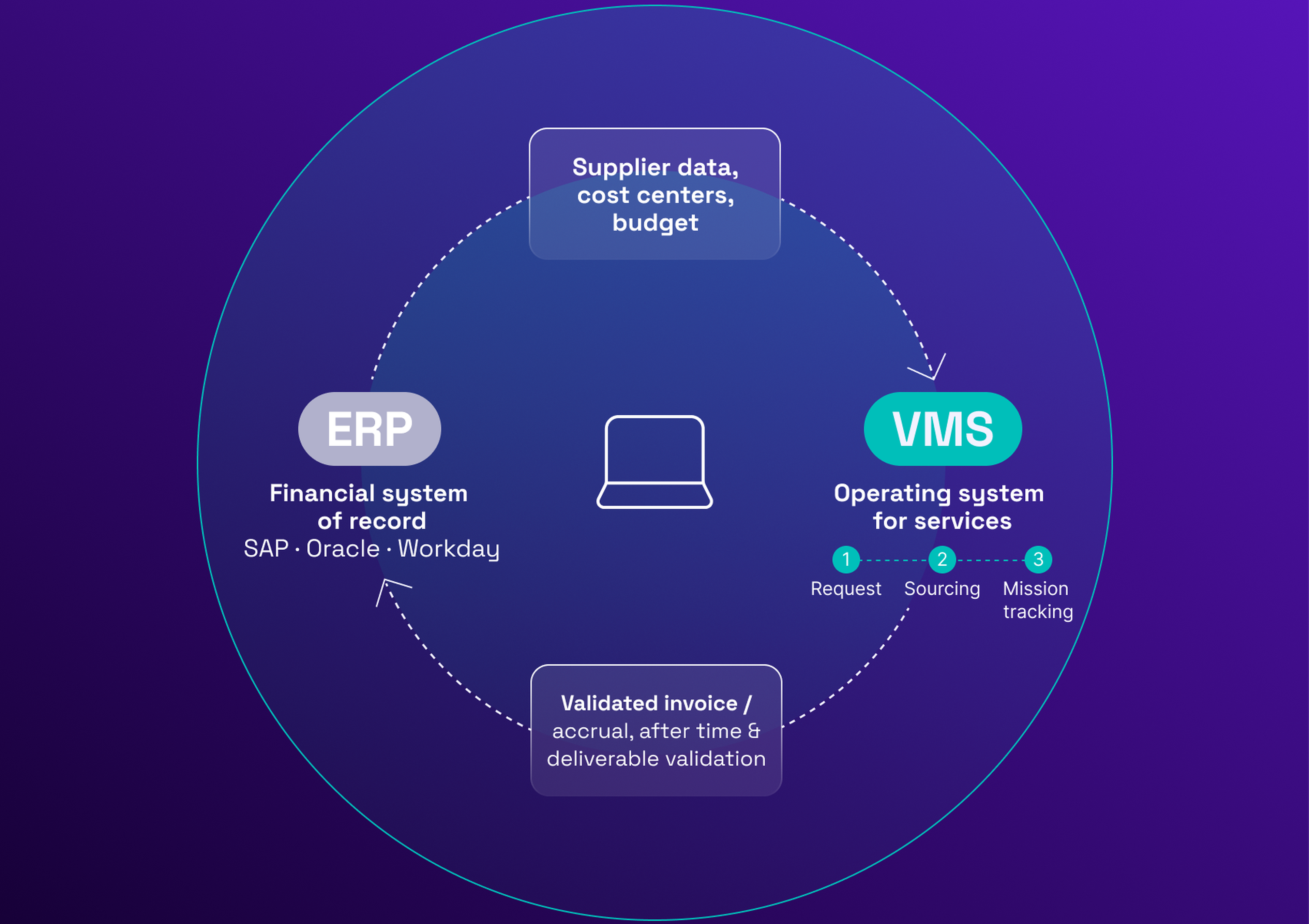
This pattern holds whether the ERP is SAP, Oracle or Workday, and it extends to e-procurement tools like Coupa or Ivalua too, where the VMS sits alongside them covering the services category those tools weren't built for. The mechanics of that connection, what gets built via API rather than manual export and import, and how it fits into a broader procurement integration strategy, matter more than which specific ERP brand is on the other end.
Do you need a VMS if you already have an ERP? A 5-question check
Do you have more than a handful of external-services suppliers? Each additional supplier adds contracts, rates and compliance documents to keep track of.
What share of your spend is day-rate or statement-of-work based? The more of your external spend looks like missions rather than one-off purchases, the more a PO-centric system strains to describe it.
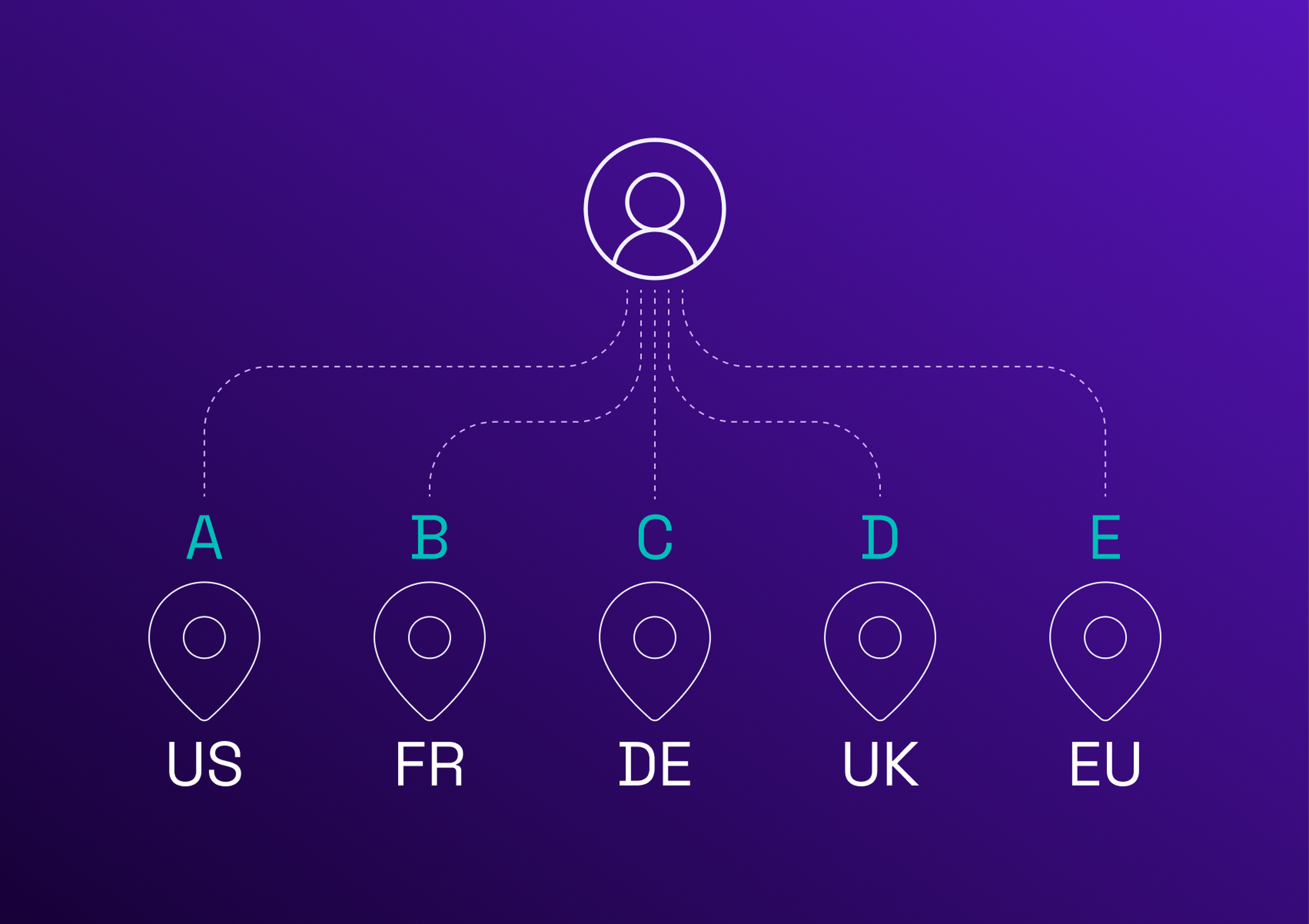
Do you operate in several countries? Multi-country services spend multiplies the compliance and rate-visibility problem an ERP alone doesn't solve.
Do operational managers approve time or deliverables themselves? If approvals already happen outside the ERP, in email or spreadsheets, that's the exact gap a VMS closes.
Do you have supplier compliance or co-employment risk? Worker classification and compliance tracking need structured, auditable data an ERP's supplier master typically doesn't capture.
Assess your procurement maturity for a fuller picture than these five questions alone can give.
Bringing the two systems together
Eleven VMS is built to run alongside the ERP you already have, not to replace it: the vendor management system handles sourcing, mission tracking and deliverable validation, while your ERP keeps doing what it does best. Calculate your VMS ROI to see what closing the gap is worth for your own external-services spend.
Book a meeting with one of our experts for a personalized demo.