Vendor management governance is the set of rules that decides who can choose, contract, extend and stop a supplier, and how those decisions are checked and recorded. For external services, it is what keeps spend, rates and renewals from drifting once the contract is signed.
In most companies, services spend is spread across business units. Missions are renewed by default because nobody owns the end date, and day rates creep up with each extension. Each decision looks small, and together they add up to spend that no one controls. This guide gives a model for services, a RACI matrix, a calendar of governance meetings and a KPI set with formulas and owners.
What is vendor management governance?
Vendor management governance is the decision rights, policies, roles, meetings and controls that make sure suppliers are selected, contracted, monitored and exited in line with company rules. It gives each decision an owner, and each owner a forum and a measure.
It answers four questions: who decides, on what basis, how often it is reviewed and what happens when a rule is broken. Vendor governance is not a document, and it is not a tool. It is a small number of rules that people follow because the process makes them easy to follow.
A reference exists for the outsourcing side. ISO 37500:2014 gives guidance on outsourcing and its governance across the life of an agreement (ISO). It is a useful checklist, and it was not written with consultants and SoW-based work in mind, which is where this guide focuses.
Vendor governance vs vendor management
The two terms are often used as if they were the same. Vendor governance vs vendor management is a difference of level: one sets the rules, and the other runs the work within them.
| Vendor governance | Vendor management |
|---|---|
Sets the rules and decision rights | Carries out the day-to-day work |
Defines who approves what | Handles requests, onboarding and reviews |
Oversees results through KPIs and steering committees | Tracks each supplier's delivery and invoices |
Changes a few times a year | Runs every day |
Both are needed. Management without governance has no limits, and governance without management stays on paper.
Why governance breaks down for external services
Services are not goods. There is no unit price, no catalog and no goods receipt, and much of the work is bought by business units directly. Governance for services procurement has to deal with failure points that a goods process never meets. For contingent workforce spend in particular, six come up again and again.
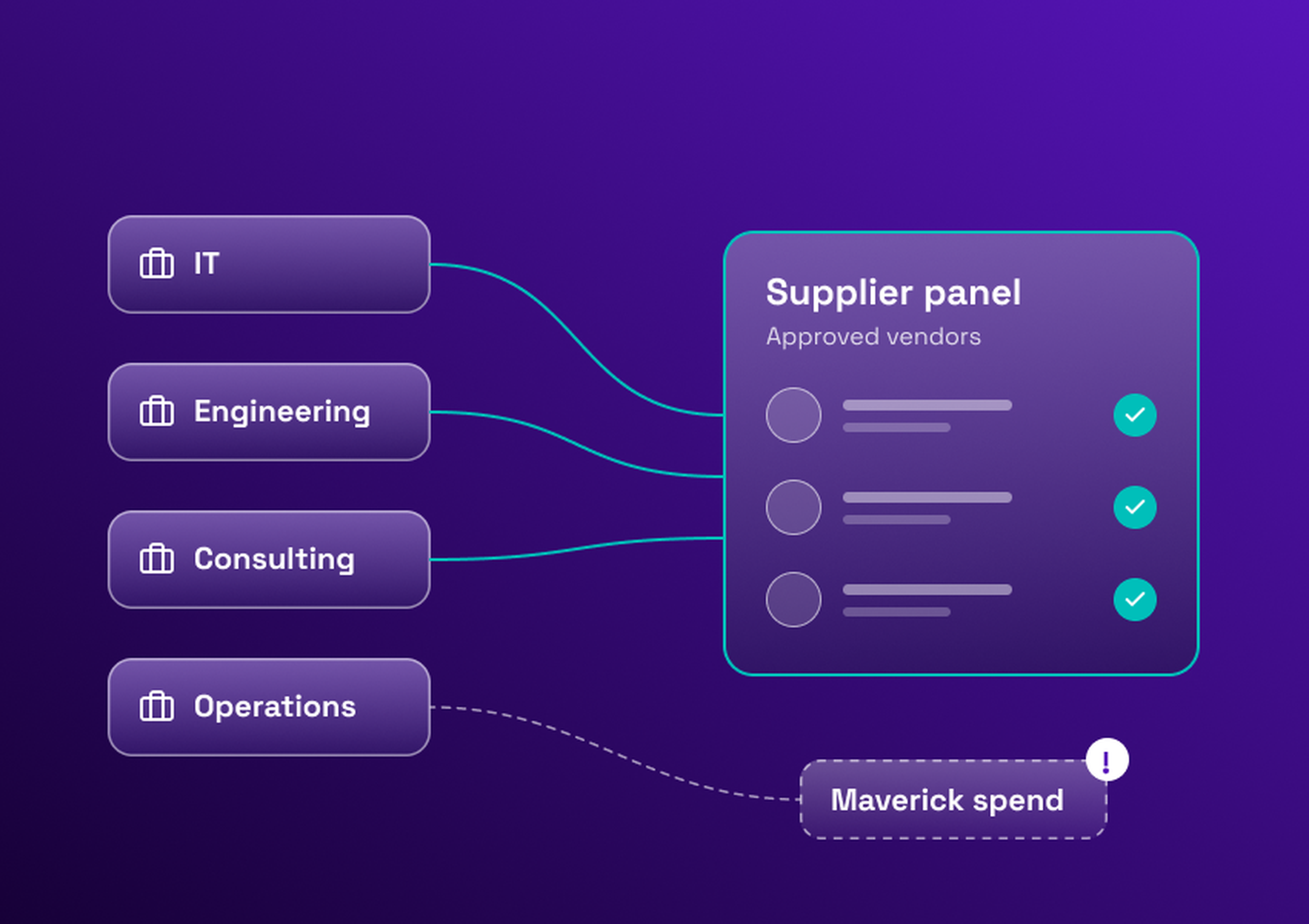
Maverick spend. Business units buy from suppliers outside the agreed panel, often because the panel is slow or unknown to them.
Silent auto-renewals. Missions and contracts roll over because no one is asked to decide before the notice date.
Rate drift. Day rates rise at each renewal, and new missions are priced above the rate card.
SoW scope creep. Work grows beyond the statement of work without a change request, so cost grows and acceptance becomes unclear.
Timesheets approved without review. Days are validated in bulk, without a check against the purchase order or the mission.
Worker-misclassification risk. A contractor integrated like an employee, for too long, creates legal exposure. See worker misclassification and contractor compliance.
Each of these is a missing decision right, not a missing document. Someone needs to own the renewal date, the rate and the approval, and the rest of the framework gives each of them an owner.
The 5 layers of a vendor governance framework
A vendor governance framework for services has five layers. They run from rules to tools, and each one depends on the one above it.
1. Policy and decision rights
The base layer states who can open a requirement, who can choose a supplier, who signs and who can extend a mission, with thresholds where needed. For example, a mission over a set length or value needs a second approval. The policy fits on a few pages, and its value is in being specific about people, not principles.
2. Supplier panel and tiering
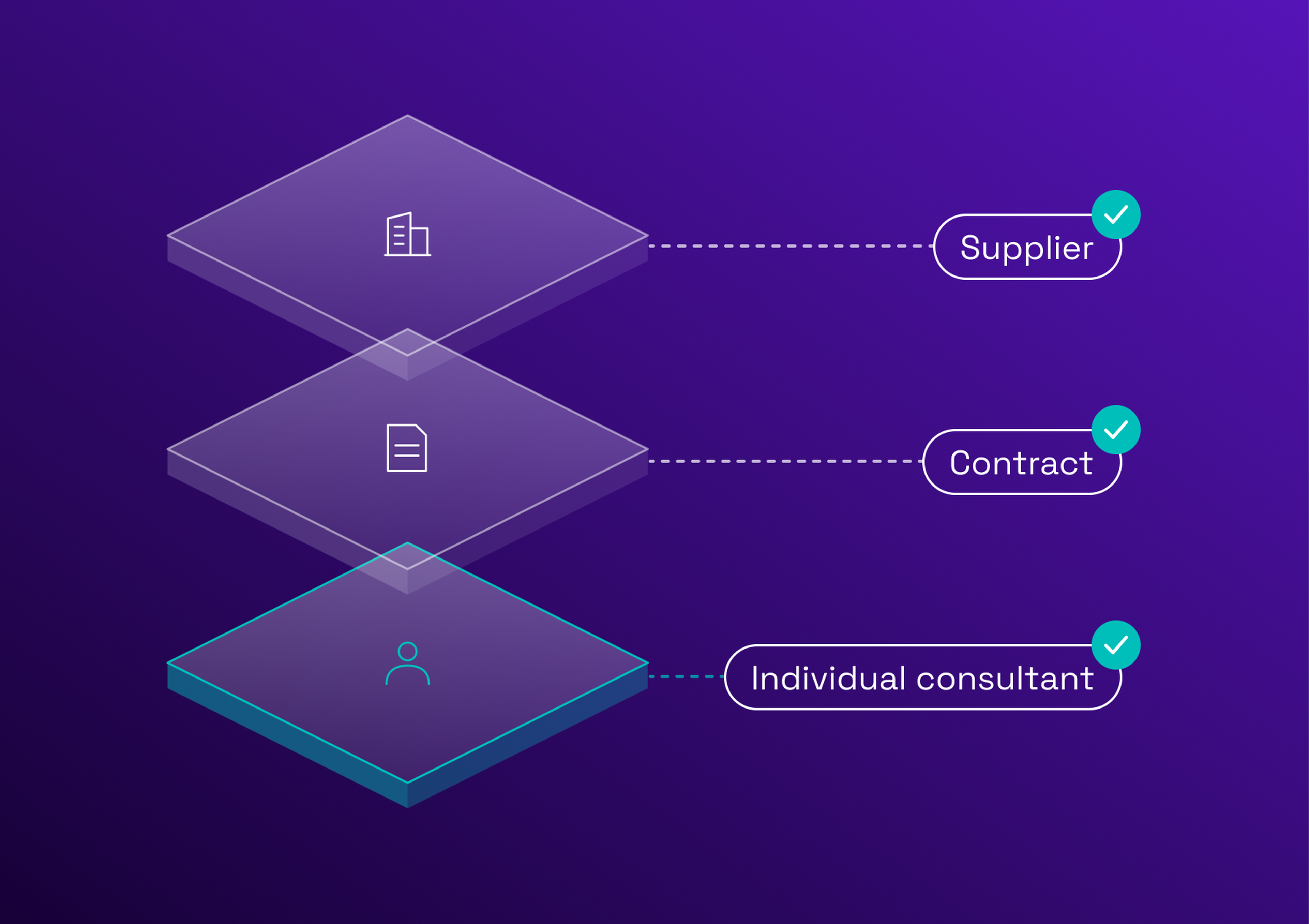
The second layer defines which suppliers can be used. Most companies work with three tiers: preferred suppliers for everyday needs, approved suppliers for specific cases and occasional suppliers for one-off needs. The panel is reviewed on a schedule, and suppliers move between tiers based on results. The preferred vendor and approved vendor list guides cover each tier, and dynamic supplier listing keeps the ranking current.
3. Contracting rules: day rate vs fixed price
The third layer sets how work is bought. It covers rate cards by profile, the choice between time and materials and fixed price, and, for fixed-price work, deliverables and acceptance criteria written into the SoW. The rate card guide covers the first, and fixed price vs time and materials covers the second. The governance rule is that nobody buys outside these terms without an approved exception.
4. Performance and risk oversight
The fourth layer checks suppliers after the contract is signed: scorecards, compliance documents and how dependent the company has become on each supplier. A supplier performance scorecard turns delivery into a score, and the vendor compliance guide covers the documents to keep valid. Dependence matters too: a supplier that holds most of a category is a risk even when it performs well.
5. Data and tooling
The last layer is one source of truth for missions, budgets, rates and documents. Without it, the other four rely on spreadsheets and goodwill. With it, the rules can be applied by the process itself. This is where a platform pays off, and a later section shows how. This vendor governance framework only works if all five layers exist, and a gap in one shows up as failure in another.
Vendor governance roles and responsibilities: a RACI matrix
Everyone says to assign clear roles, and few give an example. A RACI matrix names, for each decision, who is Responsible (does the work), Accountable (owns the outcome and decides), Consulted (gives input) and Informed (told afterwards). The rule is one Accountable per row. The matrix below is a starting point for services procurement, to adapt to your organization.
| Decision | Procurement | Business owner | Finance | Legal | IT/Security | HR |
|---|---|---|---|---|---|---|
Sourcing and shortlist | A/R | C | I | I | C | I |
Supplier selection | R | A | C | C | C | I |
Contract (MSA, SoW) | A | C | C | R | C | I |
Mission extension | R | A | C | I | I | C |
Rate change | A/R | C | C | I | I | I |
Offboarding | R | A | I | I | R | C |
Two choices are worth defending. The business owner is Accountable for selection and extension, because they carry the delivery and the budget, while procurement runs the process and protects the rules. Rate changes belong to procurement, so that the rate card does not erode one extension at a time.
Governance cadence: which meetings to run and how often
Governance happens in meetings with a defined purpose, not in a single annual review. The vendor governance model below uses four forums, each with its own frequency, attendees, inputs and decisions.
| Forum | Frequency | Attendees | Inputs | Decisions |
|---|---|---|---|---|
Operational review | Weekly | Procurement, business managers | Open requests, timesheets and renewals due | Approve requests, clear blocked timesheets |
Spend review | Monthly | Procurement, finance, business owners | Spend by supplier, rate deviation, off-panel spend | Correct drift, challenge exceptions |
Quarterly business review | Quarterly, with strategic suppliers | Procurement, business owner, supplier lead | Scorecard, delivery, risks | Agree improvement actions, rate or scope changes |
Governance steering committee | Annually | Procurement director, finance, legal, business sponsors | KPIs, panel results, policy changes | Update policy, tiers and targets |
Each meeting should end with a recorded decision. A meeting that only reports and decides nothing is the first thing to cut.
Vendor governance KPIs to track
A framework needs a way to show whether it works. These vendor governance KPIs each have a formula, an owner and an example target range. The ranges are examples to calibrate against your own baseline, since no reliable benchmark exists across companies. The procurement KPIs guide covers the wider set.
| KPI | Formula | Owner | Example target |
|---|---|---|---|
Share of spend on the supplier panel | Spend with panel suppliers ÷ total services spend | Procurement | 90% or more |
Rate deviation vs rate card | (Rate billed − rate card rate) ÷ rate card rate | Procurement | 0 to +2% |
On-time renewal decisions | Renewals decided before the notice date ÷ renewals due | Business owner | 100% |
Timesheet approval time | Average working days from submission to approval | Business owner | 3 days or less |
SoW milestones accepted on time | Milestones accepted by the planned date ÷ milestones due | Business owner | 80% or more |
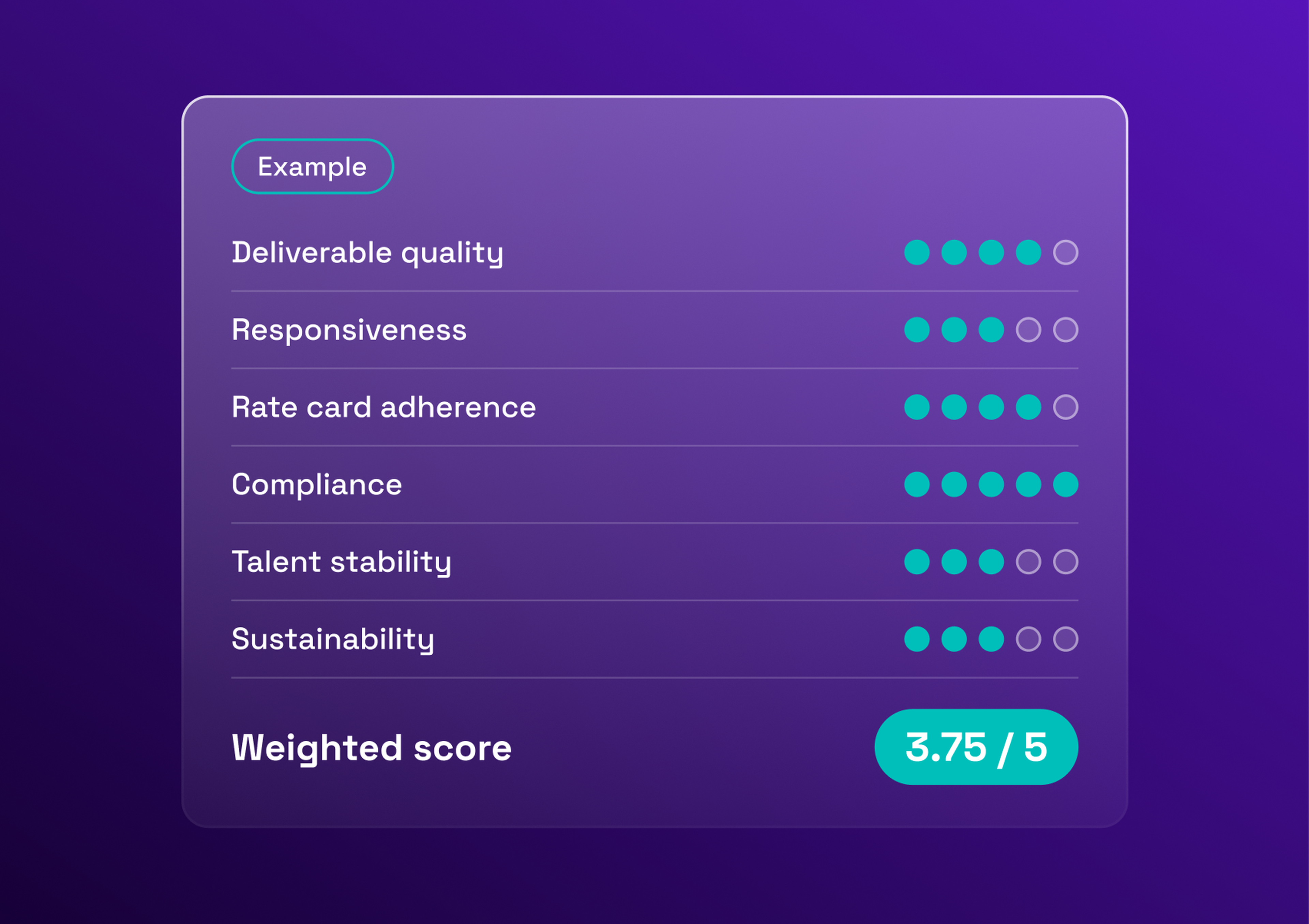
Supplier scorecard average | Average weighted score across panel suppliers, on a 1-5 scale | Procurement | 3.5 or more |
Compliance documents up to date | Valid required documents ÷ required documents | Procurement, compliance | 95% or more |
Maverick spend | Spend with no contract, SoW or panel supplier ÷ total spend | Procurement | 5% or less |
Start with three or four, not all eight. Choose the ones that match your biggest failure point from earlier, and add more once the data is reliable.
How a vendor management system enforces governance by design
A policy that depends on memory is followed until people are busy. A vendor management system turns rules into steps in the process, so that following them is the easy route. In practice, it supports six controls:
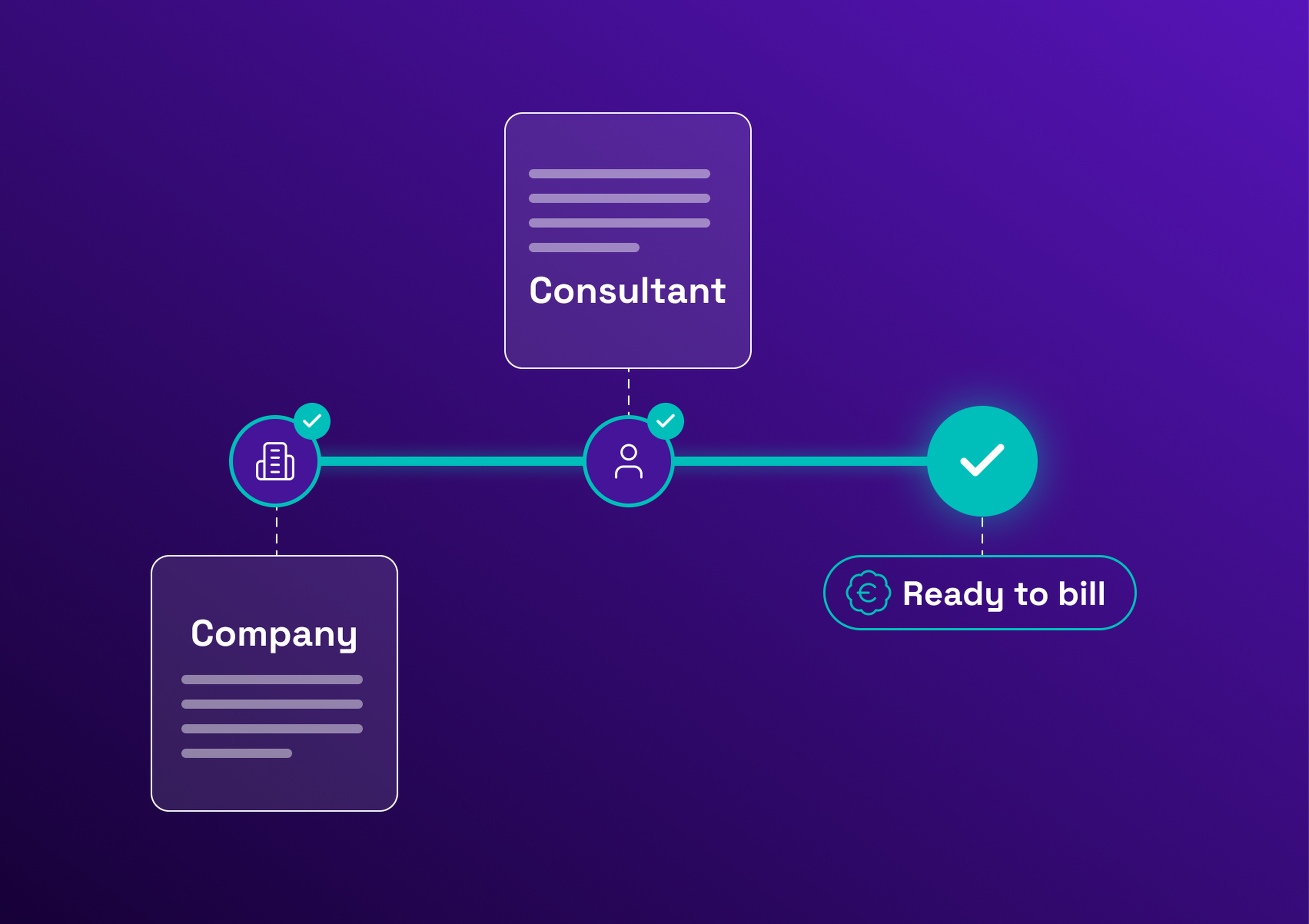
Approval workflows. A request or an extension goes to the right approver, according to the policy, before it is valid.
Rate cards locked in the platform. Missions are priced from the agreed rates, so deviations show up as exceptions.
Renewal alerts. Owners are warned before the notice date, so renewals become decisions.
Timesheet validation. Declared days are checked against the mission and the purchase order.
Audit trail. Who approved what, and when, is recorded without anyone reconstructing it.
ERP and source-to-pay integration. Supplier and mission data flows to finance systems by API, so spend is read from one source.
The effect is visible at customers that have moved the process into the platform. At Inetum, the workflows were configured with billing rules, notably the "exclusion of prior timesheets and duplicate management", and the reported results include more secure timesheet validation and stronger compliance. At Parrot, tracking key performance indicators, particularly average daily rate, is reported on its client page as having allowed it to better manage its expenses.
A platform does not write the policy or choose the owners. It enforces what has been decided. See how Eleven VMS does this for services spend.
A 90-day roadmap to set up vendor governance
Governance is easier to launch in three steps than in one project. The roadmap below is a suggestion to adapt to your size.
Days 1 to 30: map current spend and owners. List services spend by supplier and business unit, find who currently approves what, and identify where the six failure points occur. The output is a baseline.
Days 31 to 60: set the policy, the panel and the RACI. Write the decision rights, define the tiers and agree the RACI with procurement, business owners, finance and legal. The output is a short policy that people have agreed to.
Days 61 to 90: launch the meetings and KPIs in the tool. Start the weekly and monthly forums, configure the approval and renewal controls, and publish the first three or four KPIs. The output is a first review with real numbers.
Making governance repeatable
Governance is a habit more than a project. To see where your own process stands, assess your procurement maturity. It shows which of the five layers needs attention first.
Book a meeting with one of our experts for a personalized demo.